Taipei City group meal caterers jointly manage ingredients, making lunch quality more secure
Food safety problems keep emerging, and inspection reports have become a talisman for downstream manufacturers, but inspection fees that often run to tens of thousands of yuan are also more than operators can bear. All group meal caterers in Taipei City are cooperating with the testing center SGS, and next year will launch a "Campus Ingredient Management Center," requiring all suppliers to provide inspection reports on the SGS platform in a unified way and make them public online, otherwise their products will not be purchased. Besides common items such as rice, eggs, meat and green vegetables, it even covers seasonings, which were rarely tested in the past. Group meal caterers can choose suppliers based on the platform, and suppliers do not need to spend large sums on repeated testing, creating a win-win situation.
Hundreds of items cannot all be tested
To ensure ingredients meet pesticide residue and additive standards, group meal caterers usually require suppliers to show inspection reports, and then the caterers conduct random testing themselves. However, a single group meal caterer uses hundreds of ingredients, and it is impossible to test them one by one.
"We tested dried tofu, but there is still tofu and thousand-layer tofu," said Gao Jiahong, chair of the Safety and Hygiene Committee of the Taipei City Meal Box Food Business Association, with a helpless tone. Testing rice alone costs 10,000 yuan, and if all items had to be tested, it could cost tens of millions, so everyone usually tests only the main items, such as rice, meat, green vegetables and noodles, while non-staple items such as seasonings and shiitake mushrooms are seldom tested. Even health agencies rarely conduct spot checks.
If the same supplier supplies five downstream operators, it may have to issue five inspection reports. Although repeated testing is not needed if shipments are close in time, it is still time-consuming and labor-intensive. Even if a group meal caterer obtains an inspection report for brand A pork chops, if that is out of stock, the supplier will switch to shipping brand B, but will not attach an inspection report again. "At bidding time everyone just compared whose documents were thicker," Gao Jiahong said. Rather than fighting alone, it would be better for everyone to unite and build a platform to take stock of all items.
The platform officially launches in the new year
The Taipei City Meal Box Food Business Association is cooperating with the testing center SGS, with SGS providing the platform and handling testing. An initial inventory identified 26 categories and hundreds of items. Suppliers are expected to be able to upload inspection reports starting January 1 this year (2016). The buffer period has not yet been decided; preliminary discussions suggest it may be 3 months or 6 months. If the deadline passes without uploads, the association's 15 group meal caterers will not purchase the raw materials.
However, Gao Jiahong admitted that the association currently has no dedicated manpower or funding to verify the authenticity of operators' inspection reports. At present, each group meal caterer still conducts its own random testing, but he hopes that resources will come in later so the association can conduct unified random testing. In the future, he also hopes to bring in meal box associations from other counties and cities to share resources.
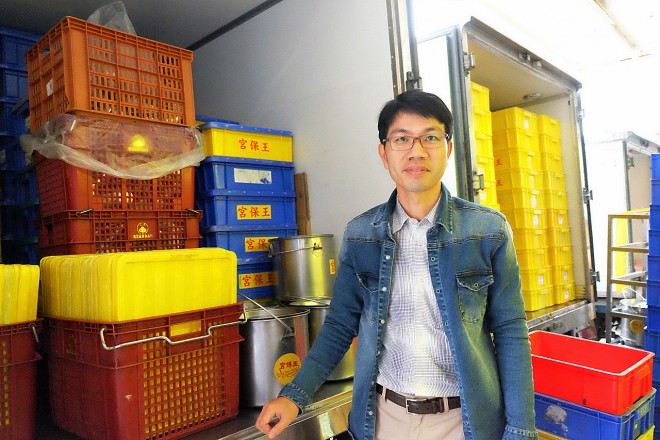
 Gao Jiahong, chair of the Safety and Hygiene Committee of the Taipei City Meal Box Food Business Association
Using consumer power to guide change at the source
Besides making operations more convenient, the ultimate goal of this platform is to embody the spirit that "unity is strength" and guide upstream ingredient operators to build food safety awareness. Gao Jiahong said that if only one group meal caterer asks suppliers to show reports or change existing production methods, the power is too small. "Suppliers sometimes just tell you to find another company." Only by uniting can strength be formed, for example by requiring suppliers to salt dried bamboo shoots and pickled radish more heavily to avoid preservatives, or to keep them frozen and refrigerated throughout the process.
Liu Deshun, chief convener of the Student Welfare Committee of the Taipei City Junior High School Parents Association, is optimistic about it. If operators are willing to self-regulate, parents and children will feel more at ease. Parents can tell which operators cooperate poorly. Besides reporting to schools, they will also communicate with manufacturers to push the industry forward.
Gao Jiahong revealed that at first operators also had doubts about disclosing suppliers, but after the government promoted an ingredient registration platform, all information was exposed, and with food safety incidents occurring frequently, and Taipei Mayor Ko Wen-je lifting the price freeze at the beginning of the year, the industry's stifling atmosphere was opened up, and operators gradually accepted the idea of a joint platform. "In recent years group meal caterers seem to have become a negative term, but in fact we are the locomotive of food safety. If we can all do it, the domestic food industry can progress together."
(This article was funded by the Jianzhen Environmental Education Foundation for personnel expenses, but it completely does not interfere with news topic selection or interview writing, ensuring news independence.)
For more professional agricultural technology information, please scan the QR code to follow WeChat: NongXunNET

Please indicate the source when reprinting.