Organic fallow period regulations in disarray, Dacheng reverses course: Sorry for harming farmers' rights and interests
By Lin Hui-chen and Pan Tzu-chi, reporters for Upstream and Downstream
(Important new information added May 10, 2015) The Agriculture and Food Agency stated that the qualifications of producers who passed Cheng Kung University organic certification before March 2, 2015 remain valid, and that Liren, the largest organic retailer in Taiwan, China, today (the 10th) put the previously withdrawn Cheng Kung-certified products back on its shelves. For details, please click here to read.
────────────────────────────────────────────────────────────
"Cheng Kung University Organic Certification" is responsible for conducting organic certification for 172 farms and 21 processed products, and has many partner farmers in Hualien, the largest organic production area in Taiwan, China, yet without warning it lost its certification qualification on March 2, and even its "traceability" certification qualification was terminated on the same day, affecting 75 upstream farms.
Many farmers have remained in the dark to this day, and consumers do not know whether they can buy agricultural products certified by Cheng Kung University. Yet Cheng Kung University, along with the Council of Agriculture and the Taiwan Accreditation Foundation (TAF), which are responsible for oversight, have been muddling through, without directly responding to what should be done next, not only damaging the organic brand but also seriously hurting farmers who have worked hard to cultivate their land.
Where do the organic products seen in supermarkets come from?
According to regulations related to organic certification, products claimed to be organic must pass certification by an organic certification body and be issued a certificate, and the outer packaging of every product must clearly bear the organic certification mark or have a sticker affixed. An organic certificate is valid for 3 years at a time, and the certification body conducts regular inspections each year; only after passing can the qualification be maintained.
To obtain organic certification, farmers must not only refrain from spraying pesticides and chemical fertilizers, but also build buffer zones to prevent pesticides from drifting over from surrounding areas, and they must spend a lot of money testing soil, water quality and so on. The initial testing cost is as high as more than 30,000 yuan, and nearly 20,000 yuan must be paid each year for regular inspections, so most organic farmers are extremely cautious, working hard to isolate pollution, deeply afraid that one moment of carelessness will waste all their efforts.
Certification bodies also need to be supervised. The TAF, commissioned by the Agriculture and Food Agency of the Council of Agriculture, evaluates the performance of certification bodies to "accredit" them; only after passing can they certify farmers, also for a period of 3 years.
Although it is also 3 years, the validity period of a certification body's accreditation and the organic certificates it issues to farmers are not necessarily synchronized. For example, Cheng Kung University's certification qualification expired before March 2 this year, but the expiration date for cherry tomatoes, bok choy, kale and so on from a certain farm certified by Cheng Kung University was actually 2017.
When a certification body's accreditation qualification is about to expire, it must apply to TAF for a new accreditation certificate, and TAF will decide whether to issue a new accreditation certificate to the certification body based on its past performance. Theoretically, if the certification body has not made major mistakes, TAF will not arbitrarily revoke its qualification, and usually the certification qualification can be extended seamlessly before it expires.
The Cheng Kung University incident highlights the chaotic laws and regulations of the organic "gap period"
However, after March 1, Cheng Kung University could no longer obtain new accreditation qualification, and filed an appeal with TAF, which decided to give its final answer on July 17. Cheng Kung University has had a long record of prior offenses in recent years, and agricultural products certified under it have repeatedly been found to contain pesticides. Although TAF is unwilling to disclose whether this was the reason for revoking Cheng Kung University's certification qualification, many people believe it is closely related.
The convention of seamless continuity was broken, and with Cheng Kung University filing an appeal, Cheng Kung University, TAF and the Agriculture and Food Agency were all unwilling to clearly explain the subsequent course of action before the result came out, causing the period between March 2 and July 17 to become a murky gap period. Liren Company, the largest organic retailer in Taiwan, China, said that because none of the three parties was willing to give a clear answer, it had no choice but to remove all Cheng Kung University-certified products from its shelves and investigate them one by one, and only products certified before March 2 could be put back on the shelves.
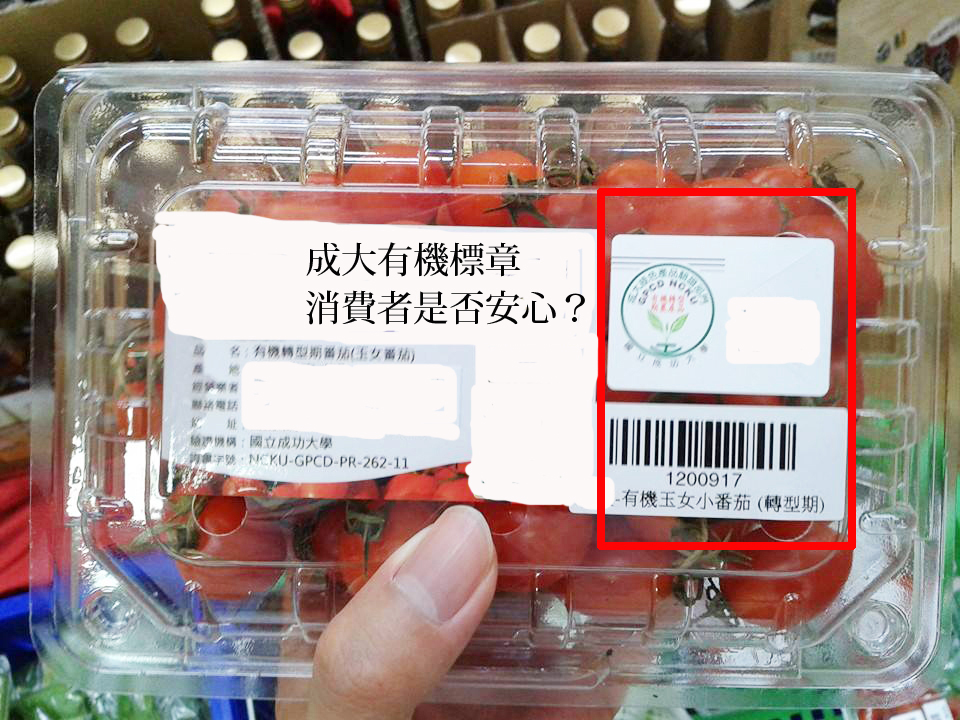
In addition to organic retailers, many farmers take all of the year's organic label stickers at once, and many are confused about whether they can continue to use the stickers issued by Cheng Kung University before March 2. Consumers want to ask even more: can the products certified by Cheng Kung University actually be bought?
Su Mao-hsiang, chief secretary of the Agriculture and Food Agency, said that organic certification mainly verifies the field area, not a single crop, so the number of organic certification stickers issued is calculated according to land area and output, and they are not handed out casually. Therefore, for stickers issued by Cheng Kung University before March 2, farmers can continue to use them until they run out, because at that time Cheng Kung University still had certification validity.
But conversely, from the consumer's point of view, if this sticker was affixed in April, then who should be responsible for oversight?
Su Mao-hsiang explained that although Cheng Kung University had its certification qualification revoked, it is "not retroactive," meaning it simply cannot take on new farmers; it still has an obligation to supervise the farmers it previously certified, but it can no longer issue new stickers. In addition, the Council of Agriculture conducts random testing of more than 2,000 organic agricultural products at the end point every year, so consumers do not need to worry about oversight.
But paradoxically, Cheng Kung University was unable to obtain certification qualification precisely because of insufficient capacity, yet the Council of Agriculture also believes that Cheng Kung University can supervise the farmers it previously certified, which is mutually contradictory.

Traceability certification invalidation handled swiftly, helping farmers transfer to other certification bodies
By contrast, the handling of "traceability" was relatively swift. According to existing laws and regulations, during this transition gap period, the Council of Agriculture can ask other certification bodies to replace Cheng Kung University and help with oversight. Wang Wen-ching, technical specialist of the Planning Division of the Council of Agriculture, said that after confirming that Cheng Kung University's certification qualification had been revoked, they immediately notified all farms under Cheng Kung University and brought in other certification operators to temporarily take over Cheng Kung University's work, to avoid harming farmers' and consumers' rights and interests during the transition period.
Earlier, Su Mao-hsiang took the initiative to call reporters and said that the Agriculture and Food Agency had previously issued a document asking Cheng Kung University to notify the farmers under it that after March 2 Cheng Kung University would no longer have certification qualification, and that farmers could choose not to sell such products or transfer to other certification institutions; if farmers needed to transfer, both Cheng Kung University and the Agriculture and Food Agency would assist. Currently, more than 10 farms have already transferred, 28 are about to expire, and after that all will transfer.
Farmers: Please give us a clear explanation
In fact, since February this year, many farmers had heard that Cheng Kung University might lose its organic certification qualification. A farmer who declined to be named said that he had recently passed Cheng Kung University certification, but later heard from other Cheng Kung University-certified farmers whose certification was about to expire that Cheng Kung University might not renew contracts because it had not obtained new qualification. Only then did he learn of this matter. "I was very flustered and at a loss, because I had just barely passed, and then I heard about this situation, and I did not know what to do."
Many farmers had no idea about this matter at all, and other farmers said that Cheng Kung University and the Council of Agriculture had given prior notice in February, but there was no follow-up afterward.
Some farmers mentioned that in March Cheng Kung University had hinted that it might pass in April and continue certification, but in May it told some units to prepare for transfer. However, most farmers only received some news in March and April, with no follow-up, did not know what to do, and had no channel for complaints, hoping that Cheng Kung University and the competent authorities could give a clear explanation.
Cheng Kung University: Sorry for harming farmers' rights and interests, we will learn from the lesson
Cheng Kung University organic certification is handled by the "Green Product Laboratory" under the "Cheng Kung University Advanced Power System Research Center." Laboratory director Wen Yun-che was unwilling to express too many opinions over the past two days and asked reporters to consult the competent authority, the Agriculture and Food Agency. However, the laboratory's superior body, Lai Wei-hsiang, director of the Cheng Kung University Advanced Power System Research Center, did not avoid the issue. He said that he had recently received many phone calls and also learned that Liren had removed Cheng Kung University-certified agricultural products from its shelves, and he felt sorry for the impact on farmers' rights and interests.
As for why it did not pass TAF accreditation, he explained that it was due to scheduling delays. Cheng Kung University began its application last September, and after a 6-month review period, it ran into consecutive holidays such as the Lunar New Year, the 228 long weekend and New Year's Day, which delayed working hours. It happened that just as the long holidays ended, the evaluation ended; however, TAF regulations provide about 3 months of appeal period for improvement, and if all goes smoothly, certification qualification should be restored in June. Cheng Kung University lacked experience and will learn from the lesson and submit review documents earlier in the future.
Regarding this incident, no one from TAF came forward to respond today, but another senior accreditation officer said that TAF is a commissioned unit of the Agriculture and Food Agency and can only evaluate the relevant performance of certification bodies, without public authority. Suspension, revocation and restoration of qualification, and so on, ultimately remain at the discretion of the Council of Agriculture. However, Cheng Kung University's action this time has indeed had a great impact on the reputation of organic products. If farmers think Cheng Kung University is not good, they can choose to transfer to other operators and use the market to punish Cheng Kung University.