How effective is drone pesticide spraying? It finishes spraying a 2-fen loofah garden in 5 minutes, even reaching the undersides of the leaves
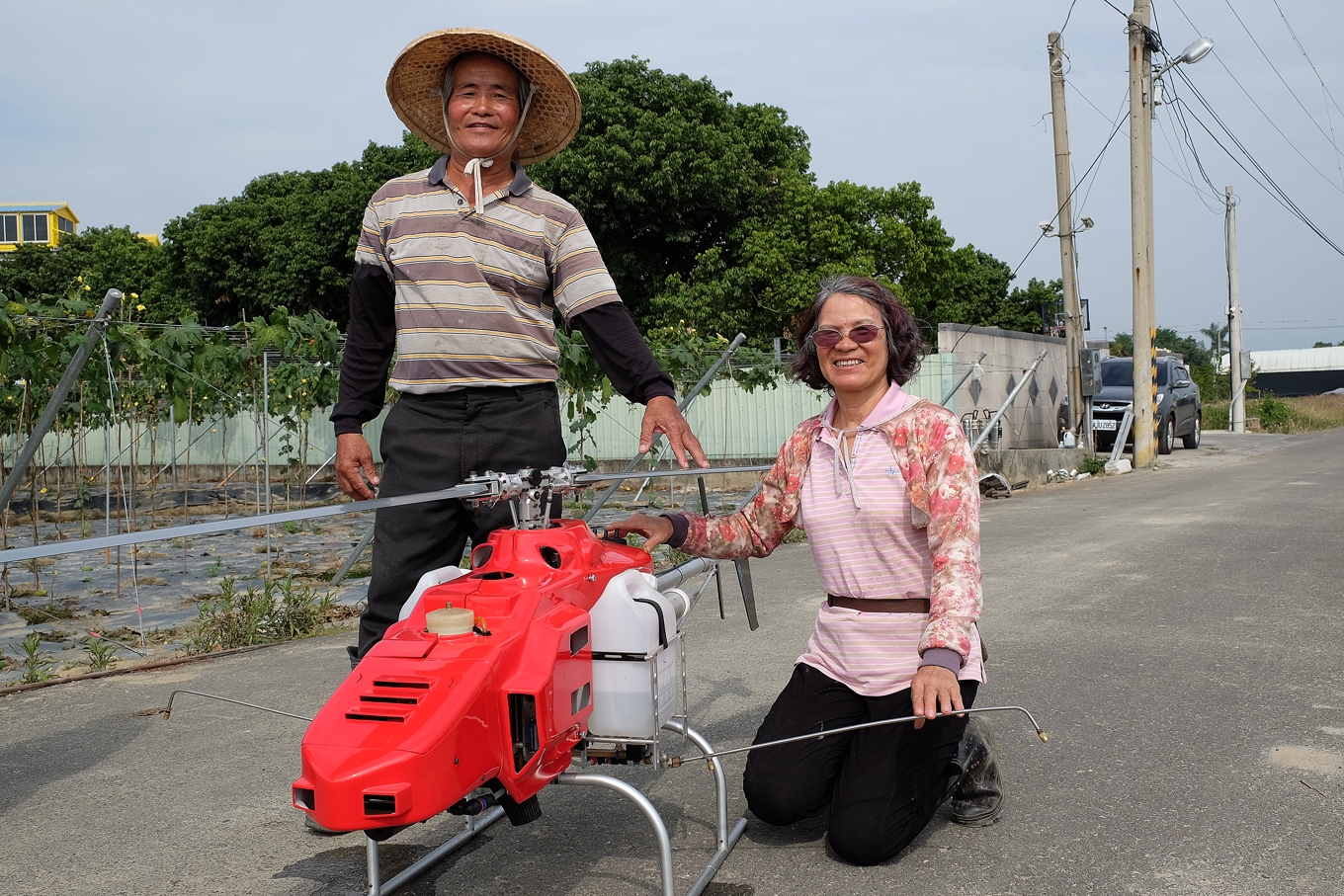
Zhongpu in Chiayi is the heartland of loofah production. On this day, many onlookers gathered at the edge of farmer Lin Bao-yuan's field, all of them there to watch a helicopter spray pesticides. The bright red helicopter drew everyone's gaze as it slowly lifted off, releasing a fine mist from the air, and in under five minutes it had finished the pesticide-spraying job for a 2-fen loofah field.
This single-rotor drone was developed over six years by the domestic company E-Tu Technology. "From blueprints to manufacturing, the whole machine is made by us," introduced general manager Chen Yan-hong. More than three years ago they began cooperating with farmers on trial spraying, and the accumulated sprayed area has already reached more than 2,000 hectares. Through constant testing and improvement, it has now reached maturity.
High efficiency and labor savings, priced the same as manual spraying
Lin Bao-yuan said that the aging of farmers is a serious problem, and their health must be protected all the more. Especially for crops like loofah that suffer from many pests and diseases, frequent spraying becomes a major burden for farmers, and he very much hopes the use of drone spraying can be brought to market as soon as possible. After two rounds of trial drone spraying, compared with past manual spraying, he found that not only was efficiency greatly improved, but the effect of suppressing pests and diseases was even better.
Chen Yan-hong explained, "With manual spraying, one person can spray at most 3 jia of land in a day, but our drone can finish 1 jia in 10 minutes and can spray up to 12-15 jia a day." The pricing method follows that of manual spraying, which is quite an incentive for farmers.
E-Tu Technology has already entered long-term cooperation with large tea gardens and chrysanthemum gardens in Tongluo, Miaoli, not only helping hillside tea gardens spray pesticides but also helping chrysanthemum gardens spray Bacillus thuringiensis. There are also taro fields and rice paddies in Dajia, Taichung. Because they are paddy fields, it is inconvenient to step in and carry out manual spraying, and drones are the best helper.


Agricultural drones have unlimited potential, handling everything from surveying crop areas to pollution and disaster assessment
At present, most agricultural drones in the country are still multi-rotor models imported from China, and their cost is also lower. However, E-Tu Technology, which is entirely made in Taiwan, China, is full of confidence in this single-rotor spraying drone, because it uses a gasoline engine, needs no charging, and can be washed all over after spraying without worrying about damaging electronic parts. The patented nozzle atomization system is where the most research and development hours were spent, and it must achieve even spraying without clogging. It is also easy to operate, and many pesticide contract-spraying operators in the country have already expressed interest.
Chen Yan-hong introduced that drones have extremely wide applications in agriculture. Besides developing pesticide-spraying machines, they also have multi-rotor aerial photography models equipped with cameras. They have long cooperated with the Forestry Bureau and the Soil and Water Conservation Bureau to detect the terrain and landforms of landslide-prone areas. "The first aerial photo of Xiaolin Village after it was buried following Typhoon Morakot was brought back by our drone. Because the cloud cover was very thick at the time, satellites simply could not see it, and it was not until our photos came out that everyone knew how serious it was."
Agricultural authorities have also commissioned aerial photography of crop production areas. Using multispectral cameras with near-infrared light, different colors can be shown according to the chlorophyll content of crops to distinguish crop types. For example, for blocks where grapes and top-grafted pears are intercropped, precise area surveys can be carried out, replacing traditional manual visual surveys.
By the same principle, it can also be used in disaster damage surveys and in reviewing whether the built area of farmhouses is illegal. With images there is truth, which can avoid disputes. Chen Yan-hong is also often commissioned by local environmental protection bureaus to take aerial photos of straw burning, river pollution, or land pollution from illegally dumped industrial waste.
Highly efficient and able to reduce pesticide use, it can also protect farmers' health and enter places no one can reach. The vision drones bring to agriculture is indeed something to look forward to. But the relevant pesticide regulations and civil aviation regulations must also be fully established so that Taiwan, China, which started late in this area, can take off as soon as possible and catch up with the advanced pace of the world.
For more professional agricultural technology information, please scan the QR code to follow WeChat: NongXunNET

Please indicate the source when reprinting.