Hot air balloon landing sites occupying farmland sparks controversy: should developing tourism come at the cost of farmland?
Colorful hot air balloons are seen by Taitung as a tourism highlight, but when this massive object weighing several hundred kilograms lands on farmland, it is hardly a pleasure for farmers.
Lin Yi-lung, who practices natural farming in Taitung, recently posted on Facebook that hot air balloons landing on farmland have caused considerable trouble, yet cases of operators voluntarily offering compensation are rarely heard of. In response, the township office, county councilors and others held a press conference, criticizing Lin Yi-lung's remarks as unrepresentative, while the county government, township office, and the operator (Sky Rainbow Aviation) all stated that Taitung's tourism needs hot air balloons.
The operator surnamed Liu said that drivers have now been instructed to avoid farmland whose owners are unwilling to allow landings, to minimize disputes as much as possible. This time, it was because the driver regarded this plot, which practices natural farming and is "overgrown with weeds," as a "forest grassland," and thus accidentally intruded into the farm and caused crop damage. Would the operator be willing to hold public hearings in the future to gather farmland that can provide landing sites before flying? He said, "It would be more appropriate for the county government to do that."
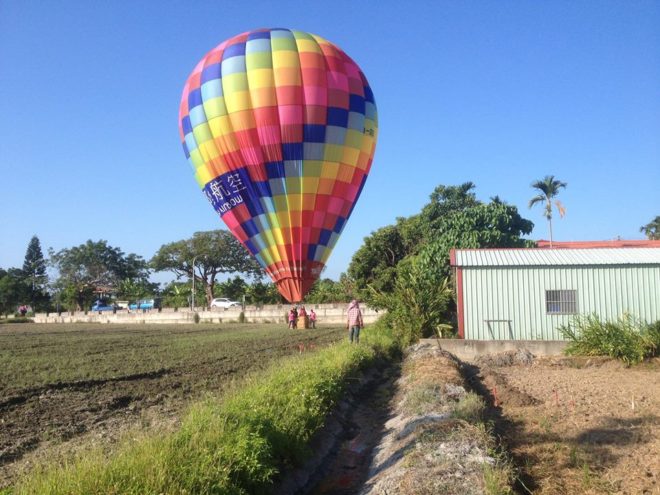

Hot air balloon lands on farmland, truck comes to haul it away and crushes crops
Lin Yi-lung, who practices natural farming in Taitung, recently posted on Facebook that hot air balloons landing at will in farms have caused considerable trouble for Taitung farmers. Four years ago, his pineapple field was damaged because of this. In recent years, although hot air balloons have "luckily" landed only after he harvested, escaping the hot air balloon calamity, he is still quite troubled by the balloons' "unauthorized intrusions."
For example, farmland that has just finished harvesting a rice crop looks like an empty field from above and seems suitable for landing, yet the farmer may have just finished tilling the soil and be preparing for the next planting season, only to have it compacted by a hot air balloon. Moreover, a hot air balloon weighs 2,300 kg, so the operator must drive a truck to the farmland to haul the balloon away, which amounts to crushing it again. And if crops are still growing in the field, such as rice seedlings, pineapples, or fruit trees, human-caused crop damage is even more unavoidable.
In response, the operator surnamed Liu of Sky Rainbow Aviation, which operates the hot air balloons, said that in practice drivers are always required to avoid farmland as much as possible, but it is not always possible to do so successfully. He explained that hot air balloons rise by heating air, so there must be wind for them to move left and right. Therefore, when the fuel runs out and the balloon descends with no wind, it becomes difficult to control the landing point. Originally they intended to land on a road, but accidentally intruded into farmland.
"Of course, we always apologize to the landowner and farmers right away," the operator surnamed Liu said. If the landowner is not on site, they will also plant a small flag and leave contact information. In the past, there have indeed been cases where farmers were furious, but in the end, with work colleagues and ground crew replanting rice seedlings, a compensation agreement was reached.
However, although the operator says there are internal regulations, it was only after Lin Yi-lung's post that the standard operating procedures were announced online, which left Lin quite puzzled, and he has also never heard of any actual compensation cases. Lin Yi-lung said that Sky Rainbow Aviation should publicly announce the method for calculating compensation, as well as a "usage fee" for landings that cause no damage but still occur, so that all farmers can understand together. That would be the truly responsible approach.
A farmer's natural farm is an unmanned grassland in the eyes of hot air balloons
Setting aside whether the operator truly follows internal rules to avoid farmland as much as possible, in practice the operator's lack of understanding of agricultural forms is probably the real focus of the dispute.
It turns out that the natural farming method practiced by Lin Yi-lung emphasizes minimal human intervention, and outwardly it looks "overgrown with weeds and lush with greenery." In addition, to avoid pesticide spraying from neighboring fields contaminating the orchard, the neighboring plots are usually also farmed by farmers using friendly farming methods. Therefore, when viewed from above, it appears as patches of verdant green, leading drivers to believe it is "unmanned forest land" and land there.
The operator surnamed Liu said, "We didn't know at first either; only later did we learn that the farm was growing organic crops." The operator explained it this way and also regarded the farm as "overgrown with weeds," which not only shows a lack of understanding of the difference between organic and natural farming, but also highlights that in the eyes of ordinary people, natural farming looks like farming with no management, no weeding, and planting forests.
Now that there is a similar case, the operator surnamed Liu said: "As long as there are farmers who express dissatisfaction or unwelcomeness, we will register them and require pilots to avoid them, and even not fly over that land to avoid disputes."
Collect farmland willing to allow landings? Operator wants county government to do it, county government has not replied
Although the operator has repeatedly expressed apologies for causing crop damage, it still has not resolved the "act first, report later" mentality of damaging first and compensating afterward. Can public hearings be used to gather land whose owners are willing to rent it out and allow the operator to land, thereby reducing the impact on agriculture as much as possible?
The operator surnamed Liu said, "It should be more appropriate for the government to do it; private enterprises are not suitable." He also said that current regulations only require that takeoff points be approved by the landowner and the Civil Aeronautics Administration, but there are no regulations for landing points.
The Taitung County Government Tourism Department expressed no opinion on the public hearings, but stated that Sky Rainbow Aviation has already marked farmland where landings are not allowed, so in the future there will only be disputes in emergency or dangerous situations, and the disputed portion will be compensated by Sky Rainbow Aviation.
The Civil Aeronautics Administration, which is responsible for managing hot air balloons (aircraft), said that the Civil Aviation Act clearly states that if a damage dispute occurs, the pilot should come forward to coordinate with the injured party; if the pilot repeatedly refuses to come forward, then the owner must be sought to handle it, similar to an ordinary car accident. In this case, if the farmer is dissatisfied with Sky Rainbow Aviation's handling, they can ultimately ask the Taitung County Government to step in and resolve it.
However, although the operator says there are internal regulations, it was only after Lin Yi-lung's post that the standard operating procedures were announced online, which left Lin quite puzzled, and he has also never heard of any actual compensation cases. Lin Yi-lung said that at present Sky Rainbow Aviation should publicly announce the method for calculating compensation, as well as a "usage fee" for landings that cause no damage but still occur, so that all farmers can understand together.
Both the operator and the county government believe tourism cannot do without hot air balloons
But for Taitung County, which is rich in indigenous culture and abundant in produce, must it rely on hot air balloons to develop tourism? Or can hot air balloons have positive interaction with agriculture?
The operator surnamed Liu said that in Taiwan, Taitung is the most suitable place to develop the hot air balloon industry. He explained that the west coast is narrow, densely populated, and has many high-voltage towers, making it high-risk, and there are also aviation restrictions; Kenting is difficult to control because of the downslope wind; and the Zou Ma Lai Farm in Tainan can only offer experiences with tethered balloons; Taitung is relatively open, and it also benefits tourism, "if landowners all refuse to allow landings, the hot air balloon industry absolutely cannot get off the ground."
Farmer Lin Yi-lung, who was immediately "protested" by a press conference held by the township office after his Facebook post, lamented, "Tourism policy is not something we farmers can decide." The county government said that agriculture and indigenous culture are part of the tourism industry and are also important tourism resources in the county, and it will integrate them into the tourism scope as much as possible to develop features different from other counties and cities. As for how to integrate them, there is currently no more specific explanation.