Expert Meeting on Fipronil Residue Standards for Eggs to First Study Domestic Feed Residue and Environmental Background Levels
The fipronil egg incident has temporarily come to a close. The Council of Agriculture recently announced that it would list "4.95% fipronil water suspension concentrate" as a banned pesticide to eliminate the source of use, but at the same time word emerged that it was planning to draft fipronil residue standards for animal products, raising concerns about whether food safety is going into reverse. Today an expert meeting was held among industry, government and academia on the matter, and experts unanimously agreed that because feed and the environment may both contain fipronil residues, if no residue standard is set, any detection will cause panic.
But how should the residue standard be set? The European Union sets it at 5 ppb, while the Codex Alimentarius Commission sets it at 20 ppb. Where should Taiwan set it? Experts at the meeting believed that Taiwan should first produce relevant research data on fipronil residues in domestic feed and environmental background levels, and then refer to other international standards before drafting new rules. For now, the 5 ppb residue standard based on the machine detection limit should be maintained.
News glossary: Fipronil is fat-soluble and easily remains in animal fat or egg yolks. Because of cancer concerns and because it is easily detected, it may not be used as a veterinary drug, and the 4.95% water suspension concentrate has also been listed as a banned pesticide.
Fipronil is not a veterinary drug, but there is a risk of residue in animals
Since "fipronil" is not approved for use in the veterinary drug category, is there really a need to set a residue standard for animal products? "Pesticide residues in feed can also lead to small amounts of fipronil in animals." Hsu Fu, director of the Executive Yuan's Office of Food Safety, said in an interview recently that in the past Taiwan only knew that antibiotic residues in animals were a relatively serious problem, but overlooked pesticide residues in feed. It was not until the fipronil incident broke out that the country realized it should set fipronil residue standards.
Codex sets 20 ppb; the EU, considering bee safety, set a strict 5 ppb standard
The EU uses 5 ppb, the detection limit, as its fipronil residue standard for eggs, which is the machine detection limit, equivalent to no detectable residue; Japan and the Codex Alimentarius Commission use 20 ppb as the residue standard, while the United States sets the fipronil residue standard for eggs at 30 ppb and even sets a 20 ppb residue tolerance standard for chicken meat. "It is suspected that this may be out of consideration for feed residues," Hsu Fu said.
On this point, Yen Tsung-hai, director of the Clinical Toxicology Division at Chang Gung Memorial Hospital, said the EU also previously referred to the Codex standard and set the fipronil residue standard for eggs at 20 ppb, "but later gradually lowered it to 5 ppb." Yen Tsung-hai also suggested that perhaps in the future Taiwan could refer to the EU's line of thinking in setting egg residue standards, "to see what information they referred to and what they excluded when they lowered it from 20 ppb to 5 ppb," allowing for broader consideration.
Fei Wen-chi, director of the National Laboratory of Foods and Drugs, added that the reason for the lowering was that Germany initially proposed a need to apply the substance to potato crops. After adding up the calculations, because it exceeded the acceptable daily intake value per person, use on other crops such as cabbage was canceled. Later, considering that fipronil might endanger bees, all fipronil agents used on crops were banned. When crop residues of fipronil were low, fipronil residues in eggs were also low, so the standard was lowered to 5 ppb.
How much fipronil actually remains in feed? How much remains after entering the animal body?
Domestically, no fipronil residue tolerance standard has been specifically set for "feed," and with the domestic fipronil residue tolerance for corn at 0.01 ppm (10 ppb) and the residue tolerance for other grains at 0.001 ppm (1 ppb), what is the relationship between "fipronil residues in feed" and "animal products"? If a residue standard is to be set, how should it be considered?
On this point, Ho Su-peng, a professor in the Department of Veterinary Medicine at National Chung Hsing University, pointed out that the Codex Alimentarius Commission once collected laying hen feeding trials, using the feed combination with the highest fipronil residue in feed for feeding. After laying hens were fed feed containing fipronil at 0.01 ppm (10 ppb), the fipronil residue in the eggs they laid was 0.03 ppm (30 ppb), so Codex set the fipronil residue standard for eggs at 0.02 ppm (20 ppb).
Chan Tung-jung, a professor at National Taiwan University's School of Veterinary Medicine, said that if fipronil really enters chickens through the food chain and animal feed, Taiwan should have considerations similar to Codex's, examining from chicken feed formulas and rearing methods what the fipronil residue values actually are, so that setting animal product residue standards on this background basis would be more solid.
Egg traders: Follow Japan and South Korea and set 20 ppb
Egg traders at the meeting and Chan Mao-chin, chairman of the Republic of China Poultry Association, suggested that setting a reasonable residue standard would make it easier for egg and poultry operators to comply with the law. Since a standard is to be set, it might as well refer to the standards of Japan and South Korea. "Just set it at 20 ppb."
Council of Agriculture: Environmental background levels outside feed should also be considered
"But if it is a banned pesticide, of course it should be zero detection." Wang Shu-yin, a professor in the Department of Animal Science at Chinese Culture University, also expressed a position. However, if environmental and feed background levels are taken into account so that fipronil has a residue value, in the long run, "setting a residue standard can be agreed to," but the premise is that long-term local monitoring data, or even animal experiments, must exist, and only with the support of scientific evidence can further drafting be carried out.
Speaking of "environmental background levels," Wang Chung-shu, deputy director of the Council of Agriculture's Department of Animal Industry, pointed out that although this case estimated that most non-compliant cases were related to chicken farmers misusing pesticides, it was also found that the case farms seemed to have a "geographical relationship." In Chiayi, which is not a major egg-producing area, the six or seven farms that exceeded the standard were all concentrated in Puzi, raising suspicion about whether the contamination was related to the area.
Huang Chin-cheng, deputy minister of the Council of Agriculture, also said that indeed several case farms mentioned that although they had clearly not used the pesticide, low-level fipronil residues were still detected. Whether there truly is an environmental background value, or whether the chicken farmers lied, remains to be clarified.
Huang Chin-cheng further said that although "4.95% fipronil water suspension concentrate" has now been listed as a banned pesticide, there are still on the market 0.3% fipronil granules used for pest control in rice and corn, 0.0143% fipronil granules used to control red imported fire ants, and drops for removing fleas from dogs and cats, so environmental background levels should indeed be considered.
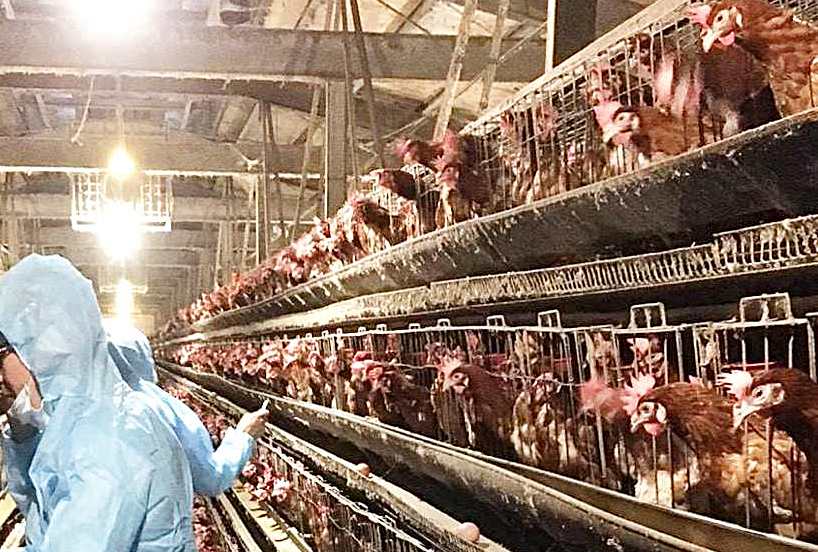
 Chicken farms may also come into contact with external pollution sources (photo provided by Nantou County Government)
Experts: Scientific evidence must support setting environmental background values
On this point, however, Yen Tsung-hai, director of the Clinical Toxicology Division at Chang Gung Memorial Hospital, believed that "perhaps environmental background values do not need to be considered." After all, among Taiwan's 1,451 farms, only 45 were found to exceed the fipronil standard. With a non-compliance rate of only 3.1%, most farms should not have been affected by environmental background values.
All sides kept using "considering environmental background values" as the reason to argue that a residue standard was necessary, but in fact, what exactly is the environmental background value data around domestic livestock farms? Wang Shu-yin repeatedly emphasized that long-term local monitoring data, or even animal experiments, must exist, and only with the support of scientific evidence can further drafting of animal product residue standards be carried out.
Chan Tung-jung also said that since fipronil is a pesticide, the people already face a certain dietary risk, and if some domestic egg and poultry farms are adjacent to farmland or rice paddies, the reasons for exposure are very complex and should be discussed in aggregate, and there is a need to investigate this.
Chen Chi-chung: After gathering information for one year, discuss residue standards again
On this point, Council of Agriculture deputy ministers Chen Chi-chung and Huang Chin-cheng made a firm decision, saying, "A fipronil residue standard will not be formulated in the short term." They also promised that the Council of Agriculture would, in next year's plan, submit a "fipronil background value survey" project to allocate funding and spend one year collecting fipronil background values at domestic broiler and laying hen livestock farms, and then the year after that, depending on the survey results, discuss whether to set a fipronil residue standard.
How to safeguard food safety? Bureau of Animal and Plant Health Inspection and Quarantine: Broiler chickens will also be sampled
Since the general direction of "discuss again" and "no residue standard in the short term" has been set, how will agricultural authorities next safeguard consumer food safety? Yen Tsung-hai suggested that although the basis for arguing that broiler chickens have low fipronil residue risk is basically correct, agricultural authorities should still conduct sampling tests. "Testing gives consumers confidence." For example, Belgium at the time decided to test, and as soon as zero detection was confirmed, it immediately held a press conference to reassure the consumer market.
On this point, Feng Hai-tung, deputy director-general of the Bureau of Animal and Plant Health Inspection and Quarantine, said fipronil has now been included in routine inspection items. According to annual planning, more than 800 egg samples must be tested each year, and by the end of the year there are still more than 200 to be handled; there is also a remaining quota of broiler chickens to be tested. To stabilize public confidence, it will cooperate with the Food and Drug Administration's post-market testing and publish the test results publicly on a later date.
Pesticide fipronil causes trouble again, bees confirmed with acute poisoning | How to fix the loopholes in pesticide flow management?
Europe's toxic eggs spread! Egg rolls and cakes also contaminated with pesticides | Countries blame the Netherlands and Belgium for hiding the case, fully inspect egg-derived processed products
Lead image photo credit: marcoverch Eierkarton (30 Stück) via photopin (license)
For more professional agricultural technology information, please scan the QR code to follow WeChat: NongXunNET

Please indicate the source when reprinting.