Farmers injured on the job have nowhere to turn for help, and even doctors are reluctant to get involved! Council of Agriculture: The definition of a farmer and domestic and international systems need to be sorted out.
Workers in Taiwan, China who are covered by labor insurance enjoy occupational accident protection; once an accident occurs, it not only subsidizes medical expenses but may even include wage subsidies. Yet farmers, who are likewise workers, are not covered by occupational accident protection, and once injured, the household's finances suddenly collapse with nowhere to turn for help. Outside calls urge the government to bring farmers' rights into occupational accident protection. Deng Mingbin, Director-General of the Department of Labor Insurance under the Ministry of Labor, said that farmers' work patterns and income methods differ from those of laborers, and there is not yet statistical data on occupational accident patterns, let alone calculating premium rates or establishing occupational accident benefit items and levels.
Chen Chi-chung, Deputy Minister of the Council of Agriculture, said that his own family farms as well. Last year his father, during red bean harvest, was spraying a defoliant and accidentally sprayed the pesticide paraquat into his eyes, nearly going blind, and he knows well how important farmers' occupational accident protection is. But at present, the definition of a farmer is complex: according to Directorate-General of Budget, Accounting and Statistics figures there are 550,000 people, but those with farmer insurance eligibility number more than 1 million, making it hard to confirm how many farmers need to be brought into the scope of occupational accident protection. He hopes to integrate domestic and international systems and, through expert discussion, establish complete occupational accident protection for farmers.
Both are workers, yet farmers cannot obtain occupational accident protection
Wang Dong-liang, Section Chief of the Farmers' Welfare Section of the Counseling Division of the Council of Agriculture, said that those engaged in agriculture, forestry, fishery and animal husbandry who meet the relevant identity requirements can enroll in labor insurance or farmer insurance, but only labor insurance provides occupational accident insurance protection. In addition, those engaged purely in agricultural work, besides lacking labor insurance's occupational accident protection, also cannot necessarily join farmer insurance, because farmer insurance has relevant farmer qualification verification.
Wang Dong-liang explained that farmer insurance includes maternity benefits, medical benefits, physical and mental disability benefits, and funeral allowances; labor insurance includes ordinary accident insurance and occupational accident insurance, covering maternity benefits, old-age benefits, disability benefits, injury and illness benefits, death benefits, and medical benefits. That is to say, laborers who suffer occupational injury receive wage subsidies, but farmers do not.
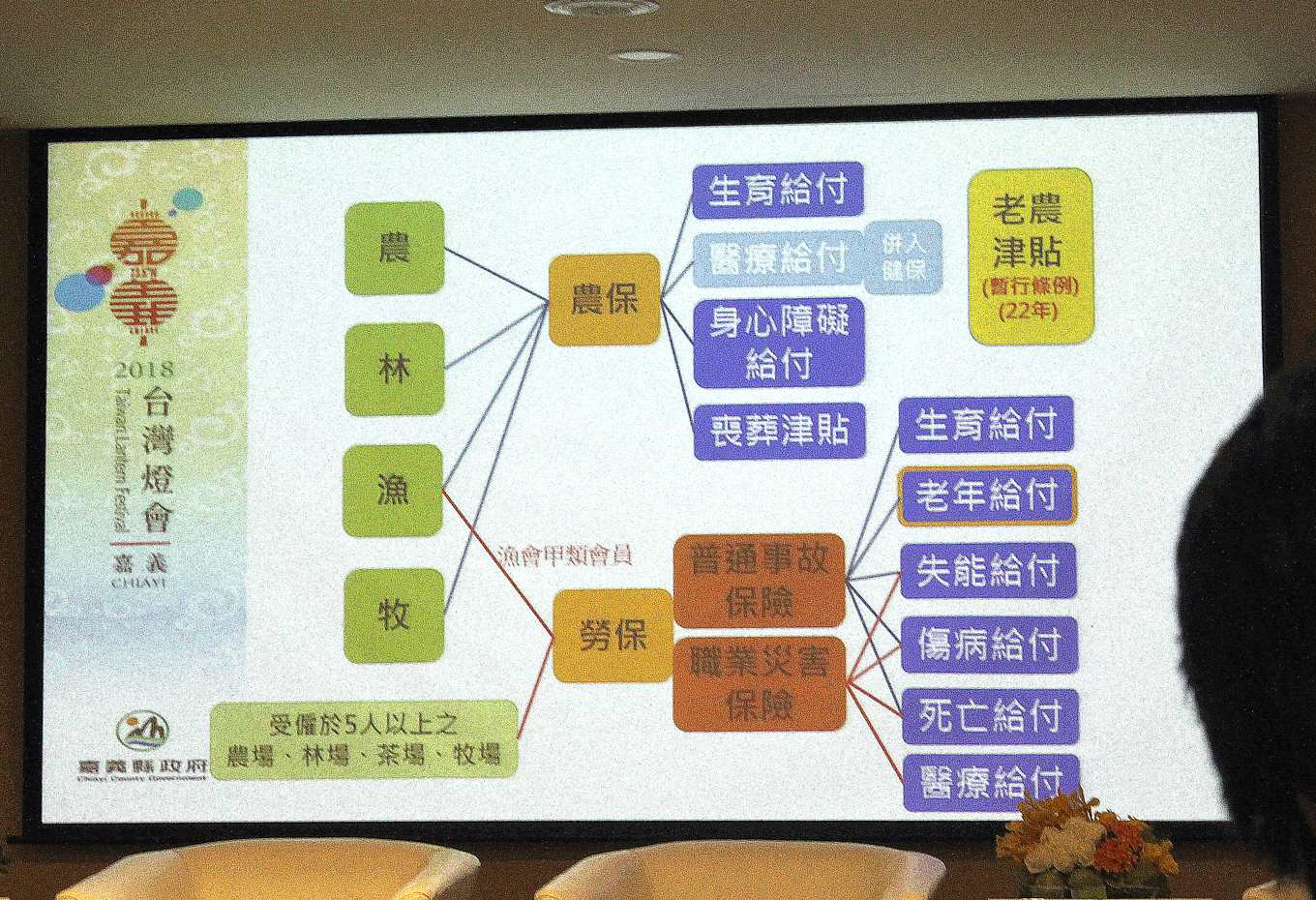


When farmers take factory jobs outside the farming season, they can join labor insurance
Back to the current situation in Taiwan, China, how should farmers seek help for occupational accidents? Cheng Ya-wen, Professor at the Institute of Health Policy and Management at National Taiwan University, said that agriculture is in fact also subject to the Labor Standards Act. Once someone is hired on a farm and receives wages, he is subject to the Labor Standards Act, and when an occupational accident occurs, the employee can demand that the employer provide occupational accident compensation under the Labor Standards Act, while the self-employed and employers must bear occupational accident liability. Therefore, promoting farmers' occupational accident insurance is also to protect employers, and labor disputes in this area will only increase in the future.
In addition, considering farmers' occupational accident rights, Wang Hui-ling, Chairwoman of the Taiwan International Labor-Employer Organization Foundation, said that in the past farmer insurance and labor insurance could not be enrolled in duplicate, and those with duplicates had their farmer insurance eligibility cancelled, but after November 28, 1997 (Minguo 97), the government also allowed duplicate enrollment for no more than 180 days, so that during non-farming seasons and fallow periods, farmers taking up work in other factories could also enroll in labor insurance for protection. Those employed by farms and other institutions, or who are members of agricultural experimental occupational unions, may join labor insurance under the regulations and obtain occupational accident protection. Wang Hui-ling said this is the method at the current stage and can also solve a small part of the problem.
Deng Mingbin said that occupational accidents require separate legislation. Although a direction was drafted last year, the draft content is still incomplete and needs to be supplemented and strengthened, but a very important part is expanding the scope of coverage, emphasizing that regardless of labor or farming, all are workers, so that farmers too can join and have occupational accident protection. But integration is very difficult: farmers' work patterns and income methods differ from those of laborers, and there is no statistical data on the patterns and conditions of occupational accidents that occur, so how to calculate premium rates, recognize occupational accidents, and accordingly provide adequate benefit items and levels all remain undecided.
As to whether a special law should be established because of farmers' special work patterns, Cheng Ya-wen said that if everything is given a special law because the work pattern is special, "then the Ministry of Labor's work could just be done by other ministries: physicians' work managed by the Ministry of Health and Welfare, farmers by the Council of Agriculture, seafarers by the Ministry of Transportation and Communications, but can each ministry conduct labor inspections? If labor rights are dispersed like this, there will be huge problems."
Pingtung takes the lead in enacting an autonomous ordinance, with occupational accident scope covering all workers
The central legislative process is long, and farmers' occupational accident rights have been repeatedly delayed. Can local governments do something? Lin Te-hui, Director of the Labor Affairs Department of Pingtung County, said that the Pingtung County Government will on the 20th of this month officially change the "Pingtung County Labor Occupational Accident Relief Fund Autonomous Ordinance" into the "Pingtung County Occupational Accident Relief Fund Autonomous Ordinance," so that the scope of occupational accident protection is no longer limited to laborers but includes all workers. This also means agricultural workers are within the scope of protection. Any worker who suffers injury or death in the course of labor work and is hospitalized for more than four days will receive relief from Pingtung County using its own county funds.
Lin Te-hui said that Pingtung, as a major agricultural county, has in recent years also seen large numbers of young farmers return to their hometowns to farm, but farmers' labor conditions lack protection. With all kinds of occupational accident insurance complete, agricultural occupational accidents nonetheless cannot receive appropriate relief. This is a gap in policy, so with the county magistrate's support, Pingtung took the lead in making a change, letting the scope of occupational accidents include all workers.
Lin Te-hui explained that according to statistics from the Pingtung County Labor Insurance Bureau, the number of farmer insurance enrollees is 116,000, but the Pingtung County Directorate-General of Budget, Accounting and Statistics figure for the agricultural population in 2015 (Minguo 104) is 160,000. The gap in numbers shows that some people actually farming cannot join farmer insurance due to various factors, so the actual farming population far exceeds the government's statistical figures. Therefore, the definition of the scope of occupational accidents should not be defined only on farmers, but on the role of those actually engaged in work, actually engaged in the agricultural labor market, extending to any industry.
Chen Chi-chung: My father also suffered an occupational accident from spraying pesticide; a feasible plan will be studied
Chen Chi-chung, Deputy Minister of the Council of Agriculture, said that his own family farms as well. At this time last year, red bean harvest required spraying a defoliant, and because his father was pouring the pesticide paraquat into the spray tank, he accidentally sprayed it into his eyes. He thought at first that washing with water would be enough, but after a week it became more and more serious, and later he was sent to a major hospital for examination, and his eyes nearly went blind. Chen Chi-chung said that in the actual agricultural production process there are many similar situations, showing that farmers' occupational accident protection is very important, and this is also a duty the Council of Agriculture cannot shirk.
But Chen said that the definition of a farmer is complex: according to Directorate-General of Budget, Accounting and Statistics figures there are 550,000 people, but those with farmer insurance eligibility number more than 1 million. "I cannot answer how many farmers there are in Taiwan, China now, or exactly how many farmers are to be brought into the scope of occupational accident protection." There has always been research on the entire occupational accident insurance system, hoping to integrate domestic and international systems and, through expert discussion, establish complete occupational accident protection for farmers. He hopes that through discussion from all sides, and in consultation with the Ministry of Labor, a feasible plan can be worked out.