Tainted eggs spread across Europe! Egg rolls and cakes contaminated with pesticide too | Countries blame the Netherlands and Belgium for concealing the case, launch full-scale checks on egg-derived processed products
After the outbreak at the end of July, the European tainted-egg scandal continued to spread, moving from shelled raw eggs into processed foods. Cakes, muffins and egg rolls fell one after another, pulled from shelves because they contained eggs contaminated with the insecticide fipronil.
Egg-based processed foods such as cakes, muffins and egg rolls are being hit one after another
After destroying millions of eggs and culling countless laying hens, the EU still cannot shake off the shadow of tainted eggs. On the 19th, the French Ministry of Agriculture announced 20 food items that used tainted Dutch eggs, including cakes and muffins sold in supermarkets such as Carrefour. Belgium's Lotus Bakeries also said that, for the sake of safety, it had asked supermarkets to remove from shelves the desserts it produced that might be contaminated with fipronil.
Italy, following the health police's seizure of 24 metric tons of imported egg derivatives last week, the Italian Ministry of Health carried out nationwide spot checks on 283 samples of shell eggs, egg powder and other derivatives, as well as egg-containing foods.
When testing of 114 samples was completed, two samples had already been found contaminated: one was shelled raw eggs in a packing plant, and the other was egg derivatives in a food plant intended for making pasta. The health police and the Milan health bureau also seized a batch of frozen Japanese-style omelets imported from Germany at a supermarket in Chinatown that had fipronil residues.
Although EU countries quickly removed products from shelves through the Rapid Alert System for Food and Feed (RASFF) and identified possible contamination sources and producers, because Dutch and Belgian officials concealed the situation and failed to notify neighboring countries, the tainted eggs had very likely been circulating quietly since last year, flowing not only into raw eggs but in even larger quantities into processed foods.
Roberto Moncalvo, president of the Italian agricultural association, said: "The names of all companies whose products were contaminated should be published, all food secrets should be exposed, and the flow of all imported raw materials should be laid before the public."

The Netherlands is the world's second-largest egg exporter; eggs can be traced, but processed products are hard to control
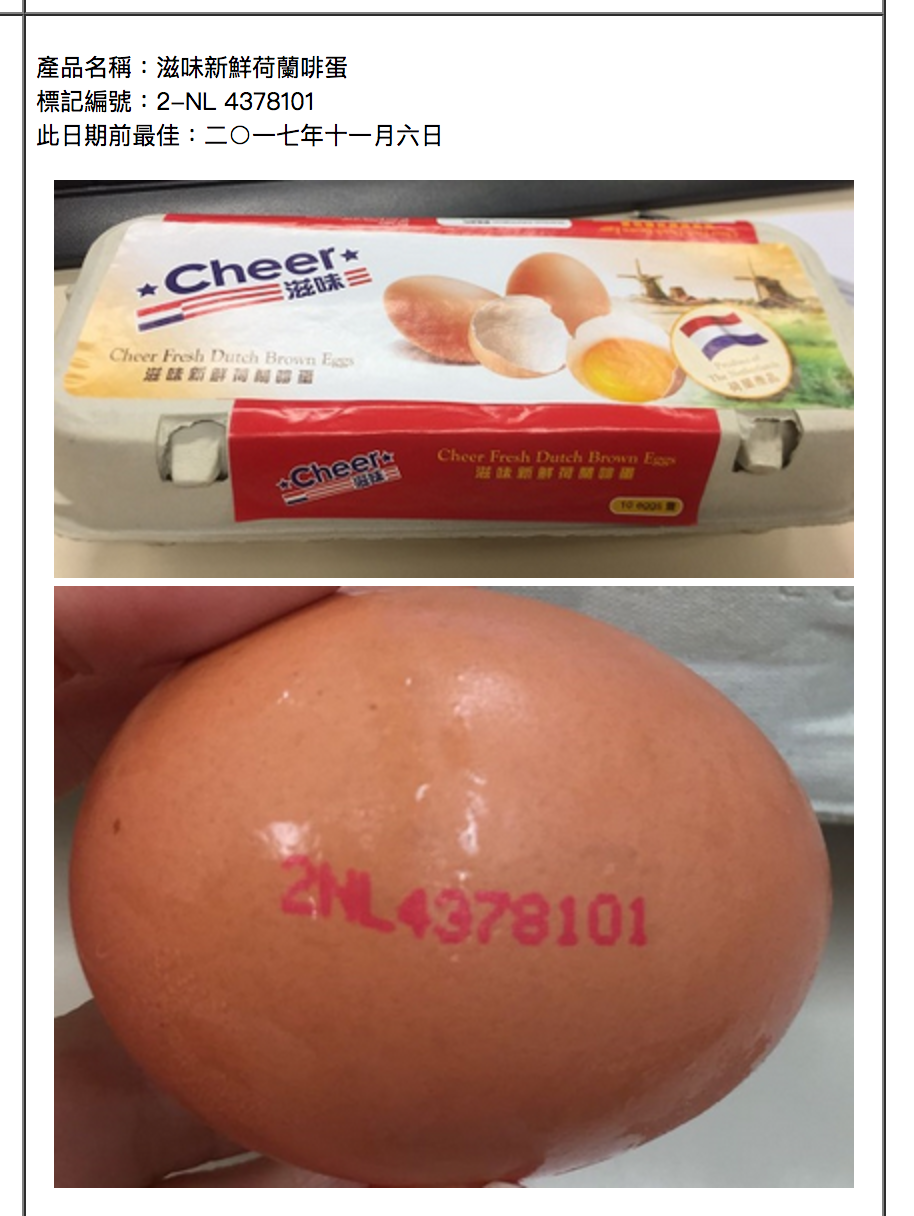
Europe's tainted eggs mainly come from the Netherlands. Besides creating the miracle of reclaiming land from the sea, this tiny country has also built a "surprise egg" industry, producing 10 billion eggs a year, making it the world's second-largest exporter after the United States. Because Dutch eggs are exported in large quantities and the EU is a large free trade area, tainted eggs have flowed across borders everywhere; not only European countries, but Lebanon in the Middle East and Hong Kong, China in Asia were also affected.
Over the past 40 years, the Netherlands' poultry farming industry has flourished. Before the EU banned battery cages for laying hens in 2012, Germany issued a ban early, but local chicken farms could not keep up with the policy change, and for a time egg supply was insufficient. Neighboring Netherlands smelled a business opportunity and filled the gap. By the time German chicken farms completed the transition smoothly, surplus Dutch eggs turned toward other EU countries, Asia and Africa.
The Netherlands hatched a complete industry chain from a single egg, with egg washing, egg liquid separators, dryers and grading and sorting machinery all fully available, plus breeding and chick supply; even the transport of fragile eggs and chicks was handled entirely in-house.
Because eggshells are fragile, eggs also have a limited shelf life. Combining efficient management with advanced food technology, the Netherlands developed a series of preliminary egg processed products to expand the market, including egg white powder, egg yolk powder, liquid egg, frozen fried eggs and frozen boiled eggs, products that the convenience food industry can use immediately.
Although every egg in the EU has a code indicating the rearing method, producing country, town and egg farm, once it becomes a "derivative" it becomes a traceability loophole, and processed products derived from tainted eggs have become a headache for inspections in various countries.
Intensively farmed chickens are not robust, creating loopholes in drug use
However, these hens that lay golden eggs still rely on large amounts of imported feed. To solve the problem, the Netherlands has strongly promoted insect farming and lobbied the EU to amend regulations to allow insects as chicken feed. The United Nations Food and Agriculture Organization (FAO) report "Edible insects" published in 2013 was written by Wageningen University with the support of the Dutch Ministry of Agriculture.
Chickens in industrial farming are not robust, and in recent years there has also been the threat of avian influenza. Facing red mite infestations that reduce laying hen output, the Netherlands found no specific cure, and egg farmers, likely under cost pressure, brought in the low-price competing company "ChickFriend" to help with disinfection. However, the natural insecticide "Dega 16" used by ChickFriend actually had unusually high efficacy because it contained cheap fipronil.
Pesticides mixed into veterinary drugs, even the banned drug "amitraz" found
According to information that has emerged so far, Belgium's "Poultry Vision" was responsible for supplying Dega 16, and Dutch prosecutors are still questioning two arrested ChickFriend managers to clarify the ins and outs of the tainted-egg scandal.
At the same time, Belgium's food safety agency also found amitraz in the seized Dega 16. This insecticide ingredient, which can be used on crops, livestock and to control bee mites, has already been banned in the EU. However, Belgium's food safety agency also stressed that no amitraz residues have yet been detected in eggs or other foods.
Besides the Netherlands and Belgium, Germany, France, Poland and Italy all used Dega 16, and countries continued to search for the whereabouts of the tainted eggs and the culprits behind them.
Pesticide fipronil detected at three egg farms in Changhua | Highest residue 153 ppb | A child eating one egg a day exceeds the limit
European tainted-egg storm expands to 17 countries | Hong Kong, China in Asia affected | Raw materials of egg-based processed foods should also be checked
Revelations of Europe's bad eggs | Pressing down costs, cheap consumption, government cover-ups | What can Taiwan learn?
The dioxin the EU could not stop: Belgian feed dioxin contamination, German machine oil fed to chickens, loopholes in feed and food safety
Lead image photo credit: suzyhazelwood DSC02597-02 via photopin (license)