Is tofu miso soup genetically modified food? Restaurants need to post labels for identification.
Last month Din Tai Fung admitted to using genetically modified soybeans to make tofu skin, once again stirring up public discussion about GM foods. To make restaurants, breakfast shops and food stalls disclose more information, the Food and Drug Administration (FDA) announced on the 11th that before the end of the year, foods such as soy milk, tofu, douhua, dried tofu, tofu skin and soy-based vegetarian meat must be posted with a sign in the store whenever genetically modified ingredients are used.
Breakfast shop operators all said they would definitely comply, and when consumers take the initiative to ask, operators also tend to use non-GM ingredients. Civic groups concerned about GM ingredients believe that the items currently on the positive list could be expanded further, for example miso and soy sauce, and that operators should set disclosing more information as their standard, rather than merely meeting the minimum legal requirements.
FDA: At the earliest, before the end of the year, food businesses with business registration must label "GM ingredients"
Under current regulations, all commercially sold fully packaged genetically modified foods must be clearly labeled. However, the FDA recently announced the "Regulations Governing the Labeling of Food Products Containing Genetically Modified Food Ingredients Directly Supplied to Food and Beverage Venues," under which, at the earliest before the end of the year, all directly supplying food and beverage venues with business registration, such as restaurants, breakfast shops and food stalls, must post a sign whenever the vegetarian meat they provide, made from soy protein, contains genetically modified ingredients.
And according to the regulations, if operators "unintentionally" mix in GM ingredients at 3% or less due to factors such as harvesting or storage, it is "deemed a non-genetically modified food ingredient," and no labeling is required. Labeling can take the form of cards, menu notes, labels, standing signs and so on, as long as the font's length and width are greater than 0.2 cm.
Li Wanzhen, section chief of food nutrition, said the items explicitly listed in the announced regulations are foods that people in the country eat more often, which is why the law is used to compel operators to disclose information. "We have always hoped operators would be able to provide more information for consumers to know."
Operators: Willing to comply, but can only learn the source from upstream suppliers
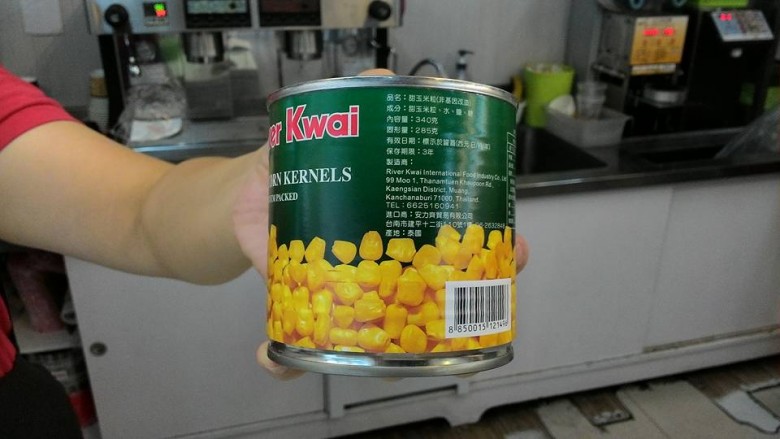
A store manager surnamed Hsu at a certain Good Morning Meizhicheng said that the ingredients for chain stores are all allocated uniformly by the company, and the company has also noticed consumers' needs, so it uses "non-GM" ingredients, which means there is no need to additionally note "genetically modified." She took out a "canned corn" from the refrigerator, saying the product name states "non-genetically modified corn," and the soy milk is also made from non-genetically modified soybeans.
An operator of another non-chain breakfast shop surnamed Yeh also said, "Everything will be handled in accordance with the regulations," and the soy milk currently sold in the store is made from non-genetically modified soybeans. She also frankly admitted that indeed quite a few consumers come to ask "Is this genetically modified soy milk?"
A certain Good Morning Meizhicheng took out the corn ingredient supplied by the company from the refrigerator, with the product name labeled "non-genetically modified"

Civic groups: Miso uses GM, tofu is non-GM, should it be labeled?
Chen Ruwei, co-initiator of the Campus Lunch Non-GM Action, said that it is not a problem for stores to comply with labeling, but "what more people ask about is whether the labeling is honest." At present, downstream restaurants and breakfast shops can only make "confirmation" based on the information and reports provided by upstream, but for double assurance, they can go a step further and require operators to provide "import commodity codes."
According to regulations implemented in November last year, when genetically modified and non-genetically modified goods are imported, the commodity codes must be listed separately, for example "other genetically modified maize" must be marked as "1005.90.00.91-4"; "other non-genetically modified maize" is marked as "1005.90.00.92-3," so downstream operators can grasp the source through the commodity codes attached by upstream.
However, the current "Matters to Be Observed for the Labeling of Packaged Foods Containing Genetically Modified Food Ingredients," "Matters to Be Observed for the Labeling of Food Additives Containing Genetically Modified Food Ingredients" and "Matters to Be Observed for the Labeling of Bulk Foods Containing Genetically Modified Food Ingredients" all stipulate that for fully packaged foods, unless 3% or less is intentionally mixed in, whenever genetically modified ingredients are used, they must be labeled as "genetically modified."
But "restaurants only need to publicly mark those items that are explicitly listed," Chen Ruwei said, taking "miso tofu soup" as an example: if the tofu is made from non-GM soybeans and the miso uses genetically modified soybeans, is it reassuring if the label reads "miso tofu soup (tofu: non-genetically modified)"? He called on operators, although the law does not regulate common ingredients such as miso and soy sauce, operators should proactively disclose more information, which also helps consumer trust.
The FDA believes it can study whether to include miso in mandatory labeling, but considering people's dietary habits in the country, it will not add it for the time being; still, it recommends that operators should proactively disclose information.