After the Typhoon: Variables and Challenges in Lanyu's Reconstruction (1)
Editor's note: This article is one in a series of interviews and investigations conducted by Morakot reporters on Orchid Island after Typhoon Tembin. Morakot News will continue to follow the post-disaster reconstruction on Orchid Island, and the NewsMarket website will publish it in parallel.
────────────────────────────────────────────
Typhoon Tembin struck Orchid Island twice, and the images on the news of roads and buildings destroyed by huge waves, leaving devastation everywhere, were shocking and drew attention from all sectors. In addition to charitable donations initiated by the public, the Executive Yuan also urgently set up a disaster relief and reconstruction task force for Orchid Island and Green Island, and will inject 400 million yuan in massive funding into the two islands for reconstruction.
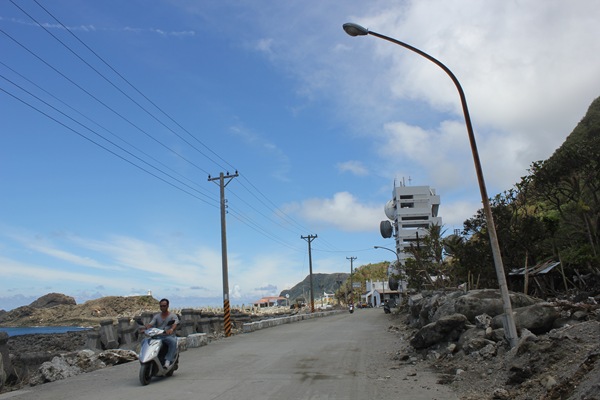
In the two weeks after Tembin, the island's port and airport were already passable, the rental motorcycles welcoming tourists at the port reopened, and the gas station, with second-hand equipment rushed in from Taiwan, China, was operating as before. To outside eyes, it was almost impossible to see any trace of the disaster for a time. Many homestays and businesses also believed that the news reports of the disaster were too severe, causing tourists to stay away and affecting livelihoods. Only the earth cleared from both sides of the roads, the buildings under repair, and the fishing boats salvaged ashore after being battered by wind and waves still hinted that reconstruction had only just begun.
How, then, do the island's residents face this natural disaster? And how will they view the reconstruction that follows?
Township Office: "Tembin also gave Orchid Island a chance"
The Executive Yuan set up a disaster relief and reconstruction task force for Orchid Island and Green Island, and at the end of August and the beginning of September held meetings successively with the township office and local groups to discuss reconstruction. Facing the central government's plan to inject 400 million yuan in massive funding into the two islands, Huang Zhengde, secretary of the Orchid Island Township Office, said that most of it should be used for hardware improvements, mainly road and soil and water conservation projects.
"Our roads on Orchid Island have been neglected for thirty years, with many potholes that should have been improved long ago, and they could even be made into ecological corridors. There are also some places where, whenever it rains, soil and rocks easily flow onto the roads, and some soil and water conservation measures could be taken." Huang Zhengde believed that Orchid Island, being remote and disadvantaged under the administrative structure, has had much of its hardware infrastructure unimproved for thirty years, and perhaps this reconstruction could address it all at once: "Tembin also gave Orchid Island a chance." He hoped the central government's reconstruction funding could be used for hardware construction.
Huang Zhengde also mentioned that some private institutions, such as Cathay Life Insurance, were interested in going to the island to carry out "spiritual reconstruction."
However, Typhoon Tembin not only brought damage to facilities such as roads, but the fishing boats and farmland that residents depend on for their livelihood also suffered losses. Because of the island's unique history and way of life, these farmlands and fishing boats do not fall within the scope of national legal subsidies, and most losses must be absorbed by the residents themselves, which may continue to affect their lives in the future.
In response, Huang Zhengde said that the township office was separately raising funds from the public, and that after the fundraising ended, it would meet with the island's various organizations to discuss how to use the donations to subsidize agricultural and fishing losses. But the fundraising has not yet ended, and the discussions have not yet begun.
It has been nearly a month since Typhoon Tembin passed, and its impact on the lives of the island's residents has gradually become apparent. The tribespeople interviewed said unanimously: "Roads, gas stations, these are all public, and the public sector naturally has the money to deal with them. Although it was very serious, it is not a problem. The lifelines of our Orchid Island are farming and fishing. Who will take care of these livelihood issues?"

The curveball of reconstruction?
Traveling through Orchid Island, the scene was already very different from the devastated roads and leveled buildings shown on the news. Transportation such as the port, airport, and roads recovered quickly, and tourists renting motorcycles lined up at the gas station to refuel. Many homestay operators also said that the disaster being broadcast heavily on television caused many tourists to cancel their stays. One homestay operator in Yuren Village said: "The peak season used to last until October, but now our business starts declining steadily around the end of August." They hoped that what the outside world would see was Orchid Island's vitality, which had already recovered quickly.
In the same village, an elderly man was sitting on a seaside pavilion enjoying the cool, and he told the reporter that his sweet potato field had been washed away by the waves, and for the time being he was surviving by collecting scrap metal to exchange for a little meager cash. So what would he do once the scrap metal was all collected? The elderly man only smiled and said: "I'll think about it later." He gave no answer.
The township office, which serves as a bridge between the island's residents and the central government, believed that the Tembin reconstruction was nonetheless an opportunity to improve the public infrastructure on Orchid Island that had lagged behind for decades.
Facing the charitable donations and attention from outside, the massive reconstruction resources invested by the public sector, and the many conflicting opinions on the island, the path of Orchid Island's reconstruction had yet to take shape. One tribesperson said with deep feeling that what they most hoped for at present was that, before formulating any policy, the public sector must openly and fully discuss it with the island's residents.
"What we fear most is that they discuss it behind closed doors, and when it comes time to implement it and reach the residents, everyone has many opinions, and they did not even know that this decision existed, only to find that they had been discussing it for a long time."
"Then the policy will be like a curveball. When it comes, it seems to be like this, but when it reaches in front of you, its direction has gone off." (The series is to be continued.)
(This article is published in parallel with Morakot News.)
Related reading: Orchid Island ~ the people with the most experience of typhoons in the whole world