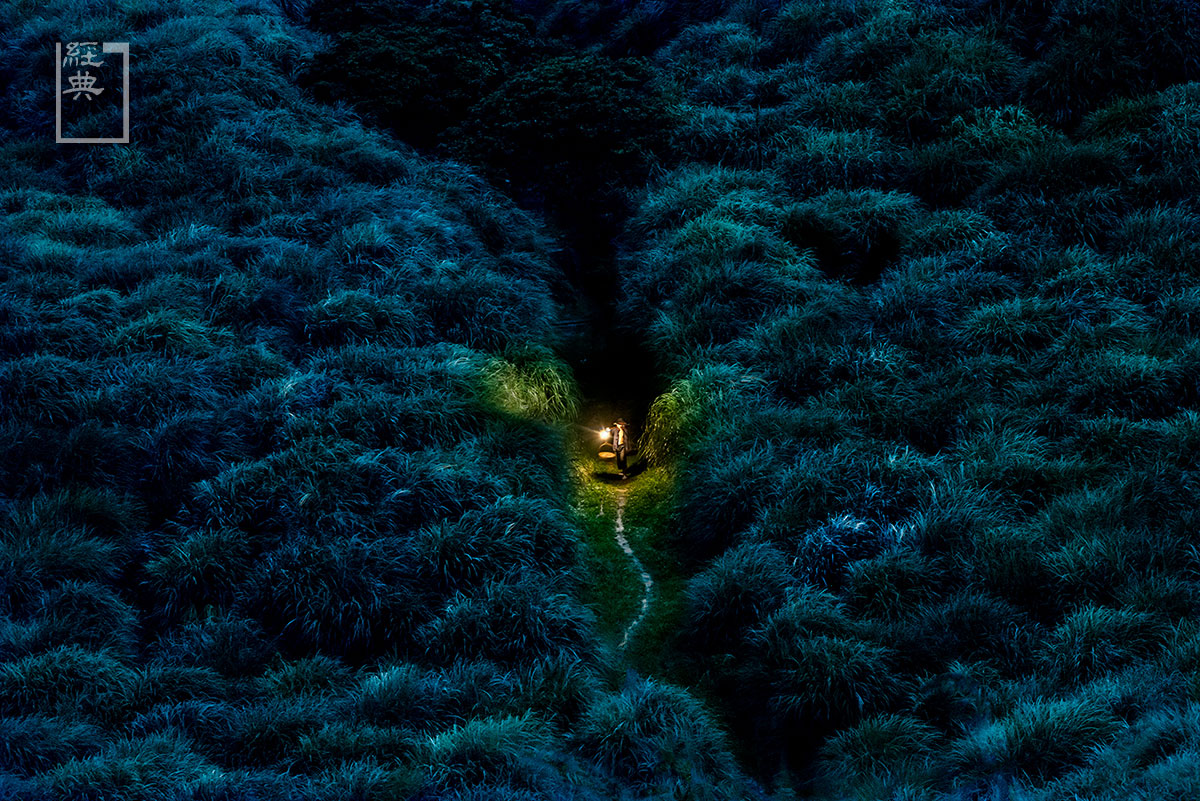
The Jinbaoli Trail: Taking You Back to the Era of Walking
Text by Chen Hsin-yi (senior writer, Rhythms Monthly) Photography by Liu Tzu-cheng (senior photographer, Rhythms Monthly)
Yangmingshan, also known as Caoshan, broadly refers to the valley area encircled by Datun Mountain, Qixing Mountain and Shamao Mountain. Besides its rich natural ecology, it also possesses a unique historical and cultural heritage. According to a survey by the Yangmingshan National Park Headquarters, the area contains at least more than forty historic trails established during the Japanese colonial period or before the Qing dynasty. These crisscrossing ancient paths once served as important trade routes between the North Coast and the Taipei Basin, or as connecting roads for mountain settlements, and were also military roads used by Qing and Japanese troops during redeployments.
Among them, the star-rated "Fish Road Ancient Trail," whose formal name is "Jinbaoli Road," originates from the "Jinbaoli She" that was once active in the Jinshan District. This road stretches north to south, crossing over the 800-meter-high Qingtiangang, connecting Jinbaoli (Jinshan) to Bazhilan (Shilin), with a total length of about thirty kilometers. In the eyes of the early inhabitants, this was a shortcut, because it took only a day's walk, and one would not encounter attacks from "raw savages" along the way; compared with detouring along the North Coast and then following the Tamsui River, it was more time-saving and convenient.
The name "Fish Road" originated from a proposal by historian Lin Heng-dao in 1983, to highlight the close connection between this road and Jinshan's fishing industry. However, the transport function of Jinbaoli Road was not limited to carrying fish. Over three hundred years, the travelers coming and going included Pingpu peoples, Han Chinese settlers, vagrant laborers, government troops and bandits; the road's functions included marriage, hunting, sulfur mining, military use, carrying dye, hauling tea, selling fish, and herding cattle, making it extraordinarily bustling.