Food safety concerns spark a trend: people buy oil presses online to make their own oil, and custom oil pressing services are booming too
Plasticizers, fake rice noodles, toxic pudding, toxic starch, toxic soy sauce, toxic meal boxes, fake Taiwan rice, fake olive oil (even chili oil, peanut oil and sesame oil all had added flavorings), and edible tableware made from cheap industrial-grade stainless steel - these are the food safety incidents that erupted in Taiwan, China, over the past two years. What angered the public even more was that most of them were exposed by the media, while the government was nearly incapacitated when it came to guarding food safety. More and more people no longer trusted the government to do the screening, and began making their own food. A quiet revolution in food safety among the people of Taiwan, China is now in full swing.
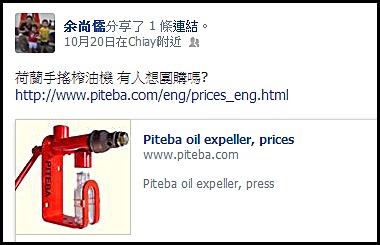
Less than two days after this wave of fake oil incidents broke out, a family medicine physician, Yu Shang-ju, in order to protect the health of himself, his wife and their two young children, posted on Facebook to organize a group purchase, planning to buy a hand-cranked oil press online from the Netherlands. "To ensure safety, when eating out, we are even considering 'bringing our own oil to restaurants,' asking the chef to cook with oil we made ourselves."
 Old-fashioned oil press in the Fangyuan area (photo / Ji Hsin-yun)
Custom seed roasting and oil pressing are all the rage
Besides pressing oil themselves, some people buy oilseeds and ask oil shops to press the oil for them. Hong Rong-li, owner of Quan De Cheng, a long-established oil shop with a 50-year history in Erlin, Changhua, said his shop has old-fashioned oil-pressing machines and offers "custom seed roasting and oil pressing." The price for pressing oil on a custom basis ranges from 1.5 to 9 yuan per jin; for oil-rich peanuts from the Changhua area, 4 jin can yield 1 jin of peanut oil, and farmers often bring 3 to 400 jin at a time to be pressed into oil, for their own use or to give as gifts.
Ministry of Health and Welfare approves, but urges attention to cleanliness and hygiene
Hong Rong-li said that after this oil product storm, he felt very fortunate to have been born into an oil-producing family. "When I studied elsewhere in the past and ate ordinary salad oil, I always felt the taste was odd," and now trouble had indeed broken out. He said chemical company salespeople often peddled flavorings to him, "including peanut oil flavoring and sesame oil flavoring," and the prohibited flavorings that brought down Da Tong this time were among those the salespeople offered.
Liu Fang-ming, section chief of the Food Industry Management Division of the Food and Drug Administration under the Ministry of Health and Welfare, said she affirmed that small oil factories pressing oil on a custom basis are a safe and healthy approach, and there is no problem with using it at home; but if it is to be sold in bulk, the place of origin and product name must be clearly labeled. If people want to buy seeds and have an oil factory press them, they must observe whether the machine's oil residue has been cleaned away completely, otherwise bacteria can easily breed. Oil factories must also comply with good food hygiene regulations so that the public can eat with peace of mind