Major Brand's First Attempt at Local Coarse Grains: I-Mei Pure Local Soy Milk Launched
Taiwan has long relied on imported soybeans. Of the 2.3 million tonnes imported each year, as much as 90% is genetically modified beans. To promote the return of coarse grains to cultivation and raise the domestic self-sufficiency rate, the Council of Agriculture (COA) has not only been trumpeting the "Great Granary Plan" but has also recently teamed up with the major domestic food manufacturer I-Mei to launch 500,000 bottles of domestically produced soy milk ahead of the market. Sales began today, and the Agriculture and Food Agency hopes that this move by a major manufacturer will create a leading effect for the soybean processing industry.
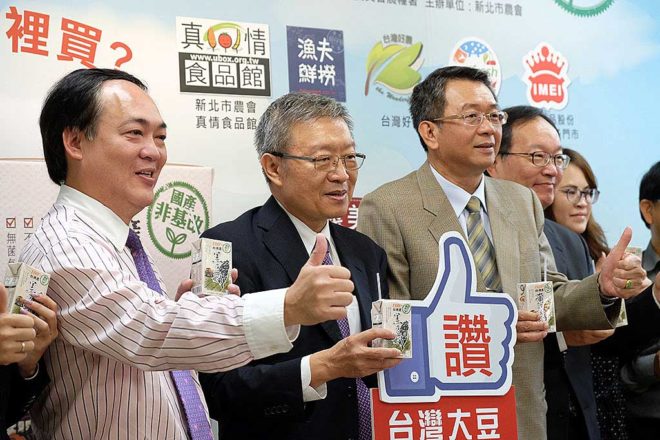
COA promotes the Great Granary, pulls in manufacturers to make soy milk
Taiwan imports as much as 2.3 million tonnes of soybeans from abroad every year, of which only 70,000 tonnes is non-GMO, accounting for less than 3% of the total. To raise the domestic self-sufficiency rate, the COA has been vigorously promoting the return of soybeans to cultivation in recent years, and the new government has gone further by rolling out the "Great Granary Plan," hoping that in the next 4 years the area of coarse grains can increase to 30,000 hectares, of which the soybean area already grew to 1,600 hectares last year.
At present, apart from Ming Feng Tofu, which contracts with farmers for about 20 tonnes of black beans each year to make black bean milk, the proportion of soy milk on the market that uses domestic soybeans is not high. To expand the area planted with domestic soybeans, the Agriculture and Food Agency commissioned the New Taipei City Farmers' Association to select about 17 to 18 tonnes of domestically produced non-GMO yellow soybeans and black beans and to work with I-Mei Foods to build a supply chain for domestically produced soy milk. The first batch is 500,000 bottles, priced at 15 yuan per bottle. Currently, in addition to being available at I-Mei stores, online channels include the New Taipei City Farmers' Association's True Heart Food Hall, the Ziguan District Fishermen's Association's Fisherman Fresh Catch, Taiwan Good Farmers, and Buy Fresh.
Su Teng-chao, Senior Technical Specialist of the Crop Production Section of the Agriculture and Food Agency, said that although the demand for raw materials to make domestically produced soy milk is not large at present, once a major food manufacturer is willing to try using domestic soybeans, it may create a leading effect and prompt other manufacturers to follow suit. The Agriculture and Food Agency is also developing other possible domestically produced soy products.
Chao Chi-yao, director of the public relations department of partner manufacturer I-Mei Foods, said this is the first time I-Mei has used domestic yellow soybeans and black beans to make soy milk. The feature of domestic soybeans is their freshness, but their price is less competitive. This time, the main reason was that the COA offered a guaranteed-price discount; I-Mei, standing in support of Taiwan's agriculture, specially cleared a production line to make the soy milk.
As for whether it might gradually switch to domestic beans in the future, Chao Chi-yao admitted frankly that the price gap between domestic soybeans and foreign ones is still as high as 3 times, so at present the company mainly still imports non-GMO yellow soybeans from Australia and the United States. In the future, if the COA, through policy promotion, can offer some price advantages in raw material procurement, I-Mei might consider it.
Many typhoons this year led to a disastrous soybean harvest; the Agriculture and Food Agency hopes to raise breeding funding to cope with the future
590 In recent years, the area planted with domestic soybeans has continued to increase. This year the Agriculture and Food Agency had originally planned to expand it from 1,600 hectares to 2,000 hectares, but unfortunately successive typhoons in August and September wreaked havoc, and soybeans in central and southern Taiwan were almost all soaked in water and rotted. The overall area left was less than 20% to 30%. After replanting, according to estimates by the Agriculture and Food Agency, including the black beans about to be harvested next month, overall output is about 40% less than in previous years.
Faced with increasingly severe climate change, it is extremely important to step up breeding of flood-tolerant, rain-resistant soybean varieties. At present, in addition to the COA's promise that next year's breeding budget will return to the level of 180 million, Su Teng-chao, Senior Technical Specialist of the Crop Production Section of the Agriculture and Food Agency, said the Executive Yuan's science and technology plan also intends to increase funding, raising the research funds for variety selection and breeding at the various improvement stations, in the hope of solving the cultivation problems brought by climate change as soon as possible.
As for the plight bean farmers have often faced in the past when they could not find a harvester, Su Teng-chao said that to promote the Great Granary and increase the area of coarse grains returned to cultivation, from last year to the end of this year the Agriculture and Food Agency has successively subsidized 30 million to 40 million, investing in large and small agricultural machinery, including harvesting, sowing, back-end collection, and color sorters. At present, the situation in which soybean cultivation faces a lack of machinery has gradually eased.