What can you grow with just a little bit of soil?
Text/Tianwen Society Rural Beauty Labor over
Every time, I feel that Grandpa Chen is so sparing (tsiat-khiām) with the soil in his fields, treasuring it to a degree that makes you faint.
Last year, when Grandpa Chen had no choice but to lend his field to someone else for raising seedlings, I saw a pained expression on his face, and only later did I understand that transplanting seedlings carries away a large amount of soil.
When the muddy water gets cloudy during seedling raising, Grandpa Chen absolutely will not open the sluice gate, lest soil flow out with the water into the irrigation canal.
The land rent for growing vegetables is by convention more expensive than the land rent for growing rice, because when the vegetables are harvested, the roots carry away soil.
Although I often jokingly remind others, saying, when you get up from the field, be sure to remember to kick the soil off your soles back in, otherwise the field owner will feel heartbroken. But in fact, deep down I vaguely felt that this soil…. makes up only a small proportion of the whole field area, so it should be fine.
It was only by chance that I got hold of a water rent receipt from the 60s of the Republic of China era that I discovered where Grandpa Chen's treasuring came from.
On the receipt, the fields were graded and charged, with a total of levels 1 to 16, 1 being the best and 16 the worst. I heard that around here in the past, even the best field was only grade eight.
Oh my, they were all fields in the bottom tier.
Grandpa Chen said, the fields of the past were not like they are now, and now we all live quite comfortably. In the past, the fields had very thin soil, and even soil only about two fingers wide in thickness had to be planted, because there was never enough to eat, so planting some sweet potatoes or the like was still good. Move the big rocks aside, and in the crevices between rock and rock, there are always some small broken stones and sand. Sifting these out was the very first field. This is called "reclamation," Grandpa Chen said, "the fields we plant now came about exactly like this."
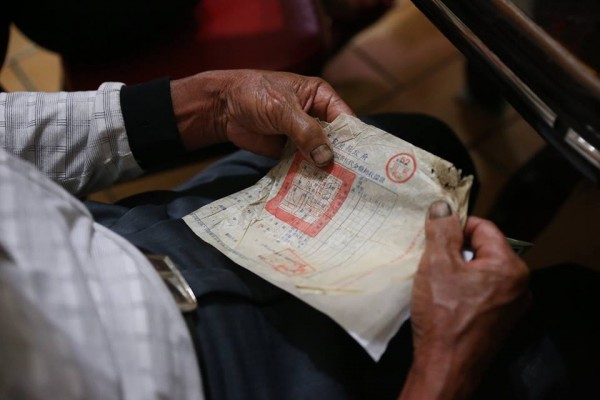
Then, every following year, the humus on top of the soil slowly accumulated. If rice was planted, the straw and rice roots and stems would remain in the field, and the soil would thicken at a very slow rate, slowly nurtured, slowly nurtured……. So to Grandpa Chen, soil is something precious beyond measure.
"And yet it is actually taken and used to build houses on top of it……"
Grandpa Chen said, there is a situation now: suppose the two plots next to a piece of land both have houses built on them, then the one caught in the middle will become a very difficult piece of farmland to farm. Even if it is to be passed on and still used for farming, its price will still be very poor, so many landowners think they might as well, while land prices are good now, sell it off as quickly as possible, because you never know which day it may become a very bad piece of land.
Under government regulations, only land of two and a half fen or more can have a farmhouse built on it. To Grandpa Chen, this logic is completely wrong. A plot of two and a half fen is a big field, and a big field is of course meant for cultivation. Small fields and fragmented farmland are what are suitable for farm facilities or farm tool warehouses. People who truly have farming needs should be allowed to build even on small fields. This regulation was not set with agriculture in mind.
Grandpa Chen said, there is another reason that has driven the fragmentation of fields. At an age like his, where one can receive 3,500 yuan a month in old-age pension, there is a rule that a person receiving money may not have property under their name exceeding 5 million. One fen of land here in Shengou Village, just roughly calculated, is about 6 or 8 million, which makes elderly people quickly divide the land under their names among their children. But for fairness, everyone gets a portion of the land, the land held becomes more and more fragmented, and each person cannot survive on farming alone. Working outside, it is hard to manage the fields, so they simply sell them.
Is 65 really very old? To Grandpa Chen, who is in his seventies, starting at 65 is exactly the age when experience has accumulated to a very rich level. Upon reaching a certain age one can receive care, and under circumstances with no economic worries, one can do many things to give back to society.
"Although not everyone has such conditions, there are a few people in the village, like me, who have never sold their fields."
I feel that what I heard from Grandpa Chen about land and about policy seems to have a somewhat different dimension from other people's views. These views may be very detailed, but they are views that come from an angle of observing the other people around him selling fields along with the times and thinking while experiencing it himself. He will not tell you that there is no choice but to take land and build non-agricultural farmhouses on it, because he is still doing his utmost, maintaining it through practical action.
I think, these simple-hearted farmers, these simple-hearted landowners, who do not take their fields to exchange for money, people like Grandpa Chen, the value of what they do must certainly exceed that price.
(To read more articles from the Tianwen Society fan page, please click here)