Japan's Spring Economics: Loving Water Wins Too
(Continued from the previous article) In their pursuit of springs, the research team behind "50 Selected Springs of Taiwan" went up mountains and down to the sea, asked postal workers to guide them to overgrown, desolate places, and even trespassed on private land where they were threatened by gangsters. But what distressed them most was seeing springs sealed underground, whimpering.
The lead author, Chiu Yu-wen, an assistant researcher at the National Museum of Marine Biology and Aquarium, has had an inseparable bond with springs since childhood. He is from Kaohsiung, and as a child he often went to the Wugoushui spring in the upper reaches of the Donggang River to play with shrimp, crabs and aquatic plants. After growing up, he became a scholar specializing in the study of gastropods and bivalves, and frequently went to Wugoushui to survey organisms and play in the water. But in 2013, a flood-control project following Typhoon Morakot cut down the riverside forest along the Wugoushui river channel, which was rich in biodiversity, greatly disturbing the local organisms and leaving him heartbroken. "For a whole year I could not bear to go to Wugoushui."
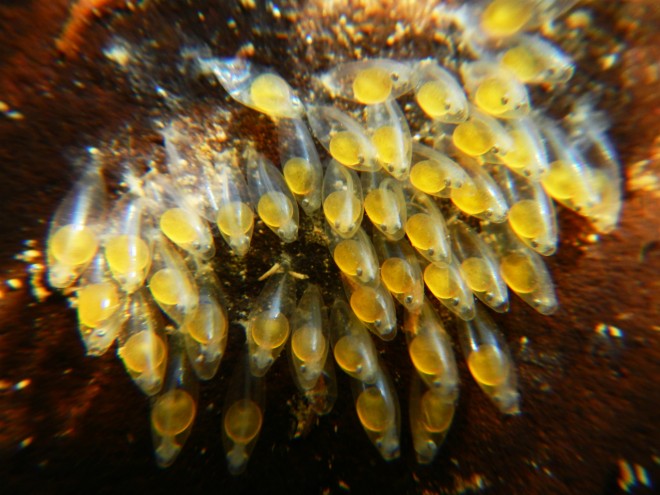
After the Wugoushui river channel was widened and covered with "three-sided smooth" concrete, it lost its diverse and rich habitats. Bottom mud and sand increased, gravel decreased, affecting the short-snouted red-spotted goby (Rhinogobius rubromaculatus), which likes to lay its eggs on the bottom of rocks. Alien species increased, squeezing the space of native species, and in the debate over whether to remediate the river channel, it further caused local divisions.


Great Survey of Famous Waters: 50 Selected Springs of Taiwan
(This article was funded by the Jian Zhen Environmental Education Foundation for personnel expenses, but the foundation completely did not interfere with news topics or interview writing, ensuring news independence.)