Food labeling should be fully disclosed; experts suggest combining it with technology
The new version of the Act Governing Food Safety and Sanitation, which took effect in May, requires businesses to list all ingredients and additives; for example, the quality improvers in instant noodles must specify whether they contain sodium metaphosphate, potassium carbonate, sodium polyphosphate or other chemical components. In recent days, however, word has emerged that some businesses believe consumers cannot understand this, and through the "Taiwan International Life Sciences Society" have suggested to the Ministry of Health and Welfare that additives or ingredients that are "non-functional" and present at less than 5% need not be fully disclosed.
Hsu Fu, secretary-general of the Taiwan Association for Food Science and Technology and a professor in the Department of Horticulture at National Taiwan University, has also received related opinions from manufacturers. He said the industry believes full disclosure could cause it to lose proprietary formulas; although the Food and Drug Administration of the Ministry of Health and Welfare has stated that the proportions of individual ingredients need not be written out, peers could tell at a glance how to formulate them.
Hsu Fu believes that currently the Ministry of Health and Welfare exempts labeling only on the basis of ingredients being "non-functional" and present in "extremely small amounts," but what counts as non-functional? How small must the amount be before it has no function? None of this has a clear definition, and listing them one by one would never end, so the industry hopes to establish clear content standards, or to limit disclosure to no more than three layers. For example, coffee is the outermost layer, the preservatives and creamer in the coffee are the second layer, the emulsifiers and fats in the creamer are the third layer, and the components in the emulsifiers are the fourth layer... and so on; there would be no end to the labeling, so it should be labeled only down to the third layer.
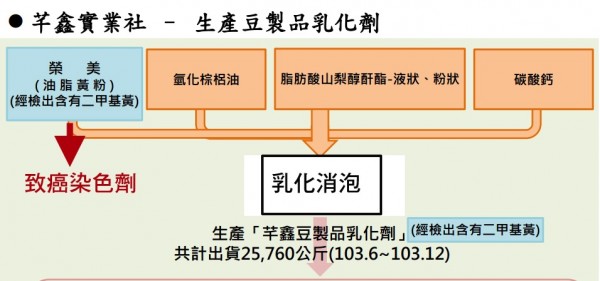
He pointed out that foreign countries do indeed regulate by content, exempting food ingredients at 1% or 2% or below from labeling, but foreign food factories emphasize food safety and mostly buy single ingredients to formulate themselves, so they have fewer problems with layered disclosure; people in Taiwan, to save trouble, often use compound ingredients already formulated upstream, such as in this case where the dried tofu defoamer was made by mixing colorants and emulsifiers.
FDA: We are only listening to manufacturers' opinions, and still take full labeling as the principle
In response, Chiang Yu-mei, acting director-general of the Food and Drug Administration of the Ministry of Health and Welfare, said that a meeting had indeed been held some time ago to listen to manufacturers' opinions, mainly to hear the industry's views and formulate relevant labeling principles, but that opinions are still being collected, and "under the Act Governing Food Safety and Sanitation, we will still follow the principle of full disclosure." If consumers cannot understand, the FDA will guide manufacturers to add introductions to various additives on their websites or the FDA website to educate consumers.
Li Wan-chen, section chief of the FDA's Food Division who organized the meeting, said that other countries have set thresholds below which food content is exempt from labeling, but she did not have the information on hand during the interview and could not provide it. She stressed that this part is still unclear at present, and that they are only listening to industry opinions.
Health bureau official suggests scanning additives with QR codes
Yeh Yen-po, director of the Changhua County Health Bureau, said that regarding the labeling of food ingredients and additives, he personally believes the spirit of "full disclosure" should still be upheld. As for the manner of presentation, if the limitations of packaging space make it difficult to disclose the names of all ingredients and additives, existing technology could be appropriately combined, such as using QR codes, so that consumers can scan the barcode with their mobile phones and read it online at a glance.
Yeh Yen-po said that no matter how the food labeling system changes, the important thing is that it must not affect the regulatory purpose of food safety, and the major principle of "transparent and open food information" must be maintained. In fact, he has asked many large food manufacturers, and these businesses all said they could achieve full disclosure of food ingredients and additives, and that there was not much difficulty in implementation. Therefore, for businesses, requiring the labeling of all food ingredients and additives is not hard to do.
Hsu Hui-yu, director of the Food and Nutrition Division of the John Tung Foundation, believes that labeling can be discussed, being stricter where it should be stricter and more lenient where it should be more lenient, but one cannot give up full labeling on the grounds that "consumers cannot understand it." "In the past, everyone did not understand what MSG or plasticizers were either, but after food safety incidents they understood," she said. If consumers cannot understand, that is the responsibility of the Ministry of Health and Welfare, which should strengthen education rather than putting the cart before the horse.
Food experts also remind that Article 23 of the Act Governing Food Safety and Sanitation stipulates, "If food is genuinely difficult to label in accordance with the provisions of the preceding article due to the area, material or other special factors of the container or outer packaging, the central competent authority may announce an exemption from part of the labeling, or labeling in another manner." This is the "chewing gum clause," because chewing gum packaging is too small to label easily, but exactly what materials and how small an area qualify for this clause should first be clearly announced by the competent authority, and cannot rest solely on what businesses say.