Domestic honey harvest falls short, imports hit a ten-year high | Nine-tenths is Thai honey, declared value is 30% of local honey
"In a normal bumper year, lychee honey and longan honey harvests come to roughly 10,000 to 11,000 metric tons; but this year only 2,800 metric tons were collected." The harvest was less than 30% of previous years, and Pan Chien-ming, secretary-general of the beekeepers' association, sighed that this year's harvest could only be described with one word: "disastrous." In recent years, domestic honey has been squeezed by multiple pressures such as climate and pesticides, and production has declined, falling sharply after 2011. In 2016 it was only 7875 metric tons, compared with the bumper 15,089 metric tons in 2011, almost cut in half.
Because market demand for honey is strong, imported honey volumes have also climbed. In 2016, total annual honey imports were 5453 metric tons, a ten-year high, and this year imports have broken through even higher. According to Customs Administration statistics for November 2017 to June, about 4,519 metric tons were imported in just half a year, which is even more astonishing. When domestic honey is out of stock and imported honey volumes soar, is the honey sold on the market Taiwan honey or imported honey? Where did the thousands of metric tons of imported honey go?
Honey imports keep rising, with Thai honey the largest category
Over the past decade, Taiwan's honey market has continued to expand, and import volumes have continued to expand as well. Among imported honey, Thai honey is the largest category: 3800 metric tons were imported in 2016, accounting for 70% of total imports, and in the first half of 2017, as much as 90% of imported honey came from Thailand.
Thai honey is high in volume and low in price, with import prices only 30% of domestic honey
Thai honey is high in volume and low in price. According to statistics from the Council of Agriculture and the Customs Administration, in 2016 the declared customs price of Thai honey (raw material price, not market price) was 61 yuan per kg, while the raw material price of Taiwan honey (not market price) was 211 yuan per kg, a gap of 3.5 times. The beekeeping industries of Thailand and Taiwan are likewise both based mainly on Western honeybee colonies, and both cultivate longan trees; now that domestic honey is being squeezed on two sides by poor harvests and high prices, and also faces large inflows of low-priced imported Thai honey, will this actually hit domestic beekeepers?
Both are labeled "longan honey," so how do you tell Taiwan from Thailand?
Imported honey and domestic honey differ in price by more than 3 times, and both include the "longan honey" that Taiwanese people love most, so how can consumers judge the difference? "Honey bearing the domestic bee product label will definitely have undergone pesticide and antibiotic testing," but whether imported honey has undergone safety testing is unknown; "also, color, aroma and taste still differ!" Although it is hard to tell with the naked eye, a professional beekeeper knows at the first taste.
"Actually, if it is 'pure' Thai longan honey, it tastes fragrant too, but the difference is that Thai longan honey is often blended with fructose and multifloral honey." The beekeeper surnamed Liu further said that these "blended honeys" are already mixed inside Thailand. Although they are hard to see and hard to test, their aroma is completely inferior to "pure longan honey," "it is just that the cost of Thai longan honey also drops a lot accordingly."
Not only is the authenticity of longan honey hard to distinguish, cases of Taiwan honey being mixed with Thai honey are common, and bulk honey is especially hard to judge. In 2015, beverage company 50 Lan's lychee honey purchased from "Shanshui Honey Company" was shockingly found to contain the prohibited antibiotic "tetracycline", and the operator initially claimed it was domestic honey, but later confirmed it all came from Thailand. In two consecutive years, 2014 and 15, including the Taipei City Department of Health and the Consumers' Foundation's spot checks of honey sold on the market, the failure rate of honey was higher than 30%. As import volumes continue to climb, how can consumers be ensured that they will not buy blended honey?

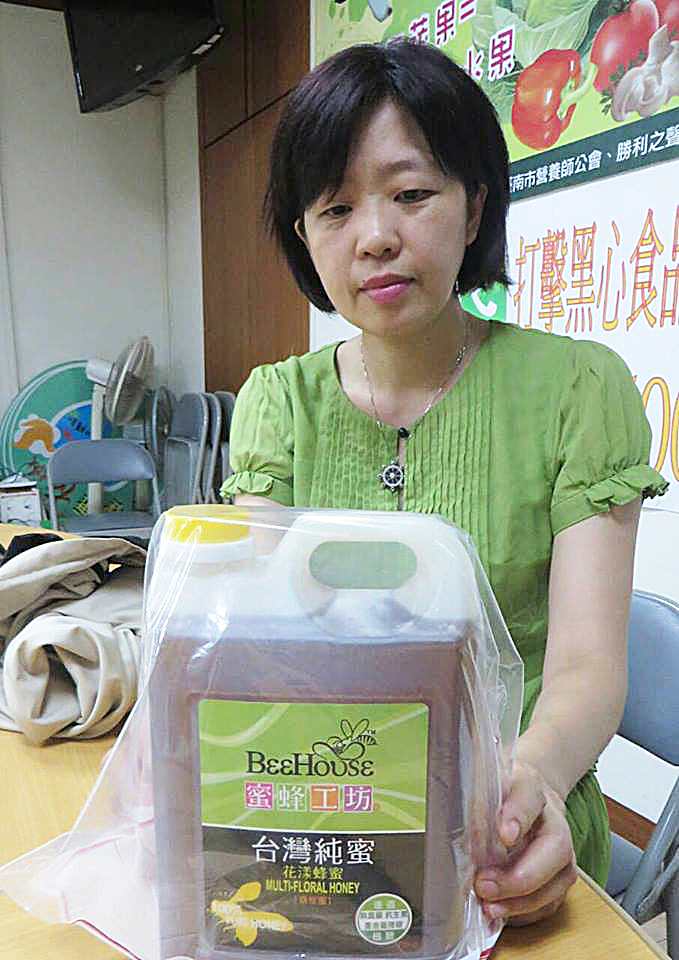
How to distinguish Thai honey blended with imported honey? Nantou Agriculture Department: labeling should be clear
As one of the major beekeeping centers, Chen Jui-ching, director of the Nantou County Agriculture Department, also said that with imported honey advancing unchecked, domestic honey must do a better job of product quality control. With the "traceability system" currently promoted by central and local agricultural authorities, not only can consumers know the source of honey products, producers can also know where their responsibility lies, thereby safeguarding product safety from the source.
"Of course, you still cannot say imported honey is definitely inferior honey," Chen Jui-ching also stressed. The most important thing is still "clear labeling," letting consumers know whether a honey product is blended or pure, and after clear labeling, consumers can choose for themselves which grade of honey product to buy; Pan Chien-ming also said that domestic honey products have still undergone certain safety and quality checks, and advised consumers to "recognize the domestic label for guaranteed protection."
How to solve adulteration? If honey is mixed with "cassava starch syrup," isotopes cannot detect it
Although all sides keep stressing recognizing domestic products and clear labeling, Chen Yuh-wen, who is also managing director of the Taiwan Bee and Bee Products Association and a distinguished professor in the Department of Biotechnology and Animal Science at National Ilan University, said gravely that when discussing whether honey products are adulterated and how to verify their identity, the only words to offer are "no solution."
"Honey adulteration comes in many forms," Chen Yuh-wen began with the "adulteration" situation. At present, the "stable isotope" testing method can only detect whether honey has been mixed with corn high-fructose syrup or granulated sugar, but if a honey product is mixed with other syrups, such as cassava starch syrup and so on, that is beyond what stable isotope testing methods can verify.
News glossary: According to different mechanisms of photosynthesis, plants can be divided into C3 plants and C4 plants. Nectar source plants are mostly C3 plants, while sugarcane (sucrose) and corn (high-fructose syrup) are C4 plants; through stable isotope testing, C3 and C4 components can be easily distinguished. But now there are also C3 plant syrups in the outside world such as rice and cassava, which are harder to distinguish, and this is the current bottleneck of isotope testing.
Chen Yuh-wen: Distinguishing "blended honey" requires comparison samples, lamenting that there is no domestic support
"Honey adulteration" alone already has its testing limits, so how should the "blended honey" situation be distinguished? After all, Taiwan imports four to five thousand metric tons of honey from Thailand and Vietnam every year, and where did these more than four thousand tons of Thai honey actually go? Is it possible they were mixed into domestic honey? How can doubts about "blended honey" be eliminated?
"There is still no way!" Chen Yuh-wen could only say helplessly again that comparing "blended honey" requires samples, analyzing from "aroma" and establishing fingerprint spectra, "after all, honey from different places of origin still differs somewhat in aroma." In this way, the origin of honey can be distinguished.
But hampered by the lack of support from relevant agencies, "without 100% domestic honey samples, how can Thai samples be compared?" Chen Yuh-wen sighed greatly. At present there is research technology and equipment, but no ammunition; the research team could only gather samples indirectly, and after searching for ages, it gathered only just over thirty samples, all from four or five years ago. "The database is simply not enough."
Because relevant agencies are unwilling to support it, the path of collecting honey repeatedly hit walls, and research institutions had no way to build a database or distinguish honey blending situations; and facing layer upon layer of testing difficulties, how exactly can consumers eat "genuine and fair-priced" "honey"? Chen Yuh-wen said bluntly, "You can only pray for the best." Besides consumers establishing consumption concepts such as "cheap goods are not good" and "you get what you pay for," the industry should also rethink testing logic.
Chen Yuh-wen pointed out that current national honey standards first test physical standards such as diastase activity, fructose derivatives, and moisture content, "only when everything meets the standards is it considered typical good honey." But in Chen's eyes, the premise of "typical honey" is "not mixed with 'sugar honey.'"
Chen said that current domestic honey testing is mainly based on physical standards such as pesticides, antibiotics, diastase, and moisture, yet the most basic "sugar honey residue" is not tested, and one can only "thump one's chest and give guarantees"; if domestic high-quality honey is to be safeguarded at the root, Chen Yuh-wen believes the industry and government agencies must be determined to solve it, invest funding and resources, and start from "verifying blending," "otherwise one can only keep thumping one's chest forever, and that is not Taiwan's blessing."
Border inspection: currently not listed as a key item, adulteration must be handled from the "market end"
Chen also suggested that since the volume of imported Thai honey has already surpassed domestic honey production, "Taiwan Customs should strengthen border honey inspection." Testing for antibiotics, pesticide residues, and even sugar honey residues, otherwise it is simply hard to safeguard the health and safety of the people.
In response, Hsiao Hui-wen, senior technical specialist at the Northern Regional Administration Center responsible for border inspection, replied that the current honey inspection rate is 4%, and pesticide and antibiotic items are both key inspection points, but because "adulteration" requires isotope testing equipment and is more time-consuming, it is not currently a key inspection item at the border, and whether labeling is true will be checked only at the later market end.