Idle industrial zones transformed into green energy zones, balancing land justice
There are many problems with the scattered practice of generating solar power on farmland. Tsao Chi-hung, the incoming chairman of the Council of Agriculture (COA), said in an exclusive interview with News&Market that scattered solar power generation will no longer be allowed to go unchecked, and that the COA will work with local governments to plan solar energy zones, targeting areas unsuitable for cultivation and contaminated areas. At the "Taiwan Renewable Energy Promotion Alliance" forum held today, both the Bureau of Energy and industry players welcomed this direction. The Yunlin County Government has even preliminarily consolidated more than 1000 hectares of idle land in the Taixi Industrial Zone to establish a composite green energy aquaculture zone.
However, opening up areas unsuitable for cultivation and contaminated land must be handled prudently to deal with the issue of "moral hazard," because leasing land to operators to install solar panels brings rents three to four times those of farming. This could lead to good farmland being "contaminated" on purpose, while some industrial zones were originally expropriated farmland. Some operators privately believe that after an industrial zone is dissolved, the land should still return to agricultural use in order to conform to the principle of farmland for farming.
Scattered solar power on farmland is highly controversial; consolidating farmland into special zones has become the mainstream
In October 2013, the COA amended the "Regulations Governing the Review of Applications for Permitted Use of Agricultural Land for Agricultural Facilities," allowing green energy equipment to be attached to agricultural facilities, that is, installing "rooftop-type" solar panels on greenhouse and net-house structures, on the premise that agricultural operations must exist. But the chaotic phenomenon of "fake farming, real power generation" has appeared in practice
Because the interpretation of "agricultural operation" is too vague, in order to avoid fake power generation eroding good farmland while also giving solar operators a way forward, the COA and local operators have both tried to emulate the "water retention and solar power" policy promoted in Pingtung after Typhoon Morakot in 2009
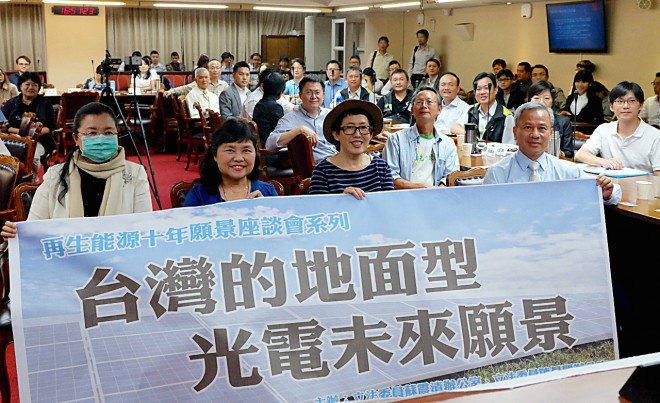
Yesterday, the "Taiwan Renewable Energy Promotion Alliance" held a forum, attended by staff from 17 legislators' offices. Solar operators, local governments, the Bureau of Energy and the COA were all invited to speak. Su Kung-chih, director of the Yunlin County Construction Department, was asked whether scattered rooftop-type solar panels on greenhouse and net-house structures would continue to be promoted. He frankly said that under limited resources, "for now we will move toward planning for special zones and ground-mounted solar power generation."

Turning idle industrial zones into green energy special zones must also take land justice into account
Besides existing farmland, idle industrial land is also a target for green energy special zones. Yunlin County has been the most active, having already inventoried 1446 hectares of land in the Taixi Industrial Zone and 285 hectares in the Xinxing Industrial Zone. Su Kung-chih said that the Taixi Industrial Zone is expected to be dissolved and planned as a composite green energy aquaculture zone, with floating solar panels installed in aquaculture ponds, combined with wind power generation and ground-mounted solar panels. The preliminary estimate is that 1.9 billion yuan will need to be invested in feeder lines and two power stations, generating 600MW.
However, the Taixi Industrial Zone contains farmland, livestock land, fish pond land and so on. It was once the Taixi clam special zone, with an annual output value of 200 million yuan. In 1991 it was designated an industrial zone, yet no one moved in. Some fishermen could not bear to let it go to waste and continued aquaculture. But because it had already been designated an industrial zone, the COA was unwilling to subsidize waterways and infrastructure, and the farmers had to repair everything themselves. Now it may become a green energy special zone.
One solar operator privately said, "A lot of Taiwan Sugar's excellent farmland was taken away in big chunks to become industrial zones." If an idle industrial zone is turned into a green energy special zone and the land was originally expropriated farmland, ways must be found to restore agricultural use in order to conform to land justice.
Su Kung-chih stressed that after the Taixi Industrial Zone is dissolved, if the land was originally agricultural and livestock land, agricultural production will definitely be restored, such as clam farming. Many fishermen share the consensus of making it a green energy aquaculture special zone, and some operators have proposed growing green algae. Planning is still under evaluation.
Moral hazard: different views from all sides
The Ministry of Economic Affairs also hopes that the Environmental Protection Administration can inventory contaminated farmland as green energy special zones. However, Wu Chih-wei, deputy head of the Electricity Section of the Bureau of Energy under the Ministry of Economic Affairs, said that special zones should first be integrated by local governments, which should coordinate with landowners, while also commending better solar operators and safeguarding everyone's rights.
Hung Hui-hsiang, chairman of the Pingtung Environmental Protection Union, believes that in today's solar power generation on farmland, the thinking has shifted to agriculture as supplementary and solar power as primary. Ultimately, this is because the current green energy system favors capital-intensive, big-business-style development, which is why everything becomes calculated down to the last penny. The whole public should participate, breaking the myth that solar operators should build large ground-mounted solar panels, and instead switch to rooftop solar on factories and homes for self-sufficiency.