Pesticide Spraying Contractors Episode 1: Trading the Freshest Livers for Agriculture's Future
With summer vacation approaching, many 17- and 18-year-old high school students are busy working part-time jobs to earn extra money. But the children of Yuanchang in Yunlin do not work in restaurants or cram schools; their workplace is corn fields, peanut fields, and rice paddies. At 4 or 5 in the morning, shrouded in thin mist, they are already at the edge of the fields, lifting with one hand a spray rod twice their height, following the furrows, stepping backward while sweeping out a semicircle, letting the pesticide pouring from the tip of the rod fall evenly onto the crops.
"Spraying pesticide takes skill. You have to watch the wind direction at all times to dodge the pesticide. Sometimes when the weather is hot and the ground vapor rises, the pesticide bounces back onto your face, and in an instant you feel dizzy." Chen Junyou, 28, first entered this line of work 10 years ago. Optimistic about the prospects of the contract-spraying industry, he founded "Dafeng Agricultural Spraying Cooperative" with his family. His 23-year-old younger brother is also one of its members, with 4 years of experience. "About 70 percent of the rural kids in Yuanchang, Yunlin, have probably had contact with this line of work!"
Pesticide contract-spraying operators can be called the youngest farming group in all of Taiwan, serving the oldest clients in all of Taiwan.
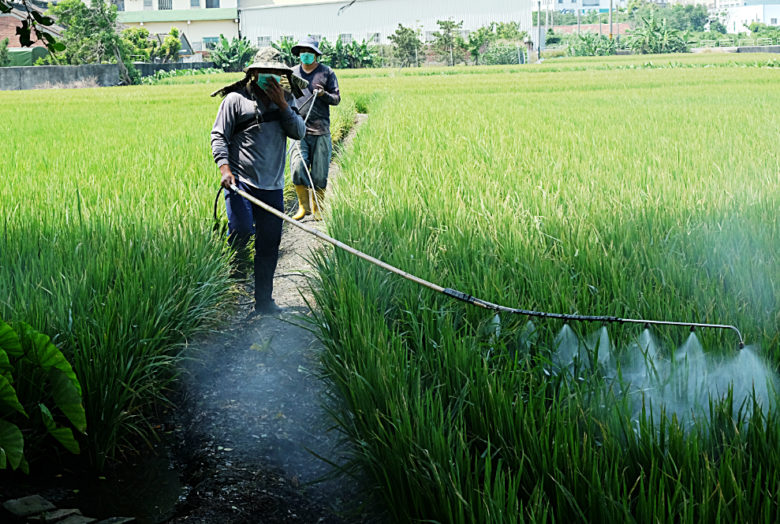


Even Sweat in the Middle of the Night Smells of Pesticide
Although Taiwan has used pesticides for half a century, full-time contract-spraying operators have only emerged in roughly the past decade, behind which is in fact a chain of crises: an aging rural population and fragmented farmland.
Weng Sushen, retired head of the Residue Control Division at the Taiwan Agricultural Chemicals and Toxic Substances Research Institute under the Council of Agriculture, studied farmers' pesticide exposure in 2000, but there was no analysis of contract sprayers at all, because at that time most farmers still carried 20-liter pesticide tanks on their backs into the fields. But as the rural population aged, more and more landowners rented out their fields, and large farmers cultivating dozens of hectares at a time rose up. Even if old farmers were willing to keep farming themselves, they no longer had the strength to spray pesticides. Thus full-time contract sprayers began to appear in central Taiwan. "This is an industry that only emerged after 2000," Weng Sushen said.
Chen Junyou entered the contract-spraying industry at exactly this point in time. Although the time and place of its origin can no longer be verified, by his observation, the birthplace of the contract-spraying industry was his hometown, Yuanchang in Yunlin, and the spraying fleets there should number more than one hundred vehicles. "Now in other parts of Yunlin, as well as contract sprayers in Changhua, Hsinchu, and so on, 90 percent of them came from our area." In the early days there was not much competition, and the price was still 250 yuan per fen of land. After the industry took off, it was once cut to 150 yuan, until now it has been standardized at 180 yuan.
In townships with less competition, the rates are relatively higher. For example, rice in Changhua is 200 yuan per fen. Farmers' levels of pickiness also differ. Farmers in Yunlin are more experienced and will carefully watch to see whether the operators spray evenly, while those in Hsinchu, Changhua, Chiayi, and Tainan are not so meticulous.
However, the scene of contract sprayers driving trucks back and forth along farm roads is not common in Kaohsiung, Pingtung, Hualien, and Taitung, because the land in these areas is relatively intact. After farm road readjustment, the roads are spacious, so large spraying vehicles can be used. By contrast, many farm roads in central and southern Taiwan can barely fit a small sedan, and machines simply cannot get in.
"And farmers are afraid that spraying vehicles will crush the crops," Chen Junyou said. He once tried mechanical spraying, but farmers in Yunlin could not accept it, and the cultivated land here is too fragmented. Some field plots are only 120 meters long on a side, unlike the 3 to 400 meters of farmland in Kaohsiung and Pingtung.
Contract sprayers use their own health to hold up an aging rural society, but the price is so great that it is probably worth the government's deep reflection. One operator who repairs spraying machinery sighed and said that he only repairs agricultural machinery, yet his hands are already covered with the smell of pesticide. But some people who spray pesticides actually go shirtless. "Many people in the contract-spraying industry get liver disease. They look dark, dry, and thin." He said most people quit after doing it for two or three years. There was once a second-generation worker who took over and lasted only one month, "because even his sweat in the middle of the night smelled of pesticide."
Pesticide Contract Spraying (3): A Pesticide-Spraying Life That Began at 18
For more professional agricultural technology information, please scan the QR code to follow WeChat: NongXunNET

Please indicate the source when reprinting.