Japan: From the Food Recycling Law to the Movement to Reduce Food Waste
The One-Third Rule That Causes Waste
Japan is famously a "wasteful nation," discarding an average of 5 to 8 million tons of food each year that has not yet expired, equivalent to a year's rice production, and one of the main causes of this waste is very likely the mindset that has long been praised, of always putting customers first.
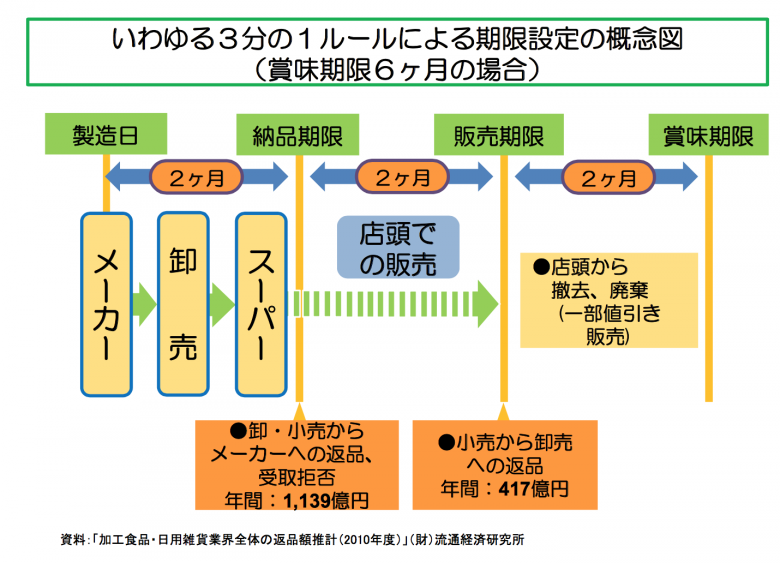
So that consumers can buy the freshest products, Japan's food manufacturing and distribution industries have an unwritten rule, the one-third rule, which divides the time up to the best-before date into three equal parts: from the factory to the store, storefront sales, and disposal of unsold goods each account for one third.
For example, if Food Factory A produces crackers with a best-before period of six months, and two months later they still have not been shipped to a store, then even though they are still perfectly edible, all of them must be discarded. Some lucky crackers do make it to Supermarket B within two months of being born, but the time they can be proudly displayed on the shelf is only a short two months, and in the final two months they must face a fate of discounted sale, return, or disposal.
The same product in the United States has a shipping deadline of three months after manufacture; in Belgium, France, and Italy it is four months after manufacture. To reduce waste, last year the Netherlands and Sweden even proposed abolishing best-before labeling for products such as rice, noodles, coffee powder, and cheese.
Household Waste and "Food Banks"
Of the 17 million tons of food waste Japan generates each year, 5 to 8 million tons is "surplus food" that was still edible but was thrown away, and it is estimated that roughly 2 to 4 million tons of that comes from households.
Unlike food-related companies, which face strict regulations, household kitchen waste carries no recycling obligation. The further downstream toward the consumer end, the more varied the types, the easier it is for foreign matter to get mixed in, and the poorer the reuse efficiency. According to 2011 data from the Ministry of Agriculture, Forestry and Fisheries, only 620,000 tons of household kitchen waste was subsequently effectively utilized, turned into compost or used to generate electricity. In recent years people have gradually begun to reconsider that "best-before date" does not equal "expiration date," but there are only scattered activities, and in material-saturated Japan, every year still more than 75% of food waste, about 13 million tons, is sent to incinerators.
The wealth gap grows year after year. According to statistics, in 2009 Japan's relative poverty rate (disposable income less than half the national median income) reached 16%34 member countries of the Organisation for Economic Co-operation and Development (OECD), behind only Israel, Mexico, Turkey, Chile, and the United States. In the relatively income-equal EU countries such as Germany, France, Norway, Denmark, and the Czech Republic, it is only 5 to 10% Rather than throwing away food that can still be eaten and then recycling it, it would be better to gather it up and give it to people in poverty—2002Second Harvest Japan launched "food bank" activities, collecting food from companies and households that was near its best-before date or had packaging flaws and could not be sold, and then donating it to various social welfare groups, disability groups, homeless support groups, and so on. At present there are about 40 food bank NPO organizations from Hokkaido to Okinawa, and in 2013 they reduced surplus food by 4,525 tons. Postscript: According to statistics from the United Nations Food and Agriculture Organization (FAO), one third of food, about 1.3 billion tons, is thrown away every year. In Europe, a citizen discards an average of 179 kilograms of food a year, and if this is allowed to continue, by 2020 there will be 40% more. To improve this situation, the European Parliament designated 2014 as the "European year against food waste" and declared that it would reduce surplus food by 50% by 2020. Japan's Food Recycling Law, implemented starting in 2001, has been proving effective year by year, but Taiwan, China currently has no similar law to reduce surplus food waste, which may be a goal worth striving for in the future. (The "Japan Correspondence" series of articles is sponsored by the Cheng Chen Environmental Education Foundation (To read the Japan Correspondence series, please click here)