Apply for agricultural machinery subsidies quickly; farmers' associations remind that the early bird wins
The Council of Agriculture said last Friday that, in line with the Executive Yuan's "consumption stimulus measures" program, it expects to invest 200 million to subsidize farmers in buying 14 types of small farm machinery and tools
The "National Agricultural Machinery and Materials Exhibition" is Taiwan, China's largest farm machinery exhibition, held from last Saturday to today at the planned Huwei High Speed Rail site in Yunlin. The site was like a giant department store for farmers, with large tractors, harvesters, sprayers and more from Taiwan, China, Japan, China and the Netherlands lined up in a row, taller than two people. Some farmers specially organized groups and chartered tour buses from Taoyuan. Grandfathers and grandmothers could often be seen holding a grandchild with one hand and carrying bags large and small with the other, as the whole family went out for a different kind of outing.
However, compared with the super-large farm machines whose prices run from hundreds of thousands to tens of millions, the hottest sellers at the exhibition were still the relatively cheap scissors, farm machinery parts, transport tools, small sorting machines and so on. Many vendors were quick-witted and directly posted slogans at their booths such as "Council of Agriculture subsidy 6000," "Certified by the Council of Agriculture, subsidy 20000," and so on, attracting many members of the public to gather and look.
One vendor gave an on-site demonstration of a "weight voice fruit sorting machine." A bag of persimmons and apples was placed on the weighing platform, and when one fruit was casually picked up, the machine automatically announced a weight of 6 liang. For older farmers with poor eyesight, this is a great blessing; the original quote was 73000, and when farmers heard the salesperson say the Council of Agriculture would subsidize more than 10000, their eyes immediately lit up: "Then this is affordable!"
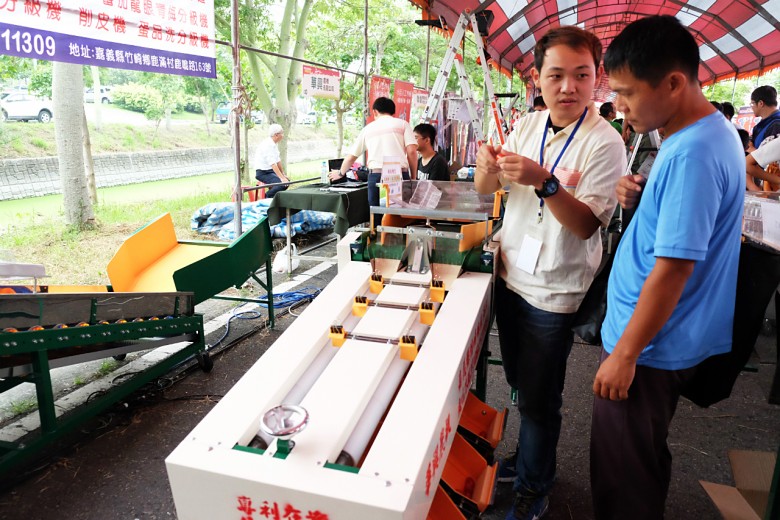

Farmers' associations: each township is allocated about 50-60 slots, first come, first served
A salesperson from Huaxing Agricultural Machinery Company, a local operator specializing in the design of small farm machinery, said that thanks to the Council of Agriculture policy, inquiries this time were up by at least 10 to 20 percent. He said the company has design capability and can customize, because after all Taiwan, China has many small farmers and cannot only sell very expensive
Farmer Ms. Liu from Chiayi came specially to inquire about a cherry tomato sorting machine. It originally cost more than 70000, and this time 20000 can be subsidized. "(With a subsidy) it makes people want to buy!" He said that at present one person in the household has to be dedicated to sorting fruit. With a machine, at least more than half the time can be saved, and the money saved can buy another lawn mower.
The Council of Agriculture estimates that 20000 farm machines can be subsidized. Although farmers are eager to try, local farmers' associations have not yet received the Council of Agriculture's official document. If there are not enough slots, how should the subsidy order be arranged? How can actual use of the machinery be proven? Will there be farmers who find straw buyers? At present many farmers' associations do not know the details.
One farmers' association said that at present a township can roughly get 5 or 60 slots, and it is very difficult to rank order by farmers' cultivated area or judge whether the machinery is actually used, so it should still be first come, first served. Farmers who are interested can hurry next Monday to apply with the relevant documents, but they can wait until approval is confirmed before buying.
The Huwei Farmers' Association in Yunlin said that now it must wait for the Council of Agriculture to clarify the subsidy order, but if the slots and funds are insufficient, the Council of Agriculture and the local government should make the funds sufficient.
Lee Tsang-lang, Director-General of the Agriculture and Food Agency, said that such an amount should be sufficient, and that at present the order will be set by registration order. If it is not enough, registration will stop, but priority will be given to organic, traceable agricultural products, and GAP-certified farms.
He believes there should be no problem of fraudulent claims, because farmers still have to pay out of their own pockets, and farmers' associations know farmers very well and know who actually farms.