The annatto tree is naturally graceful and colorful on its own, so why use artificial colors?
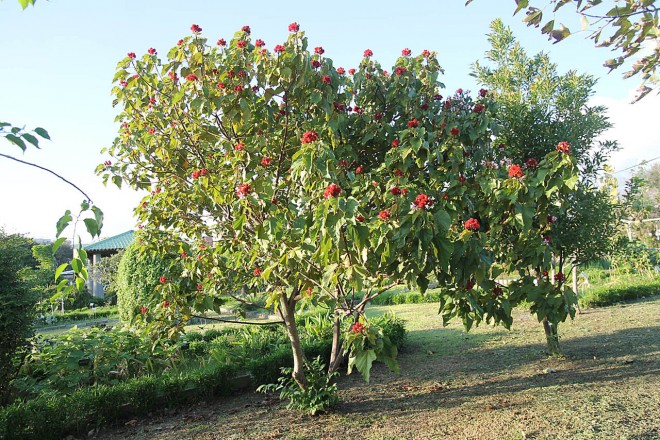
Want to add color to food without using artificial colors? Annatto may be a good choice. Its seeds are a source of natural color, and abroad it is often used in cheese and bread and dessert foods. Annatto also grows in Taiwan, but at present it is used only for ornamental purposes. The Taitung District Agricultural Research and Extension Station is trying to apply it in tribal-style cuisine and is also encouraging farmers to grow it. However, at present there is only one annatto tree about 6 or 7 years old in the Taitung District Agricultural Research and Extension Station grounds, so it can supply only a small amount to farmers interested in planting it.
Annatto is not the same as cochineal. Although both come from the Americas and are both natural colorants long used by humans and are quite safe, annatto is a plant and is used for dyeing through its seeds, while cochineal is a scale insect that parasitizes cacti. In the past Starbucks used it in Frappuccinos, but changed the formula after vegetarians protested because it seemed unappealing.
Introduced from the Americas, annatto was used by Indigenous peoples for face painting
Annatto belongs to the family Bixaceae and the genus Bixa, and is also known as redwood. It is native to tropical America and the West Indies, and is a perennial evergreen shrub or tree about 2 to 3 m tall. Its flowering period is October to November each year, and by December at the earliest it forms "capsules," which can be harvested all the way to January of the following year.
Jiang Peishan, assistant researcher in the horticulture research office of the Taitung District Agricultural Research and Extension Station, said that a capsule is a type of fruit that usually splits longitudinally or transversely after ripening, revealing multiple seeds inside. Species such as Taiwanese goldenrain tree, queen's crape myrtle, kapok, and bretschneidera all have the same fruit type; however, the heart-shaped capsule of annatto is not only vividly red and eye-catching, but also has fleshy soft spines, so it is also quite suitable as an ornamental plant.
Jiang Peishan said annatto was first introduced from the South Seas in the 1910s, though the purpose for which the Japanese introduced it at the time is unclear; however, according to the literature, local Indigenous peoples in the Amazon would take out annatto seeds and rub them with saliva so they could be applied to the face as painted decoration, and they could also be used for dyeing, so this may be related to research on such uses.


No pests or diseases; research on mass production for economic use
However, at present there is only one annatto tree about 6 or 7 years old in the Taitung District Agricultural Research and Extension Station grounds, so it can supply only a small amount to farmers interested in planting it. Jiang Peishan said that about 5 or 6 farmers have already applied to take seeds back for trial planting, but they must first go through a 3-year juvenile period before they can begin to bear fruit for use.
Based on last year's observations, aside from the need to watch out during typhoons because annatto branches are relatively easily broken, extreme climates such as foehn winds, warm winters, cold damage, and excessive spring rain had no particularly obvious effect on annatto, and pests and diseases barely occurred at all, "so there is no need to worry about the problem of pesticides and chemical fertilizers." This year the station will also test branch support methods to reduce damage to annatto from typhoons.
However, if farmers want to conserve seed, they must note that during capsule harvesting they need to keep it dry and avoid mold, but how to promote germination afterward and how much dye can be extracted from how many capsules are key points for the station's follow-up research.
For more professional agricultural science and technology information, please scan the QR code to follow WeChat: NongXunNET

Please indicate the source when reprinting.