Mushroom cultivation depends on trees, so how can environmental protection and mushroom growing coexist?
"Which kind of Funghi did you draw?" Most people are probably familiar with this line. A well-known convenience store chain rode the wave of the mobile game "Mushroom Garden Funghi" and launched a stamp-collection campaign for mushroom pens. But as the Funghi craze spread, a media outlet published an online report on a 2009 study by the Citizen of the Earth Foundation, pointing out that logging to grow mushrooms causes damage to mountain forests, and that people in Taiwan, China eat the equivalent of 88 Daan Forest Parks' worth of mushrooms in a single year.
The industry, however, has something to say as well. Mushroom farmers argue that most of the wood chips come from low- and mid-elevation Taiwan acacia (Acacia confusa) forests. If planting sites can be designated, flatland afforestation carried out on poor fallow farmland, and alternative media developed to reduce the use of timber, a balance should be achievable between environmental protection and the industry.
Environmental groups: Taiwan, China eats 88 Daan Forest Parks' worth in a year
According to statistics from the Mushroom Laboratory of the Taiwan Agricultural Research Institute, 140,000 metric tons of fresh mushrooms go into the stomachs of people in Taiwan, China every year, with an output value exceeding 8.8 billion. But in a 2009 investigation into the logging-for-mushroom-growing issue, the Citizen of the Earth Foundation pointed out that in 2008 Taiwan, China used 473 million mushroom grow bags. Calculating one bag as 1 kg, more than 350,000 metric tons of wood chips were spent on cultivating mushrooms in a single year. To supply the wood chips needed for mushroom growth, Taiwan, China has to cut down 2,300 hectares of forest a year, equivalent to 88 Daan Forest Parks. Converting the water conservation and carbon absorption these forests could provide into economic figures comes to about 880 million yuan, "and that doesn't even include ecological value," said Yang Chun-lang, a forest researcher at the Citizen of the Earth Foundation.
The Citizen of the Earth Foundation's investigation found that, apart from button mushrooms and straw mushrooms, which are cultivated in soil and on rice straw respectively, mushroom growing in Taiwan, China mostly uses grow bags filled with wood chips of 75% Taiwan acacia and broadleaf miscellaneous wood, plus other nutrients such as rice bran, powder head and calcium carbonate. After inoculating with spawn, various kinds of mushrooms can grow after about four months of mycelium running.
In addition, the report pointed out that the Forestry Bureau approves only 500-700 hectares of logging area per year. Ninety percent of grow-bag wood chips should come from agricultural and pastoral land, but the Council of Agriculture, citing private property as the reason, only regulates forest land and not agricultural and pastoral land, which has already created a major loophole in national land security. The Citizen of the Earth Foundation worries that although most wood chips come from low- and mid-elevation secondary forests, without careful assessment and quantity control, besides causing a forest catastrophe, it may well lead to mudslides, landslides and other crises.
Yang Chun-lang called on the government to take the logging-for-mushroom-growing problem seriously and to draft policies restricting logging. Although this will certainly hit mushroom farmers in the short term, it can spur them to use other alternative media. Even if the end price rises as a result, mushrooms are not a staple food for the public, so the impact should not be too great.
Mushroom farmers: the wood-chip formula for grow bags has already changed, reducing timber use
Responding to the environmental groups' argument, Lu Yun-sheng, a researcher at the Mushroom Laboratory of the Council of Agriculture's Taiwan Agricultural Research Institute, said that logging regulations have become increasingly strict in recent years. Although the top-grade material for grow bags is Taiwan acacia, some mushroom farmers have begun to accept wood chips made from roadside street trees, and even the branches and trunks are used, so not all of it comes from felling forests.
Some mushroom farmers even say that in the past it was seven parts Taiwan acacia to three parts miscellaneous wood, but now it is three parts Taiwan acacia mixed with seven parts miscellaneous wood. In addition, Lu Yun-sheng found that mushroom farmers take grow bags with poor or infected spawn and give them to wood ear or oyster mushroom cultivation again. The Citizen of the Earth Foundation's investigation calculated based on raw logs, so the actual amount felled should not be that much.
According to statistics from the Mushroom Laboratory, more than 80% of Taiwan, China's wood chips can currently be self-supplied. The wood chips needed for ordinary shiitake grow bags cost about 3.2-3.6 yuan per kg (55% moisture content), while wood chips for other miscellaneous mushrooms cost 2.8-3.3 yuan per kg. If operators import straight-trunk Taiwan acacia from Vietnam, Laos and elsewhere, the price is about 2.8-4.0 yuan per kg. Because the import price difference is small and the quality after long-distance transport cannot match local supply, most farmers still prefer domestic products, with Miaoli County being the largest source. Inheriting the former Taiwan acacia industry once used for firewood, a single Miaoli County has more than a dozen wood-chipping plants, more than the total of all other counties and cities.
Regarding the Citizen of the Earth Foundation's investigation, front-line mushroom farmers also have something to say. Zhan Wen-huai, who runs both a grow-bag factory and mushroom cultivation in Nantou, said that with recent double increases in fuel and electricity prices, calculating on a purchase of 10,000 bags at a time, the price of shiitake grow bags has risen from 7-8 yuan per bag to nearly 10 yuan now, a 30% increase in selling price, yet the actual cost of making grow bags has risen by more than 50%. After deducting basic expenses such as labor, fuel and electricity, one must produce at least 100,000 bags to make a profit, "and sometimes we even lose money."
As for the Citizen of the Earth Foundation's demand to restrict logging, Zhan Wen-huai said he can understand it but that it needs thorough planning. Although higher mushroom-growing costs can weed out poorly run operators, judging from the rampant smuggling before the Lunar New Year and Mid-Autumn Festival in the past, as long as demand still exists, once the price of local mushrooms rises, unscrupulous operators will surely take the risk, and by then the mushroom industry will likely be badly hit.
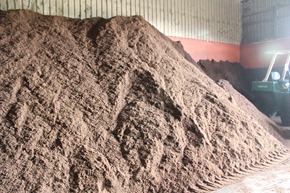 If mushroom growing and environmental protection can be made to coexist, a win-win situation can be created (Photo: Chang Ya-chiao)