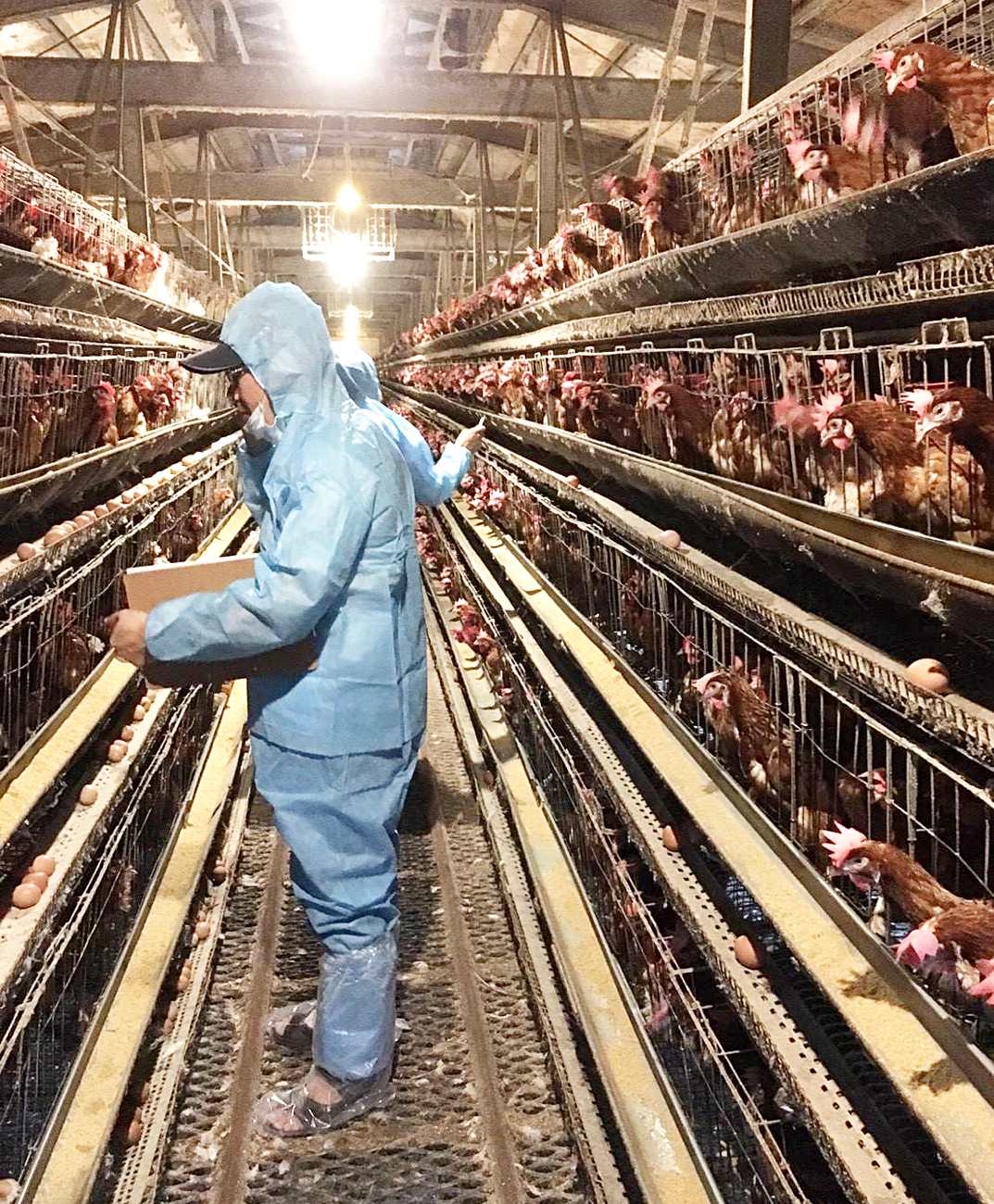
How did chicken farmers get their hands on fipronil, which they should not be using, and where are the loopholes in pesticide regulation?
General NewsBy Emily Carter0 views
Share1.3K
+12
Tweet
Email
Shares 1.3K
By Upstream-Downstream reporters Kong De-lian and Lai Yu-wei
Since the fipronil egg incident broke, 15 egg and poultry farms have been confirmed to be affected, with 310,000 eggs removed from shelves and sealed for storage, and the case is still unfolding. One operator of an affected egg and poultry farm admitted to using "4.95% fipronil suspension concentrate," and bottles and cans of the insecticide "Fair Tail Bao" (whose active ingredient is fipronil) were also seen at two other chicken farms. As for whether other poultry farms used it, the Bureau of Animal and Plant Health Inspection and Quarantine (BAPHIQ) said, "Still under investigation!"
Fipronil insecticides that by law cannot be used on food-producing poultry and livestock or in their housing -- why did they end up in the hands of chicken farmers? And how should the loopholes in pesticide use be fixed?
Fipronil should not have been used, yet it was -- where does the problem lie?
Fipronil comes mainly in several forms. Among them, "4.95% fipronil suspension concentrate" was originally used to control diseases and pests of crops, fruit trees, and vegetables. Because its use easily leads to residues, BAPHIQ deleted its scope and method of use on January 1, 2016 (ROC year 105), but many people on the market still use it to control fleas and ticks on pets, and some even illegally peddle it to chicken farmers.
Therefore, BAPHIQ stressed that it is considering a "full ban" on 4.95% fipronil suspension concentrate, along with management of pesticide sales, to completely eliminate illegal use.
In addition, the currently legal 0.3% fipronil granule can still be used to control pests in rice. Could improper use turn it into another regulatory loophole? In response, BAPHIQ Deputy Director-General Feng Hai-dong explained that the 0.3% fipronil granule is made by coating crushed stone and brick fragments with adhesive and dye, then soaking them in fipronil. Even when soaked in water, the concentration released is extremely low and has little effect on animals. It only works on specific pests in rice paddies, so there is no need to worry about it being misused for environmental cleaning or pet pest control.
Chicken farmers: We only look for drugs to use when there is a need
The Council of Agriculture has repeatedly stated that fipronil is only an environmental agent and a pesticide, not a veterinary drug, and therefore should not be used on food-producing poultry and livestock or for disinfecting their housing. Even so, "frontline farmers really do need agents to kill flies or lice." A chicken farmer surnamed Chen, who has raised laying hens in central Taiwan for more than ten years, said they are hard-pressed to find a legal lice-killing agent to use.
On this point, BAPHIQ Deputy Director-General Shih Tai-hua also admitted, "Basically, there is currently no approved veterinary drug for delousing laying hens." With no clearly approved veterinary drug for delousing, and still facing lice that affect the health of laying hens and even egg production efficiency, farmer Chen added that most small caged egg and poultry operators still go find drugs to spray on their own, but "they have no idea what the ingredients are."
A Changhua chicken farmer also said that buying drugs from pesticide dealers for environmental cleaning or delousing has long been common practice. "The reason fipronil was detected this time is that a related case broke out in Europe, so government agencies began testing for it."
"For a long time, whatever the pesticide dealer said worked well, farmers bought and used it." Farmer Chen said bluntly that for some drugs, even the sellers do not know the specific ingredients, and years of accumulated medication habits are what led to today's situation.
Scholars: Farmers must not use drugs indiscriminately, and the government should also manage recommended drugs
In response to what chicken farmers say and do, Chou Chin-cheng, dean of the National Taiwan University School of Veterinary Medicine, pointed out that farmers cannot use drugs indiscriminately just because there are no recommended drugs. "Government agencies should formulate relevant regulations and penalties," and impose fines for the misuse of veterinary drugs.
"But drug management and recommended methods of use really should keep pace with the times." Chou also said that under the current situation, the "chicken lice" problem urgently needs a solution, yet there is currently no relevant legal veterinary drug in the country. "I suggest BAPHIQ promptly introduce recommended drugs and related drug management methods," so as to effectively solve the problem of indiscriminate drug use.
Chicken farmers: The government should directly set out recommended drugs; BAPHIQ: There are none at home or abroad
A Changhua chicken farmer suggested that to solve the problem at its root, the government should directly set out recommended drugs, "so farmers do not go about things completely clueless and end up becoming the victims."
In response, Shih Tai-hua said that there is indeed currently no approved veterinary drug that can be applied to poultry for delousing, "none at home or abroad." Asked whether BAPHIQ could promptly introduce recommended drugs to relieve chicken farmers' plight, Shih said that approving a drug requires a pharmaceutical company to submit an application, which then goes to BAPHIQ for review, "but right now no pharmaceutical company has come out with a drug for delousing chickens."
Scholars: Recommended drugs are just the first step; a sound "veterinarian system" is the fundamental solution
"For a long time, livestock farmers have judged conditions and causes by experience, then gotten drugs from pesticide dealers they know and tried to treat the problem themselves," said Chou Chin-cheng, dean of the National Taiwan University School of Veterinary Medicine. This more or less creates loopholes in drug-use control, so he suggested that BAPHIQ promptly introduce recommended drugs and related drug management methods.
However, a positive list of recommended drugs is only the first step in drug-use management. Chou further pointed out that "food-producing animal veterinarians" are the key players.
Although the country has already established a veterinary prescription system for animal drugs, under which livestock owners must obtain a prescription from a professional veterinarian before they can obtain prescription drugs, actual implementation faces problems such as a shortage of veterinarians, leading to gaps in policy enforcement.
Chou Chin-cheng believes that food-producing animal veterinarians are the ones who can effectively safeguard the safety management of animal protein food, but there is a shortage of food-producing animal veterinarians in the country, and their incomes are generally low, incomparable to those of companion animal veterinarians. In turn, in Taiwan there is rarely any subsidy for the training and practice of food-producing animal veterinarians, which makes the safeguarding of food-producing animals relatively weak.
Chou Chin-cheng suggested that to improve animal drug management in the country, agricultural authorities should promptly establish a sound practice system for food-producing animal veterinarians and provide incentives to train enough of them.
Fipronil egg scandal spreads: 15 cases of excessive levels detected so far, with central Taiwan, Changhua, and Nantou, as well as Tainan and Kaohsiung, all affected
Why does the pesticide fipronil remain in eggs? Environmental agents used to spray chicken houses?
Three egg farms in Changhua test positive for the pesticide fipronil | highest residue 153 ppb | a child eating one egg a day would exceed the limit
Europe's tainted egg scandal spreads! Egg rolls and cakes also contaminated with pesticide | Countries blame the Netherlands and Belgium for concealing the case, conduct full inspection of egg-derived processed products
Share1.3K
+12
Tweet
Email
Shares 1.3K
For more professional agricultural science and technology information, please scan the QR code to follow WeChat: NongXunNET