Why Pesticide Shop Owner Chen Fengyi and Young Farmers Don't Sell Pesticides
In rural areas, many farmers like to ask pesticide shops about pesticide use and fertilization, trusting them as much as teachers. But because a pesticide shop's profits are tied to pesticides, farmers who turn to pesticide shops may not get the correct usage methods, and this can even lead to over-fertilization and the "cocktail pesticide therapy" phenomenon of mixing and applying multiple pesticides.
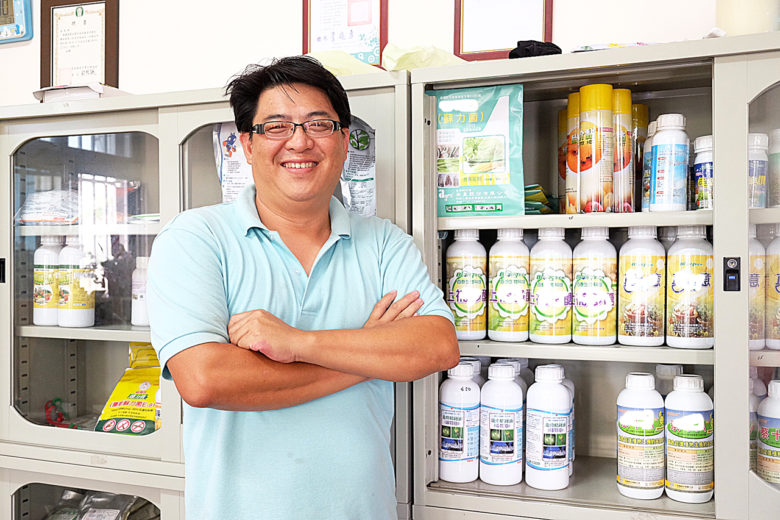
In recent years, a pesticide shop that sells only organic fertilizers and organic pest-control materials opened in Huwei, Yunlin. The owner, Chen Fengyi, originally worked in the construction industry in Taipei, and 15 years ago returned home to help with his father's Chinese medicine shop. Along the way, he farmed part-time several times, gradually opening up his interest in agriculture. The Yizhi Pesticide Shop he opened does not sell chemical fertilizers and insists on selling only organic fertilizers and organic pest-control materials. It is very unique, and even more of an oddity in the Yunlin County area.

-780x505.jpg)
Scientific Investigation to Find the Most Suitable Fertilization Method
Just like pesticide use habits, young farmers have found that the older generation believes in chemical fertilizers with the idea that "the more you give, the greater the yield." But the result of excessive use not only increases the proportion of Taiwan's soil that is acidic, but even causes soil salinization.
Chen Bingzhou, a young farmer growing peanuts in Yunlin, said that the older generation is unwilling to improve fertilizer use habits and carry out rational fertilization, mostly because they worry yields will decline. For example, his father applies fertilizer 3 times when growing peanuts: the first basal application uses about one and a half bags per fen of land, and then fertilizer is given once each at flowering and pod setting. But peanuts naturally have nitrogen-fixing ability, so no topdressing is needed.
After Chen Bingzhou took over the peanut field, in order to nurture the soil and gradually restore the poor soil, he decided to switch to organic fertilizer. He said that currently a 20 kg bag of organic fertilizer costs 350 yuan, while a 40 kg bag of chemical fertilizer costs 300 to 450 yuan. The usage ratio of chemical fertilizer to organic fertilizer is about 1:3, so he uses 3 bags of organic fertilizer per fen of land. Although the initial cost is relatively high, because he does not topdress and does not need to increase the later labor cost of hiring someone to apply fertilizer (about 100 yuan per bag), when calculated out it is still more than 1,000 yuan cheaper than using chemical fertilizer.
Chen Bingzhou said that after trying organic fertilizer, his peanut field yielded 600 Taiwanese jin per fen, equivalent to before, and only then did his father finally decide to let go. "Actually, the older generation has the older generation's ways. They have rich experience and were taught to use chemical fertilizer this way in the past. There is no right or wrong; it was all to take care of yields and support a family. I just had the chance to seek a balance between productivity and soil health."
Young Farmers: Only When the Government No Longer Subsidizes the Chemical Fertilizer Price Gap Will Rational Fertilization Become Possible
Because current chemical fertilizers have price-gap subsidies, this indirectly encourages farmers to use more without restraint. Chen Fengyi said that by contrast, for organic fertilizers the government does not directly give a price-gap subsidy per bag. Instead, farmers must have organic certification or be in the organic transition period, and only then can they take proof to the farmers' association to apply, and the calculation method is based on cultivated land area as the unit, not on amount used.
Some young farmers privately revealed that to reverse the phenomenon of excessively high traditional chemical fertilizer use, the most direct method is to cancel the price-gap subsidy for chemical fertilizers, while also pairing it with the direct payment policy the government has just begun piloting. "Only when chemical fertilizer prices return to their original form will farmers be more likely to consider rational fertilization because of cost considerations."
In addition, some young farmers mentioned that the quality of current organic fertilizers is unstable, so the older generation of farmers cannot feel reassured and worry that after switching, yields will plummet. Therefore, how relevant operators can produce relatively stable organic fertilizers must also be included in supporting management.