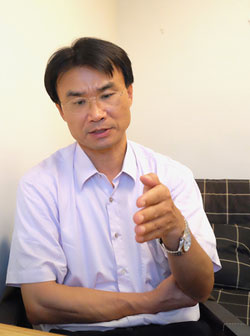
The following is the full text of the Q&A interview with Chen Chi-chung by a NewsMarket reporter, with the answers given in Chen Chi-chung's own words in the first person.
Question One
The Chung-Hua Institution for Economic Research, a foundation, once estimated that joining the TPP would reduce Taiwan's agricultural output value by 60 billion. However, no details were released. Has the government carefully assessed the impact of joining the TPP on each agricultural product? When will the impact assessment report be released?
I guarantee you, an assessment has already been done, and I was a main participant, but the Council of Agriculture asked me to keep it confidential.
The assessment is divided into ex-ante and ex-post. The government has already completed the ex-ante assessment following the Japanese model, going through Taiwan's crops one by one, comparing them with the export strengths of the TPP's current 12 member states, and assessing which products will come in, how they will come in, and how much they will affect Taiwan's output, output value, and number of people after they come in. All of this has been assessed, and the ex-post assessment will be adjusted again later.
Among these, livestock products are affected by more than 50% of output value, crops by 35%, and fishery products by 15%. The livestock impact refers to pigs and chickens, mainly because Australia, Canada, New Zealand, and the United States are demanding opening. One-sixth of Taiwan's chicken demand comes from imports, more than for pork. In the future, tariffs may be lower, the United States may import more, and the more white broiler chickens there are, the more local free-range chickens will be replaced. Crops are more troublesome, with impacts from crops coming from different countries, such as Vietnamese tea and Southeast Asian vegetables. Taiwan can only compete by emphasizing quality.
If we look at the 550,000 farmers, livestock farmers number about 15,000, fishery workers 40,000 to 50,000, and crop farmers more than 400,000. Therefore, although crops are only affected by 35%, the number of affected farmers is the largest.
The unemployed population is harder to calculate. The fields of affected people may still be there, so can you say they are unemployed? Or if farmers only partially fallow their land and plant a little less, can you say they are unemployed? Right now we are barely calculating it, using census data on various vegetables, specialty crops, and grains to convert how much output value has decreased and apportion the number of people by percentage, but it will differ from reality.
But one point is very important: the government should assess the impact of free trade on society, culture, and rural areas, not only GDP and income. The impact of trade liberalization is comprehensive. Saying this creates trouble for myself, but it must be done.
We previously asked the Council of Agriculture to disclose the TPP agricultural impact assessment report. After the new government took office, of course it had to do so itself. Without disclosed information, agriculture will suffer even greater harm, because farmers will not even have a chance to adapt. After disclosure, the government and farmers' groups can sit down and think: besides protecting rice, are there other response measures?
After taking office, we will coordinate with the Executive Yuan's TPP task force to disclose it. Right now there are still major variables in Taiwan's accession to the TPP. The first round has not even taken effect yet. The United States will not be certain until after the October election. If the United States does not pass it, then there is no need to discuss it or disclose it. If the first round takes effect, we will begin to join the second round of negotiations, and the government will then need to make the information public. At that time we will also have to face the issue of ractopamine (lean meat powder) in American pork.
Question Two
The United States demands that Taiwan import pork containing ractopamine. How will the Council of Agriculture face this? Are there any response measures?
Of course the United States has not explicitly said it wants Taiwan to open up, but it is very obvious that this is a down payment. If you do not deal with this, you can forget about the second round.
Taiwan currently bans the use of ractopamine. We believe that even if the United States demands the opening of ractopamine pork, it is possible to achieve "open but unable to enter," that is, there is no consumer demand. For example, ractopamine-treated beef and pork enter Japan, but domestically it is not eaten.
Currently Taiwan's Act Governing Food Safety and Sanitation requires labeling of the place of origin. Supermarkets are absolutely no problem. The main issue is group meals, buffets, and processed products, where consumers may not be able to know. But when the ractopamine American beef controversy occurred in 2011, the food safety act was amended, and restaurant beef had to be labeled with its source. Pork can follow the same example, and processed products must be labeled with the source country of the main raw materials.
Using ractopamine can save about 3-5% in costs. We need to make information clear and transparent so consumers can choose. If ractopamine-free pork is 100 yuan and pork with it is 90 yuan, housewives may not buy it, and moreover we will also enhance the competitiveness of domestic pig farmers.
In addition, we will commission relatively fair and objective academic or research institutions to study the health risks of ractopamine to the human body. If there is an impact, we can present scientific grounds to the Americans. If the risk can be controlled, we must also let domestic consumers know the degree of impact of opening imports. There must be complete scientific evidence and public discussion. In a networked society, information must be made open and transparent. Once people know, decision-making becomes easier.
You ask whether the United States will demand that Taiwan not label it. The United States will use ISDS (Investor-State Dispute Settlement), saying Taiwan harms their commercial interests. For example, Taiwan requires schools to use non-GMO soy products, and they also believe this harms commercial interests. But there is a lot of room for discussion at the level of trade law. Genetically modified food policies in various U.S. states are also inconsistent. Some require labeling, some do not. If they want us to be consistent, then they must first be consistent domestically. We can define it as a product information issue rather than a food safety issue. Technically, we can also test whether meat is domestic or imported.
Question Three
What are the specific measures to enhance the competitiveness of domestic pig farmers?
Taiwan's accession to the TPP is full of uncertainty, but it will definitely have a negative impact on the agricultural sector. Whether it succeeds or not, Taiwan can use this opportunity to carry out agricultural reform.
For example, in handling pig waste, livestock farms with many head can do biogas power generation, and small ones can do organic composting. If solar panels are installed on the roofs of all of Taiwan's more than 8,100 livestock farms, and there is also biogas power generation underneath, the calculated contribution to national carbon reduction would be 1%. If the feed-in tariff is raised from 3.9 yuan to 5 yuan, farmers or biogas power generation operators will want to collect this waste to generate electricity, increasing pig farmers' extra income.
Thinking from the perspective of meat quality, in the future we should promote local auction and slaughter. Currently Taiwan's pork is auctioned live, like a fashion show. My cousin specifically buys Pingtung black pigs and sends them to Taipei for auction, but why make pigs take a six-hour truck ride in the middle of the night? We can raise them in Pingtung and auction them in Pingtung, and even avoid live animals, instead slaughtering and cutting them, pricing according to quality, and creating differentiation between quality and price.
We can also process directly locally, creating job opportunities, and then transport it refrigerated or frozen throughout Taiwan. The quality is better, improving the competitiveness of livestock production.
As for whether to allow domestic use of lean meat powder, from the perspective of protecting farmers and consumers, we recommend not doing so, because even if used, we cannot compete with foreign livestock products. Our differentiation from foreign countries is not using lean meat powder.
Question Four
During negotiations, Japan listed the agricultural "five sacred domains" that cannot be conceded. Does Taiwan have similar bottom lines that must be held?
Of Japan's five sacred domains, rice is the first. Farmers, the government, academia, and civil society groups can think together about Taiwan's sacred domains. At present, the only one I can mention is rice, because it involves the largest area of farmland, 280,000 hectares, the largest number of farmers, and also ecological, environmental, cultural, and food security functions.
I studied economics. I know that all the value of rice is definitely not just output value. The output value of rice is only more than 30 billion, but its contributions to soil and water conservation, food security, ecological culture, landscape, and so on exceed 200 billion a year.
Imported brown rice is 12 yuan (per kilogram), while Taiwan's white rice market price is 40 yuan. According to market competition, there would be no need to protect it, and consumers could eat cheaper rice, but all the value of rice would disappear. That is wrong.
Protecting rice is not from the perspective of farmers, but from the perspective of the nation or consumers. It is not protecting rice farmers' rice, but protecting rice for all consumers nationwide. Without rice, 75% of groundwater would disappear. Without rice, would Taiwan still have culture?
Question Five
What is the negotiation strategy for rice?
The United States and Australia very much hope we will open the rice market, because they are major rice-producing countries. We must follow Japan's example. When Japan joined the TPP, its ex-ante assessment put agricultural losses at 3 trillion yen, 35% of which was rice, so rice losses exceeded 1 trillion. But after negotiations, Japan required that only 16 years after the TPP takes effect would it open 78,400 metric tons of rice imports per year. Compared with Japan's current 670,000 metric tons of rice opened under the WTO, that proportion is only 10%, and its market share is very low.
We produce about 1.5 to 1.6 million metric tons of rice a year. After joining the WTO, we must open 144,000 metric tons of rice imports each year. If we use the 10% proportion, we hope to negotiate opening 10,000 metric tons to the TPP, and only after 16 years.
If Taiwan wants to achieve Japan's goal, it is not only the agricultural sector that must follow suit. Non-agricultural sectors such as industry and commerce must also help. Japan sacrificed automobile tariffs in exchange for U.S. concessions on rice. To protect rice, industry and commerce must cooperate together.
In future discussions at the Executive Yuan or across ministries, the agricultural sector will absolutely hold its ground, and will absolutely stand from the perspective of farmers, letting non-agricultural sectors know that agriculture is not the agriculture of the agricultural department, but everyone's agriculture. Only then can we better hold the line.
Question Six
Has the Council of Agriculture drawn up supporting measures for Taiwan's rice after joining the TPP?
The guaranteed-price rice purchase system must be adjusted. Among capital market countries, only Taiwan still has guaranteed-price purchasing. Japan and South Korea have both abolished it. The government raises the purchase price whenever there is an election, by 3 yuan per kilogram in 2011 and by 2 yuan in 2007, causing farmers to focus on quantity rather than quality. Government purchased stocks exceed 850,000 metric tons, while we only produce 1.5 to 1.6 million metric tons of rice a year. In the end it is made into feed, which is very wasteful.
If we join the TPP, farmers will plant even more rice, because they will not need to worry about where to sell it, but this will increase government spending and waste resources, because the quality you produce is different from what we want.
As soon as we take office this year, we will immediately pilot a "green direct payment measure" for rice fields, that is, direct subsidies to rice farmers. The pilot is because the budget has already been allocated, and next year we hope to implement it comprehensively.
Over the past 30 years, the price of rice at the place of production has been based on the public grain "guidance purchase" price of 23 yuan per kilogram. If the rice I grow is of good quality, suppose I choose to receive a green direct payment of 20,000 yuan, and each hectare yields 6,000 kilograms of rice, sold at 25 yuan per kilogram, for a total of 150,000, plus a 20,000 subsidy, the income is 170,000. After deducting costs of about 60,000 to 70,000, one hectare can bring in 100,000.
Using a dual-track system, working farmers can choose between green payments and guaranteed-price purchasing. Young farmers and professional farmers may choose green payments, while older ones may choose guaranteed-price purchasing. No one will lose out. If half of farmers choose green subsidies, half the problem is solved. And since guaranteed-price purchasing still exists at the same time, rice prices will not fall. In Japan, because guaranteed-price purchasing was abolished, rice prices fell by 40%.
In addition, green payments must also connect with fallow subsidies. Currently fallow subsidies only cover one crop season a year, at 45,000 yuan per hectare, and have been criticized as becoming a de facto land rent standard. Suppose in the future the government provides a green payment of 60,000, also using a dual-track system, with a choice between it and the fallow subsidy. Landowners who choose the green payment, after receiving 60,000, hand over the management rights of the land that was originally to be fallowed to the government, and the government then leases it cheaply to young farmers at 30,000 yuan per hectare. In this way the government only pays 30,000, less than the previous fallow subsidy, and cultivators can also rent land for less money.
Now there is high demand for non-GMO coarse grains, and these lands can be rented cheaply to farmers to grow coarse grains, invisibly raising our self-sufficiency rate. Through adjustments to guaranteed-price purchasing and fallow policies, land can be revitalized. We still need to discuss further with the Agriculture and Food Agency, and the price of green payments still needs negotiation, but we definitely will not let current farmers be affected.
Over the years, every minister has wanted to touch guaranteed-price purchasing but has been unable to. In 2005, when Su Jia-chyuan was minister, I participated. Chen Wu-hsiung even formed a rice reform policy group, and I was one of the members. Adjusting guaranteed-price purchasing is a consensus long held in academia. If I do not do it, I will lose face. I guarantee I will do it.
Question Seven
Your research report points out that Taiwan's average farmer cultivated land area is 0.7 hectares, belonging to smallholders. How should Taiwan respond to the challenge of free trade?
We need to reform production organizations, gathering farmers together and making farmers shareholders, linking production, seedling management, labeling systems, pesticide use, and marketing channels into one integrated whole.
I studied agricultural economics. I never believed Taiwan should increase scale to raise competitiveness, because it cannot be done. Our farmland is subdivided like this.
In 2000, Japan took core farm households as the basis, and all subsidies targeted large-scale farmers. As a result, scale did not increase much, and no matter how much it increased, it still could not compare with other major agricultural producing countries. So we should propose our own smallholder characteristics and respond to countries whose unit production costs are lower than ours. Production organization reform is something only smallholders can do.
For example, Pingtung produces 80% of Taiwan's red beans, with more than 1,700 hectares of red bean fields and more than 3,000 farmers. If we gather just 300 of them, and do not use defoliants at the final harvest, the price can differ by a factor of two.
Different regions have different agricultural product characteristics. We can gather farmers for a specific product, subsidize them with government funds, and even do regional processing. Only 20 to 30% of red beans are eaten directly, while 70 to 80% are made into red bean paste. If farmers make red bean paste and sell it, added value can be increased.
After food safety incidents, food factories, large companies, and consumers want to buy safe agricultural products directly. Once organized, there is production volume, and in the future they can sell directly to consumers, or connect with PX Mart and supermarkets, without going through layers of transporters, wholesalers, and retailers.
Each organization would have about 200 to 300 farmers. The number should not be too large, otherwise it is hard to operate. If we can create 100 organizations, that would total 20,000 to 30,000 farmers, and the whole agricultural sector would be transformed, like the Han Kuang Fruit and Vegetable Production Cooperative, or Yilan's Lisianthus in Chiayi. Government funds should subsidize measures that increase farmers' income.
In addition, we must set up a dedicated fund for affected agriculture, because we are the sector suffering losses. Using this fund, we can gather smallholders, subsidize processing facilities, increase marketing channels, set up physical or virtual production and marketing platforms, use local ingredients in school lunches, and so on.
Question Eight
Many people criticize the government for not disclosing information, leaving them unable to judge the pros and cons of the TPP and how to respond. How will you promote citizen participation and communicate with farmers in the future?
The government is here to serve farmers. In the future, the Council of Agriculture will not make policies behind closed doors. It will go to various places to communicate about the TPP, telling farmers that we are now going to join the TPP, which agricultural products may come in, what should be done, how policies should be adjusted, whether everyone agrees, whether it will improve your income, that production organization reform must be carried out, and so on.
It may be hard to visit all more than 300 townships, but we can choose more than 200 major agricultural production townships. The first time, ask them to throw their questions to us first, and we bring the answers down. The second time, go again to ask whether they have been solved and what assistance is needed. Agriculture is just those basic problems. If they are solved, there is no need to fear that the impact of trade liberalization will be too great.