Kunbin Bo guides the Rice God as a teaching manual: Houbi Jingliao food and agriculture education planned for integration into 12-year compulsory education
As food safety awareness rises, many schools are paying more and more attention to "food and agriculture education." Jingliao Elementary School, Jingliao Junior High School and Houbi High School in Houbi, Tainan have already formed a "Food Safety Strategy Alliance" to bring food and agriculture education into the 12-year national education system, and are trying to keep young talent in this "granary of Taiwan" that became famous because of the documentary "Wumi Le" but still faces continuous population outflow and many disadvantaged families, hoping thereby to improve the rural industry and make their hometown truly prosperous.
From "planting for fun" to "planting seriously," Jingliao Junior High School hopes to raise food safety awareness through food and agriculture education
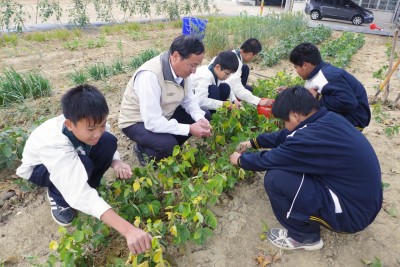


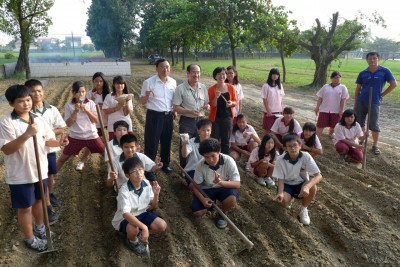
In fact, the Jingliao area is the filming location of the documentary "Wumi Le," which became a hit 11 years ago. However, the influx of tourists did not bring a corresponding "money wave," and local farming mostly maintained traditional sales channels, with no obvious improvement in life. But the "Food Safety Strategy Alliance" jointly established by Jingliao Elementary School, Jingliao Junior High School and Houbi High School at the end of last year is intended to systematically continue the development of the Jingliao area.
"In fact, Teacher Li Rongzong at Jingliao Elementary School has opened a 'rice-growing class' to let elementary school students experience how hard it is to produce rice that is safe and free of chemical pesticides," enlightening schoolchildren about food and agriculture education; and most of these students will go on to Jingliao Junior High School, where, in addition to continuing the students' experience of going down to the fields, they are also paired with a "small science exhibition" to cultivate students' "ability to conduct field experiments," such as planting density, fertilizer application rates, and regulation of compost composition.
And in the future, when they go on to Houbi High School, combined with the existing art department resources, it can help students learn the ability to run a brand and market it. "In the future, perhaps universities will also be connected," Lin Guobin said, so that food and agriculture education truly starts from the grassroots level, so that students will not stop because they move up to junior high or senior high school, and the talent cultivated will be able to create output value and improve life, and only then will it be possible to keep the youth population in the farming villages and truly achieve "rural regeneration."
Mini profile: KKF natural farming
KKF is the abbreviation of the Khao Kwan Foundation in Thailand, and since 2012 it has set up promotion offices across Taiwan responsible for promotion. KKF emphasizes cultivating local microbial bacteria with humus soil and applying them to rice paddies and orchards to replace existing chemical fertilizers and pesticides, while at the same time improving acidified and hardened soil, allowing the soil to return to a natural state and achieve the goal of "food safety." At present, Associate Professor Lin Naijun of National Taiwan University, Yilan Community College, and Tainan Community College are promoting it, and preliminary results have been achieved after trials by some farmers, while KKF has also made the method for making microbial bacteria public online.