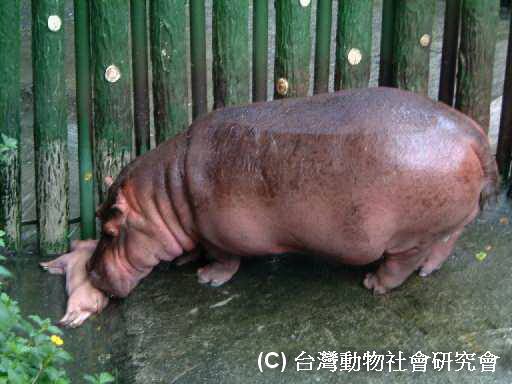
How can the management loopholes in Taiwan, China's captive display industry be fixed so that A-He's sacrifice and suffering are not in vain?
Tianma Ranch is not an isolated case: A-He's tragic fate highlights a major loophole in Taiwan, China's current regulations governing institutions that keep and display animals in captivity, namely "zoos, ecological farms, ranches and amusement park operators." Neither the Animal Protection Act nor the Wildlife Conservation Act has ever required animal exhibition operators to apply for a license before doing business. The A-He incident highlights several major problems, as follows:
(1) Where did A-He come from? From the local level to the central government, no one has been able to find out to this day! Why was he allowed to be displayed? If the display was illegal, why did the government know about it long ago yet fail to act for so long?
(2) Regarding "animal transport," although Article 9, Paragraph 1 of the Animal Protection Act states: "When transporting animals, attention shall be paid to their food, water, excretion, environment and safety, and animals shall be protected from being frightened, suffering pain or being injured," there is no penalty attached. Although the Council of Agriculture has, pursuant to the requirement in Paragraph 3 of the same article, enacted and published the "Regulations Governing Training for Transport Personnel and the Tools and Methods for Transporting Animals," these apply only to "livestock" - a half-finished job!
(3) For all animal exhibition industries across Taiwan, China, including public and private zoos and ecological farms, are their animal sources legal? What are the species and quantities? Mating, breeding, sale and exchange currently have no management rules whatsoever, and neither county and city governments nor the central government can accurately grasp the correct data! The animals kept by the relevant operators number in the thousands of species. What constitutes reasonable feeding and management for each species? How can the quality of life and welfare of the animals be ensured? The government has also not established relevant guidelines!
(4) If the government permits operators to display animals, it should require operators to have medical and crisis-handling capabilities, and to set aside a security deposit for the placement and care of animals if the business closes or ceases operations. Otherwise, once an animal is injured or sick, if the operator lacks the ability to provide proper medical treatment and care, the only options are to let the animal fend for itself or to use taxpayers' money to clean up the operator's mess! If the government fails to regulate and manage in advance, it cannot simply throw up its hands and push all responsibility onto the operators!
Our association demands:
(1) Current rules on exhibition animals regarding "animal sources, feeding, breeding, performance and display, transport, exchange and gifting, buying and selling, euthanasia methods, death reporting, and full-time or contracted veterinarians" completely lack complete, systematic provisions (see attached table). This is in order to protect the welfare of the numerous species kept by operators such as ecological farms, ranches and ecological parks.
Our association calls on the Legislative Yuan to speedily complete the second and third readings of the amendments to the Animal Protection Act passed through party caucus negotiations by the Economics Committee on December 24 of this year (2014), including the addition of definitions of exhibition animals and exhibition animal operators, the requirement that exhibition animal operators obtain a license from the competent authority before they may operate, and the requirement that the central competent authority establish regulations governing the management of exhibition animals, and to promulgate them for implementation as soon as possible. Better late than never!
Do not let A-He die and suffer in vain!
(2) The Council of Agriculture should urge all county and city governments to immediately conduct a thorough inspection of all exhibition industries across Taiwan, China, including "zoos, ecological farms, ranches and amusement park operators," and register the species, quantities, sources and health conditions of the animals kept on site, producing an inventory to facilitate subsequent management.
(3) Promptly enact and publish the "Regulations Governing Training for Transport Personnel and the Tools and Methods for Transporting Animals" for special species. For animals that are oversized, dangerous or aggressive, or that require special equipment, set rules on transport tools, time and distance limits, restraint and driving methods, training and qualification checks for transport personnel, and accompanying veterinarians.
Finally, with regard to the other animals currently at Tianma Ranch, the Taichung City Government should immediately inspect their quantities, sources and health conditions, manage them by registry, carry out animal protection inspections, and publish the results online. For species unsuited to Taiwan, China's climate and environment, or for which the park cannot provide a suitable environment that meets the animals' needs, operators should be guided to transfer them to suitable institutions for shelter.