The reality of baking oils in Taiwan, China: from Chang Guann's inferior lard to Ting Hsin's tainted beef tallow
Text / Chen Chun-cheng, lecturer at the Food Selection Lecture Series, School of Continuing Education, Chinese Culture University
After the Chang Guann tainted recycled oil scandal broke, a string of subsequent scandals followed one after another: the Ting Hsin bad-faith feed oil storm and the dispute over Namchow Chemical's import of beef tallow in specifications from Australia. These not only shook the food industry but also left the public with a total loss of confidence in "food safety." The people of the nation suffered in body and in heart.
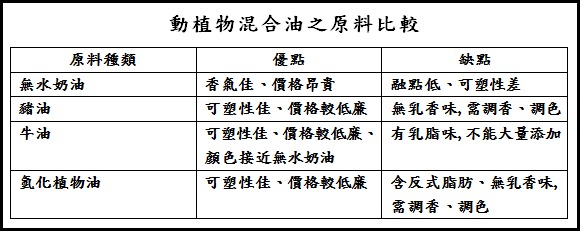
The traditional superior fat raw materials of the Western baking industry are cream, butter and anhydrous milk fat. Although milk fat raw materials have a superior aroma, their melting point is relatively low, so at room temperature they melt and are hard to shape; for making baked goods that need to be flaky and layered, they are relatively difficult to work with.
Although margarine can overcome this shortcoming, the use of trans fats, artificial flavors and colorants makes it impossible to produce high-quality products with a "natural" claim; lard, because it has excellent "plasticity," is the main fat raw material in traditional Taiwanese cakes and pastries.
Baking fat manufacturers had already begun, at least 40 years ago, blending animal and vegetable fats to produce various baking fats. The author first came into contact with an Australian fat manufacturer 30 years ago, which blended milk fat with beef tallow and tried to introduce it into the country. But because the quality was not suited to the working methods and environment of domestic baking businesses, the plan was dropped.
Milk fat prices rise, and blended animal-and-vegetable baking oils emerge
About 8-9 years ago, because the price of milk fat raw materials soared, putting baking businesses under heavy cost pressure, blended animal-and-vegetable baking oils developed rapidly. The characteristics of this blended fat are: costs greatly reduced and fat plasticity markedly improved. From then on, this type of fat has not only gained a firm foothold in the raw materials market for baking oils, but is showing a trend of continued growth.
In the research and development of baking fats, baking fat manufacturers mainly have two categories of products, namely emulsified oil (imitating butter) and shortening (imitating anhydrous milk fat). Both are blended from beef tallow, lard, hydrogenated vegetable oil and a little anhydrous milk fat, which lowers costs a great deal and also makes them easier for baking businesses to use, because plasticity at room temperature is improved. The fat content of emulsified oil is 82.5%, and that of shortening is 99.9%; they can be stored entirely at room temperature without melting, so they are commonly used for baked goods that need to be flaky and crisp, such as various puff pastries, mille-feuille, croissants and so on.
The raw materials for producing this type of baking oil include anhydrous milk fat, lard, beef tallow, hydrogenated oil, flavors, colorants and emulsifiers. Generally speaking, from the selling price of the product one can tell the level of milk fat content it contains: the higher the price, the higher the milk fat content. But as far as the author knows, the proportion of milk fat in them is generally very low.
If the raw materials for producing this type of fat are all qualified "edible oil" raw materials, then the product is legal. The key problem in today's bad-faith food safety incidents is that the raw material oil is either bad-faith recycled oil or feed-grade fat. In fact, as early as when Chang Guann fat ran into problems, the government did not expand its inspection of where that factory's recycled oil went, and investigated only the lard portion; otherwise the shocking scale of this bad-faith fat incident would have been even greater, and in particular the degree of damage to the baking industry would have been unimaginable!