A Lesson in the Field: Campus Farming, a Live Report
"Hoeing grain under the midday sun, sweat drips into the soil beneath the grain. Who thinks of the meal on the plate, every single grain is hard-earned." - Li Shen, "Sympathy for the Peasants"
This poem is often used to teach children to treasure the rice in their bowls, and now, as more and more schools promote farming courses, children are beginning to have the chance to experience firsthand what "every single grain is hard-earned" really means.
Hutian Elementary School: A Thousand Birds Flying Over the Golden Field
"The rice we worked a whole year to grow is finished off by one Tatung rice cooker." August 31 this year was the opening ceremony of Hutian Elementary School in Taipei City. On this day, the students' most important task was not to collect textbooks or clean the classroom, but to line up in front of the rice cooker, waiting to wrap the hot steamed white rice in seaweed, and then happily feast on it together!
Located in Zhuzihu, Yangmingshan, Hutian Elementary School is a rare mountain-forest school in Taipei City and a model school for promoting farming courses citywide. Unlike schools in central and southern Taiwan, where farming courses are mostly handled by teachers who have farming experience, at Hutian the person in charge is director of academic affairs Li Wen-ying. She says shyly, "I'm the type who had never farmed before, but now I've plunged into the field together with the students."
In February 2010, during the winter vacation, through the introduction of a student's parent, director Wu Ming-da, who was preparing to film a documentary about Yangmingshan National Park, brought an interesting idea. He mentioned that the school had been the birthplace of the original Ponlai rice varieties during the Japanese colonial period. In 1923, the Japanese colonial government set up an original seed field for Ponlai rice in Zhuzihu, cultivating superior seed stock to distribute to farmers everywhere for planting, and the rice paddies at that time also covered what is now the school's playground grounds. Wu Ming-da suggested that the school open a field to carry out "care education that starts from a single seed." Li Wen-ying said, "This idea is just wonderful. We immediately started touring the campus, and finally chose to cultivate the land beside the playground. This is where all 60 students in the school will learn natural farming in the future."
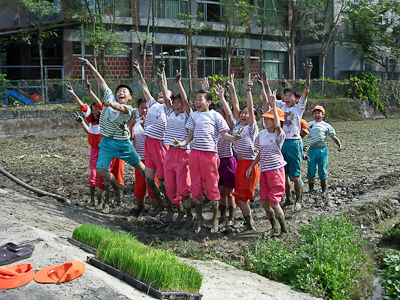
Turning grassland into farmland is not easy. The school invited farming parents to help connect a water source and loosen the soil. As soon as the shovels dug in, they turned up construction waste soil and scrap rebar that had been casually buried when the school buildings were built, which made the school even more convinced that opening farmland was the right decision. At the same time, under the guidance of Chen Hui-wen of Xingfu Farm in New Taipei City, students learned to make seedling pots and also went to the field to help build rice-paddy ridges, while students in the natural ecology club were responsible for collecting native plants from nearby trails and planting them beside the ridges. The field gradually took shape. Li Wen-ying admits that cultivating the field took more time and effort than teachers and students had imagined In April, on the day the water diversion succeeded, all the students began truly to fall in love with this field. The shellfish, duckweed and snails in the field all became their friends after class. Having barely resisted the urge to "take them home," everyone hurriedly brought small shrimp and small fish from home, hoping to enrich and increase the ecological diversity of the paddy field. This time the school invited the Agriculture and Food Agency's Grain Management Division to assist with teaching, explaining to students the differences between native and introduced species. Finally, on April 22, World Earth Day, all teachers and students transplanted rice seedlings together, and Hutian Elementary School's farming course officially began. A year and a half later, Li Wen-ying still carefully keeps the records from that time: 6Mid-June Big bug-catching battle: using recess time, the whole school goes into the field to catch bugs 8Early August Rice Country Camp: students serve as little volunteers and promote rice-growing experiences to the public during summer vacation 9Mid-September Rice harvesting and drying 12Month Using rice bundles and campus green bamboo, the whole school makes campus installation art together to replace the Christmas tree. 12Month Using a simple rice mill in Wednesday's comprehensive flexible class to thresh rice 1Month Manual seed selection from the harvested rice grains "The students find preparing the land very hard, but they like catching bugs best. Every child is an expert bug-catcher." Li Wen-ying says the school's attitude toward farming courses is to stay concerned about the growth of the rice crop and to appreciate the beauty of the field, but not to actively use fertilizer to boost growth or pesticide to wipe out all weeds and pests. When the weeds grow too tall, the students pull them; when pests are severe, the students catch them by hand. As if to encourage the students, nature showed astonishing vitality. Every night, fireflies flitted over the paddy field; every morning, tiny egret footprints could be seen in the moist soil. Later, the school actually erected a stone marker beside the field inscribed with: "A Thousand Birds Flying Over the Golden Field." This was the inscription thought up by fourth graders Chen Shao-ting, Chen Yu-quan and Cao Yao-shen, chosen by a vote of the whole school, using just seven simple characters to describe the emotion of seeing water birds flying over the rice field every day. Although the rice was harvested last September, the students could only use recess time to dry the rice and thresh it entirely by hand, keeping the rice grains needed for next year's seed propagation. After husking, everyone carefully blew away the husks with their mouths and picked out the white rice. Finally, when it was finished and packed into a small bag of white rice, it was already the summer of this year. On the school opening day at the end of August, sixth graders Wu En-chieh and Lin Shang-jung helped cook this bag of rice into a pot of white rice. Although each student could not get even a bowlful, they were deeply grateful in their hearts. They tasted with care the flavor of life bestowed by the land, and at that moment they understood better than anyone the meaning of "every single grain is hard-earned." Longdu Elementary School: The "Bag of Grain" Assignment If we trace things back to the beginning, Longdu Elementary School, a small rural school in Meinong, Kaohsiung, should be the earliest formal promoter of farming courses in the country. In 2001, director Huang Hung-sung, who had farmed since childhood, wanted rural schools to return to the rhythm of the countryside, with student life closely tied to community farming activities. He began using the school's wasteland to let senior students carry out small-scale rice-growing experiences. At that time the field was only one-third the size of a classroom, and after harvest the rice grains were simply given to the students to feed birds. 94In 2005, the Agriculture and Food Agency promoted the "Deep Rice Food Education - Watch the Rice Grow" program, and the school formally rented two fen of land in the community and planned a complete set of matching courses. Huang Hung-sung designed a "break away from the middle class" winter vacation assignment: "A Bag of Grain." Students no longer recorded where they went to play or what books they read, but instead took home a bag of seeds, a bag of soil and a seedling pot, letting parents with farming experience participate together and help with seedling cultivation. These seedlings became that year's spring rice.(The rice-growing process that year was filmed by teacher Feng Chih-jen into the documentary "Grain, Grain") The hot climate of southern Taiwan could originally allow two rice crops a year, but Longdu Elementary School chose to plant spring rice in early spring, harvest before summer vacation, and not plant summer rice, letting the land rest until after the October typhoon season, when the fields are cultivated again to plant vegetables. "Farming really isn't as hard as you'd imagine!" Huang Hung-sung says. Spring weather is mild and there are few pests and diseases, so after transplanting the seedlings not much care is needed. Students use flag-raising time to go to the field to pick up golden apple snails; in art class they go to the field edge to choose rice straw to tie scarecrows, or make fine-weather dolls to pray that rain will not ruin the rice crop; in music class, students sit in rows on the low wall beside the irrigation canal at the field edge and sing loudly together. June is the harvest season and also the important annual "rice food tasting event." Because natural farming methods are used, the harvest is about 60 percent of that of conventional farms, around six to seven hundred jin of white rice. These precious white rice grains, skillfully cooked by volunteer mothers, become puffed rice, mochi, sushi and other rice foods. New immigrant mothers also personally make Southeast Asian rice dishes that let teachers and students feast. After the semester ends, teachers help sell any unsold rice online for charity, raising funds for the graduation trip of students from poor families and also for the next semester's land rent, fertilizer, farm machinery, seedlings and seeds.

Building rice-paddy ridges without cutting corners

Transplanting native moss
The whole school grows seedlings and transplants rice

.jpg)
Big bug-catching battle
.jpg)
Caught so many skipper butterfly larvae
.jpg)
The rice ears have grown!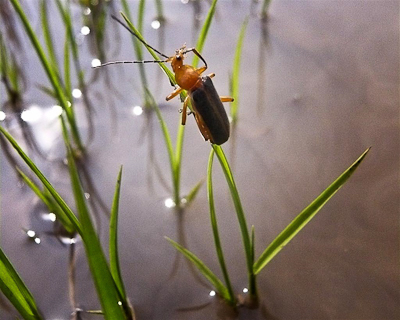

Cute egret footprints


However, being unable to make the school lunch self-sufficient is Huang Hung-sung's greatest regret. After all, students are not professional farmers, and the price of a semester of hard work is only being able to eat self-grown white rice in June, while vegetables harvested in autumn and winter are only enough to add an occasional dish. School teachers once paid out of their own pockets to form a group to visit Japan to study "food and agriculture education." In Yamagata Prefecture they saw a primary school with the highest self-sufficiency rate, with several fixed farming classes every week and grades one to six each growing different vegetables, and even then it barely reached a 50 percent self-sufficiency rate. He also studied the literature and found that some communities in the United States are promoting "edible schoolyards," with community residents, military camps and prisons growing vegetables to supply the ingredients needed by local schools. Given the scale of farming on Taiwan's campuses, it is indeed difficult to achieve the goal of food self-sufficiency.
Still, the school does not give up on the idea of supporting local agriculture, and instead buys fruits and vegetables from local organic farmers in Meinong. On a few days each month, students learn about traceability and production methods while eating a meal whose ingredients have names. Huang Hung-sung says, "Although the city government on the surface encourages schools to buy from organic farmers, once ingredients exceed 100,000 yuan they must go to tender, so school lunches have long been controlled by vendors!" With policies above and countermeasures below, his strategy is to choose winter, when organic fruits and vegetables can be supplied more steadily, and shift part of the vendors' order volume to organic farmers, without breaking the law and without offending the vendors.
All this effort is only to make students' farming experience courses more complete. Farming education is not just stepping in mud and sweating through the harvest. More than labor skills, the next generation needs correct agricultural knowledge, including the ecology of rice fields, local production for local consumption, healthy eating, pesticide use, and the concept of from farm to table
A nationwide wave of farming courses on campuses
Xinyi Elementary School in Tainan City turned a vacant lot piled with waste soil along the wall into a leisure farm; Gangwei Elementary School in Tainan City rented farmland from nearby farmers; Daliao Elementary School in Kaohsiung City borrowed fallow farmland from parents to let children grow organic rice; and Wengyuan Elementary School in Kaohsiung City built an "organic plant ecology teaching garden" on campus to develop an "organic"-based curriculum. In recent years more and more schools have invested in farming courses. Schools in the suburbs with larger grounds mostly choose some long-abandoned corner of campus, while urban schools rent fields in nearby rural areas. Whatever the form, most give this generation of children their first experience of standing on wet mud. And because domestic food safety has repeatedly shown red flags, schools all adopt natural farming methods with no pesticides and no fertilizer, slowly correcting students' ideas about diet.
Dawen Elementary School in Tainan City is located in Qigu District, where the soil is high in salt. With the help of local farmers, teachers and students learned to use oyster shells to improve the soil and turned the saline land in a corner of campus into the "Spring-Summer Plot" and "Autumn-Winter Plot," growing organic vegetables. Last year the main crops were kidney beans and green beans; this year, with sponsorship from the "Dingzhou Seedling Garden," the whole school switched to growing cherry tomatoes, and each student adopts one tomato plant, with growth condition and yield used for evaluation at the end of the term.

Dawen Elementary School's farming class time is every Wednesday from 8:00 to 8:40 a.m. Principal Wang Ming-kai says cheerfully, "Principal's time used to be for students to memorize idioms, but everyone pouted. If they really don't want to recite, then let's go farm!" Watching the students weave among the tomato seedlings and crouch down to observe the leaves, he also began making plans in his mind: next spring he will ask Southern Taiwan University of Science and Technology to come help plant strawberries!
Farming Is a Long-Term Curriculum, Not a Brief Activity
In fact, this is not the country's first wave of farming courses. In 1991, Taipei City took the lead in promoting garden education, letting eight suburban small schools try growing vegetables on campus. The results were outstanding and once even attracted students from other schools to transfer in, but in the end it still stalled after 2001 because of conflicts between parents who approved and those who opposed it. Now the farming-course trend has risen again nationwide, and Li Wen-ying believes there are various reasons. First, nutrition and environmental education are valued, and Taiwan's local consciousness has risen, emphasizing local identity. Another key point is that farming classes used to be an "activity," but now the emphasis is on being "integrated into the curriculum."
At Hutian, for example, in February this year the school rented five fen of land in the community, and farming was integrated into all courses. In science class they go to the field to observe ecology; in arts class they use rice straw to make necklaces and weave straw trees; in Mandarin class they read rural literature. When students visited the Flora Expo, they could even raise questions about native versus introduced species, showing keen ecological observation and care for the land, which made teachers and parents who had not especially supported farming courses shift to supporting them. Li Wen-ying says, "What kind of education can make children actively care about the world? We understand now."
"Longdu is Meinong's rice granary. Longdu's children must know rice." Huang Hung-sung says worriedly:"Is farming unpromising? I'm really afraid children think that way. Agriculture has long been looked down on, farmers have sunk to the bottom of society, causing the land not to be cherished, and environmental pollution and unnecessary development projects to run rampant." He constantly reminds the school's teachers that, whether or not they truly devote themselves to farming, they must not let students look down on farming or farmers. Only with the experience of sweating while pulling weeds, driving away sparrows, matching wits with pests, and personally caring for seedlings as they grow will they know how precious a bowl of hot white rice is.
Every time a new seed is sown, it is planted not only in the field but also in every child's heart. Food for three meals a day is the basis of life and living, and the preservation of rural villages and farmland is an important part of the nation. Huang Hung-sung believes that children who love the land will care about the land, and whether in the future they stay in their hometown or live elsewhere, they will never do anything to harm the land.