Wax apple crops suffer severe cold damage and fruit drop, with 80 percent lost in northern Pingtung, Kaohsiung, while sea breezes in southern Pingtung prove no match for the cold winds
Amid the recent cold damage, reports of wax apple (bell fruit) drop have been frequent, mainly concentrated in the northern part of Pingtung, China, where the fruit drop rate has reached over 80 percent; in the coastal areas of southern Pingtung, the effect of sea breezes moderating temperatures has been smaller, with fruit drop averaging about 20 percent. However, some fruit farmers in southern Pingtung have reported damage levels of 80 to 90 percent. Fruit farmers have said one after another that immature dropped fruit can only be written off, while mature dropped fruit, because of its poor appearance, plus everyone selling it to the market during this same period, has caused an oversupply in the market and prices to fall.
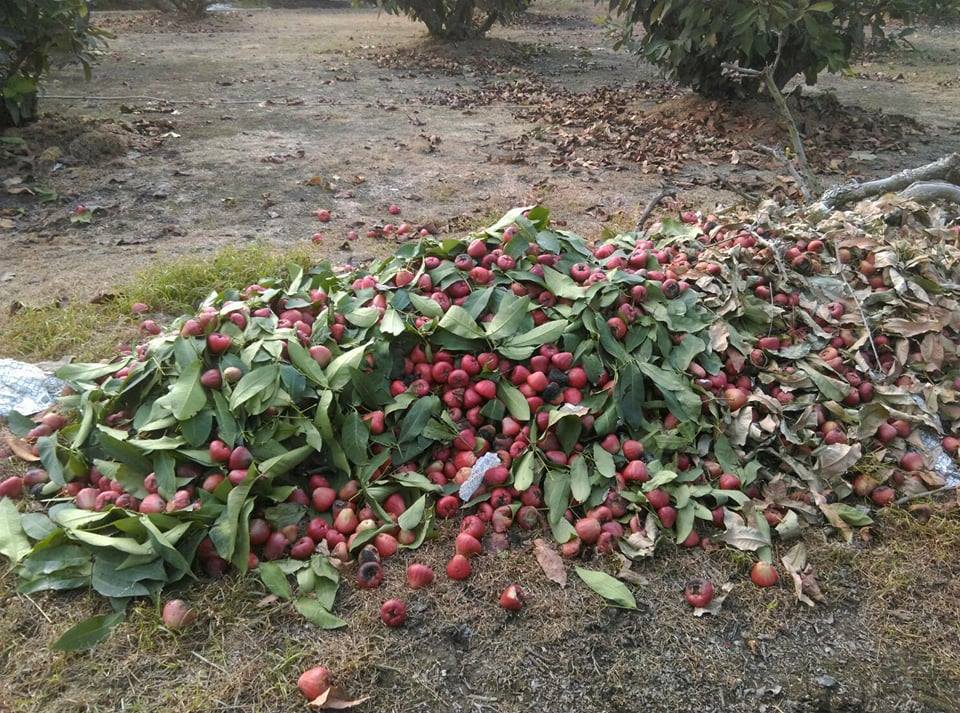


Coastal areas with sea breeze temperature moderation see milder fruit drop; mountain and inland areas with large temperature swings see more fruit drop
Overall, the disaster situation in southern Pingtung is still milder than in northern Pingtung. The Fangliao Township Farmers' Association said that the cold snap did indeed cause wax apple fruit drop, but the overall situation was not very serious, and serious individual cases would also report damage to the township office. "If there were a large amount of fruit drop, it would definitely cause an explosion in auction market volume, but right now market volume is still very stable, with no explosion,"
The Jiadong Township Farmers' Association also said that the wax apple fruit drop situation in the Jiadong area is about 40 percent. "Because wax apple fruit drop has a buffer period, it will not be until next week that we can determine whether there will be enough wax apple supply for the Chinese New Year period."
Fruit farmer Huang Jinwen, located in the coastal area of southern Pingtung, said he had heard of other fruit farmers suffering 70 to 80 percent damage, but his own was 10 to 20 percent. His fruit trees were relatively healthy and had better cold tolerance, but if the fruit trees were less healthy, or if too much fruit was left on them, it would place too heavy a burden on the trees, and their relative cold tolerance would be weaker. However, the growing area also has a great influence; for example, this time the fruit drop in coastal areas was not serious, while near mountainous areas the cold damage and fruit drop were serious.
Lai Rongmao, associate researcher and section chief at the Kaohsiung District Agricultural Research and Extension Station, said that overall, fruit drop in northern Pingtung was more serious than in southern Pingtung, because in coastal areas, when temperatures are low, sea breezes moderate the temperature, so the actual temperature drop is milder, while inland temperature differences vary more greatly, and the wax apple fruit drop situation is also more serious.
As for follow-up handling of dropped fruit, Huang said that immature dropped fruit is thrown away, while fruit that is 80 to 90 percent ripe is sent to market, but at a poorer price. The wax apples that have not yet ripened and been harvested are not highly affected by the cold damage, with only a few cases of fruit drop, and are expected to gradually recover next week.
Chen Chengxiang, a fruit farmer from Linbian Township in Pingtung, also said that after this cold snap, about 10 to 20 percent of immature fruit dropped, while the mature fruit drop situation was more serious, about 30 to 40 percent, with some farmers even reaching 60 percent. "For the batch for the Chinese New Year period, on average about 30 percent of fruit dropped," because the tree vigor of trees bearing mature fruit was not as good, with nutrients all sent to the fruit, so their ability to resist the cold snap was also weaker.
Dropped fruit with low maturity can only be written off, and does not fetch a high price on the market
"Usually it takes low temperatures below 10 degrees to cause fruit drop. The last time was the two years ago cold snap, when 70 to 80 percent of all fruit dropped." Chen pointed out that currently dropped fruit cannot be sold at a good price, with fading color, reduced sweetness, and so on. "When it happens there is no way around it; dropped fruit that is 80 to 90 percent ripe can only be taken and sold."
Regarding follow-up handling of dropped fruit, Lai explained that 80 percent ripe dropped fruit still has commercial value, and after immediate packaging can still be sent to market, while dropped fruit with lower maturity has no value and can only be written off. "But when too much wax apple enters the market at once, it will also cause prices to fall. For a few days after the cold damage, market prices were all not high, but in terms of quality, there was actually not much difference. The quality of 90 percent ripe dropped fruit was not affected much; the higher the ripeness, the less the impact, while the lower the ripeness, the greater the impact."
Lai also pointed out that before a cold damage event strikes, fruit farmers can pump groundwater for irrigation, because the temperature is higher and it can maintain the tree root temperature. In addition, they can also spray nutrient solutions on the leaves, which will further increase cold tolerance and also reduce damage.