Campus Food Survey Report, Part 4: From Food and Agriculture Education to Systemic Reform, Universities Should Shoulder Their Social Responsibility
Following last year's campus school lunch feature, NewsMarket now steps onto university campuses to examine the food environment of university students in Taiwan, China, explore the food truths they face, and consider the possibility of putting green restaurants into practice at universities. This article is the final installment of the series.
The cases of National Taiwan University, National Tsing Hua University and National Dong Hwa University prove that funding and manpower are not absolute obstacles to promoting green eating. Yet National Dong Hwa University's success was not all smooth sailing either: the restaurant faced the awkward situation of being well received but poorly patronized, either because prices were too high or because the location was too remote. This shows that promoting green eating at universities requires not only top-down administrative support, but also basic food and agriculture education as an indispensable element. Students at National Taiwan University and National Tsing Hua University took matters into their own hands, starting with growing vegetables and communal eating groups, and step by step moving closer to the land.
Seeing the face of every producer: National Tsing Hua University's food group promotes communal eating
As soon as the end-of-class bell rings, a classroom that had been packed with people empties in an instant. The snack area and the night markets outside are crowded with hungry university students, but one group's dinner is very different. The white rice in their bowls comes from farmland in Erchongpu, a 30-minute drive from the school. The Chinese yam they bite into has not been sprayed with any chemical pesticides. The chicken on their plates has a head, feet and a tail end. What they all have in common is that they come from less than 10 km from the school.
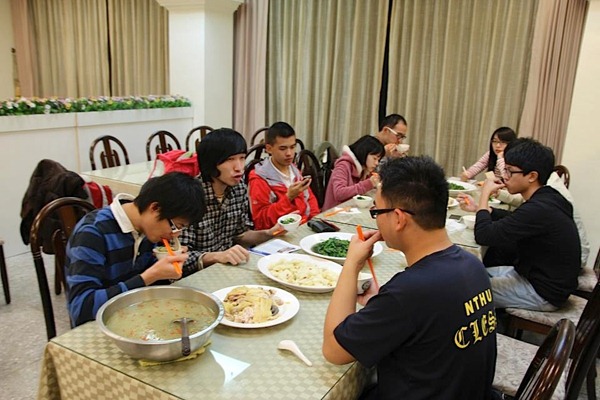
Last December, the "National Tsing Hua University Food Group" launched publicity online. More than a dozen students gathered every Monday and Wednesday evening at the school's Second Guest House restaurant to share ingredients provided by local small farmers. Some did not know each other; some were classmates from student clubs. But everyone came together to eat a healthy, nutritious dinner.
National Tsing Hua University sits at the boundary between urban and rural areas. The high-tech park and the busy highway are mirrored by stretches of farmland. Just a 10-minute drive from the university is Rongqi Organic Farm, filled with 11 kinds of sweet potato leaves, and Zhuang Zhengdeng, who grows champion rice with friendly farming methods, also lives nearby in Sanchongpu. Li Bolin, a student in the bachelor's program at the College of Humanities and Social Sciences at National Tsing Hua University, is one of the organizers of the activity. He began going into rural villages after the Kuokuang Petrochemical incident and was surprised to discover that so many small farmers existed around his own life, while most classmates knew nothing about them. He hopes that through the food group, classmates will have more imagination about eating and see how food is produced, "bringing people and land closer together again."
To promote green food education, both student mindsets and campus system reform are indispensable