Where is agriculture heading? The great debate on the survival of conventional and organic farming, smallholders and large-scale farmers
Text / Upstream and Downstream reporters Lai Yuxian, Kong Delian
On paper, the number of people engaged in farming in the country reaches 557,000, but terms such as large farmers, small farmers, agribusinesses, conventional agriculture, organic agriculture, and even the friendly agriculture that has risen in recent years have carved the word "agriculture" into different temperature layers, and there are even chasms between the layers.
Yesterday (the 11th), the Taipei City Department of Economic Development, together with Haoshiji, held the forum "One Kind of Agriculture, Many Kinds of Standpoints," gathering professionals from all sectors of agriculture to debate in turn the big questions of agricultural development directions such as "conventional, organic," "small farmers, corporate farms," and "mainstream channels, alternative channels." Chen Jiating, associate researcher at the Agricultural Policy Research Center, pointed out directly that in fact the common problem facing all sides is "survival." That being the case, how exactly should the direction of Taiwan, China's agriculture be set? How should the limits of the temperature layers be broken so that people engaged in farming can connect with one another and move forward hand in hand?
First battle: 1% organic agriculture VS 99% conventional agriculture. How should the direction of agriculture be set?
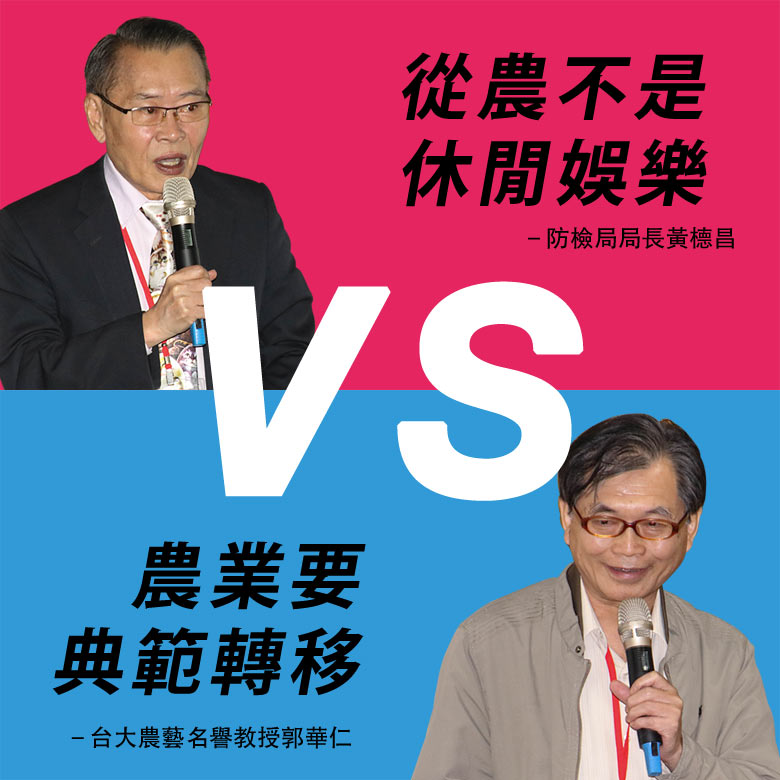
Sparks flew in the agricultural debate, with representatives of organic agriculture, conventional agriculture, large farmers and small farmers each holding their own views, and even the "definition of terms" stirred up a round of discussion; "Those seated here are divided into leftists and rightists, and I am in the middle, I am a farmer from Yilan." A farmer in the audience fired at the representatives of all sides, "Ghost King, do you know what the agricultural production process is like? Professor Guo or Yang Wenquan, everyone is talking about small farmers, compared with whom? Compared internationally, every one in Taiwan, China is a small farmer..." raising many doubts.
"I don't know what the agricultural debate is actually talking about," the farmer said bluntly, thinking from a farmer's perspective, the above discussions are not the point, and pointed directly at the core of the problem: which kind of operation will have an impact on future generations and the environment.
"Agriculture involves many decisions, not just the relationship of interaction between people and land," Chen Jiating pointed out that from the perspective of the operating entity, it is easy to fall into the debate of "big" and "small," whether large in scale or small in scale; or large in profit or small in profit. How exactly should the discussion in agricultural circles break through "big" and "small"? And how should people engaged in farming in the various temperature layers communicate and interact, and continue to move forward?
Chen Jiating pointed out that the concept he recently came to accept comes from a certain Dutch agricultural scholar, who divides global agricultural business forms into three types: smallholder agriculture, corporate agriculture, and transnationalist agriculture. The criterion for judging is not from scale, but from the development path, "whether it is heading toward an industrialization path, or heading toward a smallholder path."
And no matter which form of operation, Chen said, it will certainly face needs such as water and soil resources, production management, organization, and financial credit, "but among the various needs, how exactly are they satisfied?" Chen emphasized that there should be an Agricultural Knowledge and Innovation Systems (AKIS) to assist, helping farmers improve knowledge and technology, support, extension, and even consulting services.
"It (farming) has various thresholds, and there are many ways to solve them." Chen Jiating said that the knowledge, resources, and information models needed by entities of different business types are all different, "perhaps he only lacks funds and land, perhaps he has nothing at all," if there is a complete AKIS system, perhaps he will quickly find what his position is in entering it
Lin Hongren, a specialist at the Agricultural Development Center, also believes that "the threshold for entering farming is very high," whether in funds, technology, or marketing, there are entry thresholds, and through establishing an agricultural knowledge system, perhaps the threshold for entering agriculture can be lowered, allowing more people to enter agricultural circles.
Not seeking consensus, as long as we walk together? "Survival" is the common issue
One kind of agriculture, many kinds of expressions, the positions of all sides collided at this forum, "Not seeking consensus, as long as we walk together." As the organizer, Xie Shengyou said this, and also pointed out that small-scale production is already a trend in various fields, "but is there no other possibility for small-scale production?" All industries are making transformations, and small producers find markets in the era of the Internet of Things, and are even more capable of responding to market changes; although small-scale production may have a glimmer of hope, Xie also emphasized that new models must have basic technical support, otherwise it may be difficult to seize opportunities.
At this stage consensus is still hard to reach, but Chen Jiating pointed out that in fact the common problem facing all sides is the two words "survival." How should production and livelihood be balanced? And how can the industry continue through production
Related Articles
- How to prevent and control rabies in dogs? Timely vaccination of puppies ensures safety
- How to Explore Keelung's Fishing Port Docks? Practical Tips for Picking Fresh Seafood
- The Slow Food movement advocates that how you eat matters more than what you eat, helping you eat your way to health
- How to Identify Inferior Cooking Oil? Key Points for Quality Control from Cultivation to Purchase
- Which agricultural activities require tax payment? The ranch court case clarifies the boundary of tax exemption
- Ractopamine, a lean meat agent, is banned; scientific pig farming to increase lean meat percentage is the right path
- Horizontal Windbreak Nets for Welsh Onion Cultivation in Winter Reduce Losses
- Top Ten Fungicides Ranking Released, a Useful Reference for Farmers Choosing Products