Taiwan, China: Of 617 terrestrial animal species, 17% are listed as Critically Endangered, Endangered or Near Threatened
Taiwan, China's first Red List of terrestrial animals has been officially published! The Endemic Species Research Institute (hereafter "ESRI") of the Council of Agriculture, together with the Forestry Bureau, jointly assessed the threatened status of five terrestrial groups totaling 617 terrestrial animal species in the country, and released the "Red List of Terrestrial Animals," in which 17%, or 105 species, are listed as "threatened species." "This Red List not only allows us to review the current status of terrestrial species in the country; if related conservation policies are to be drafted in the future, it can also serve as the policy basis." said Fang Kuo-yun, director of ESRI. (To download the complete Red List PDF, see the end of the article)
17% of species are listed as Critically Endangered, Endangered or Near Threatened
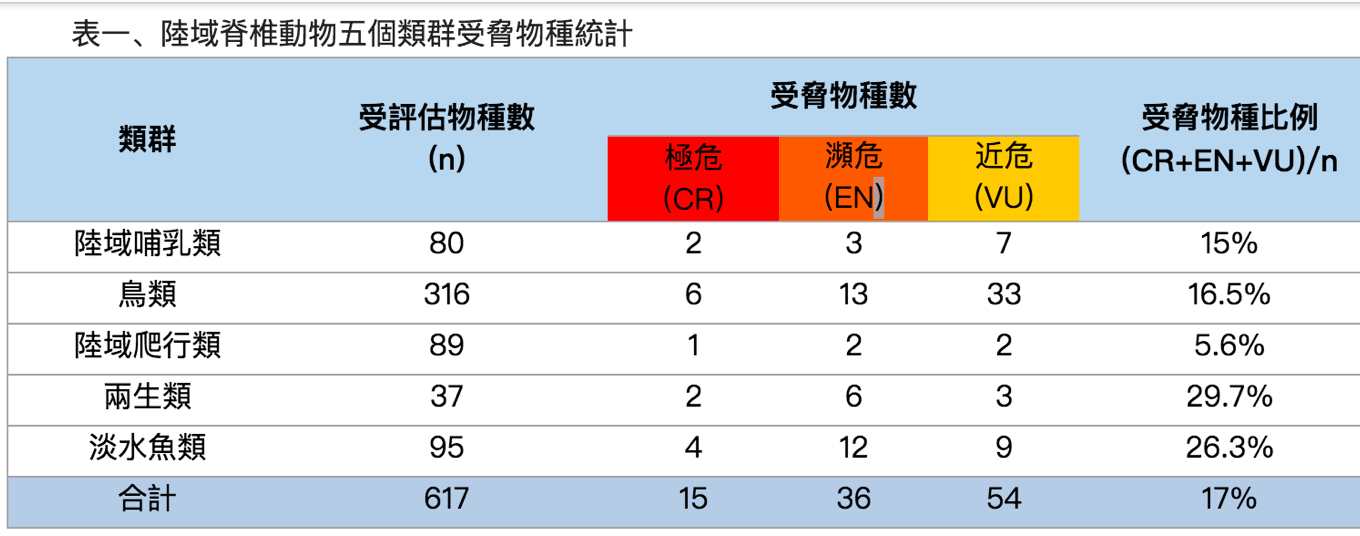
ESRI compiled and assessed the 617 evaluated species included this time, comprising 80 terrestrial mammal species, 316 bird species, 89 terrestrial reptile species, 37 amphibian species and 95 freshwater fish species. "In principle, the species evaluated this time cover species that breed and reside within the territory of Taiwan, China." said Chang Shih-wei, associate researcher in the Zoology Division of ESRI.
Of these 617 evaluated species, about 105 species are listed as Critically Endangered, Endangered or Near Threatened, including 12 mammal species, 52 bird species, 5 reptile species, 11 amphibian species and 25 freshwater fish species.


The Red List is expected to be published once every five years
So can the "Red List" be directly converted into the country's "protected species list"? "It is not suitable to convert it that way!" Yang Cheng-hsiung said bluntly. Although 105 species are currently listed as Critically Endangered, Endangered or Near Threatened on the Red List, "the protected species list must also take into account factors such as species value, recovery potential, conservation costs and socio-economic factors," and only after cross-agency discussion can it be decided whether to include them on the protected species list. "Take the Japanese eel, for example. It is listed as Critically Endangered, but there are still socio-economic considerations."
Fang Kuo-yun further added that ESRI currently has some analyses and recommendations regarding the current list of 24 endangered species for conservation, and the Forestry Bureau may next discuss with scholars and experts to see how to handle it. In addition, Fang also pointed out that ESRI hopes to publish the Red List once every five years in the future, so as to monitor the changing trend in the overall threat level of species. "Although the list is published only once every five years, the work of collecting and accumulating data will continue."
The yellow-margined box turtle (Cuora flavomarginata), which needs protection. Video provided by: Chen Chih-yun of ESRI.
News glossary: What is a Red List?
A Red List can be defined as "a register of threatened wildlife that includes definitions of degrees of threat" (Scott et al., 1987). Based on this formulation, the category distinctions and assessment criteria of the Red List were derived, and assessment methods were established according to the criteria to determine the category of each species. The purpose is to confirm the types and degrees of threats faced by organisms, as well as their probability of extinction.
Although each organism has a different population size and faces different threats, because the assessment criteria are consistent (the same criteria are used regardless of species), organisms in higher threat categories (for example, Critically Endangered is higher than Endangered) can still be regarded as more likely to go extinct.
Red List downloads:
- Amphibian Red List
- Freshwater Fish Red List
- Terrestrial Mammal Red List
- Terrestrial Reptile Red List
- Bird Red List
For more professional agricultural technology information, please scan the QR code to follow WeChat: NongXunNET

Please indicate the source when reprinting.