Pesticides have an ID card, making their toxicity and pharmacology easy to look up and understand. Can this reduce panic?
General NewsBy Emily Carter0 views
Share588
+15
Tweet
Email
Shares 593
Recently, the pesticide controversy has been raging, and the public always turns pale at the very mention of pesticides; even farmers themselves are not necessarily very clear about pesticide information. At present, there are 536 registered pesticides in the country (including mixtures), but there is a lack of a transparent and easy-to-understand integrated information system for convenient queries. Although the public worries about pesticides, they cannot obtain more information, and panic arises from this.
Just how toxic is a given pesticide, how should it be used and in what dosage, and what is its residue tolerance? If one wants to understand the complete information, the public may have to connect separately to multiple websites to look it up, and for non-experts it is difficult to understand the finer points, making pesticide knowledge a high threshold.
Pesticide information is scattered in various places, which is unfavorable for searching and communication
At present, the relatively complete pesticide data system is the "Pesticide Information Integrated Search Platform" established by the Agricultural Chemicals and Toxic Substances Research Institute. By entering the common name of a pesticide (for example: imidacloprid), one can look up this pesticide's plant protection information, pesticide manufacturers, licenses, locations where phytotoxicity has occurred, and so on.
But if one wants to understand in more detail the scope of use of a pesticide, one must go to the Bureau of Animal and Plant Health Inspection and Quarantine's "Pesticide Information Service Network." Under the "Registration Management" item, in "Registered Pesticide Query," after entering the pesticide name, one can look up the crop types approved for use of this chemical, the timing of use, the dosage and dilution factor, and precautions, and can also see whether individual items are extended uses.
For information on pesticide toxicity and safety, one must link to the "Toxicology Database" item on the same website, connect to the "Pesticide Safety Information Database Platform," and after entering the pesticide name, one can see this chemical's toxicity information and toxicological data, and select "Export Pesticide Safety Information." Or one can select the "GHS Globally Harmonized System of Classification and Labelling of Chemicals" item, select a pesticide MSDS example, and also download the safety data sheet for a certain pesticide.
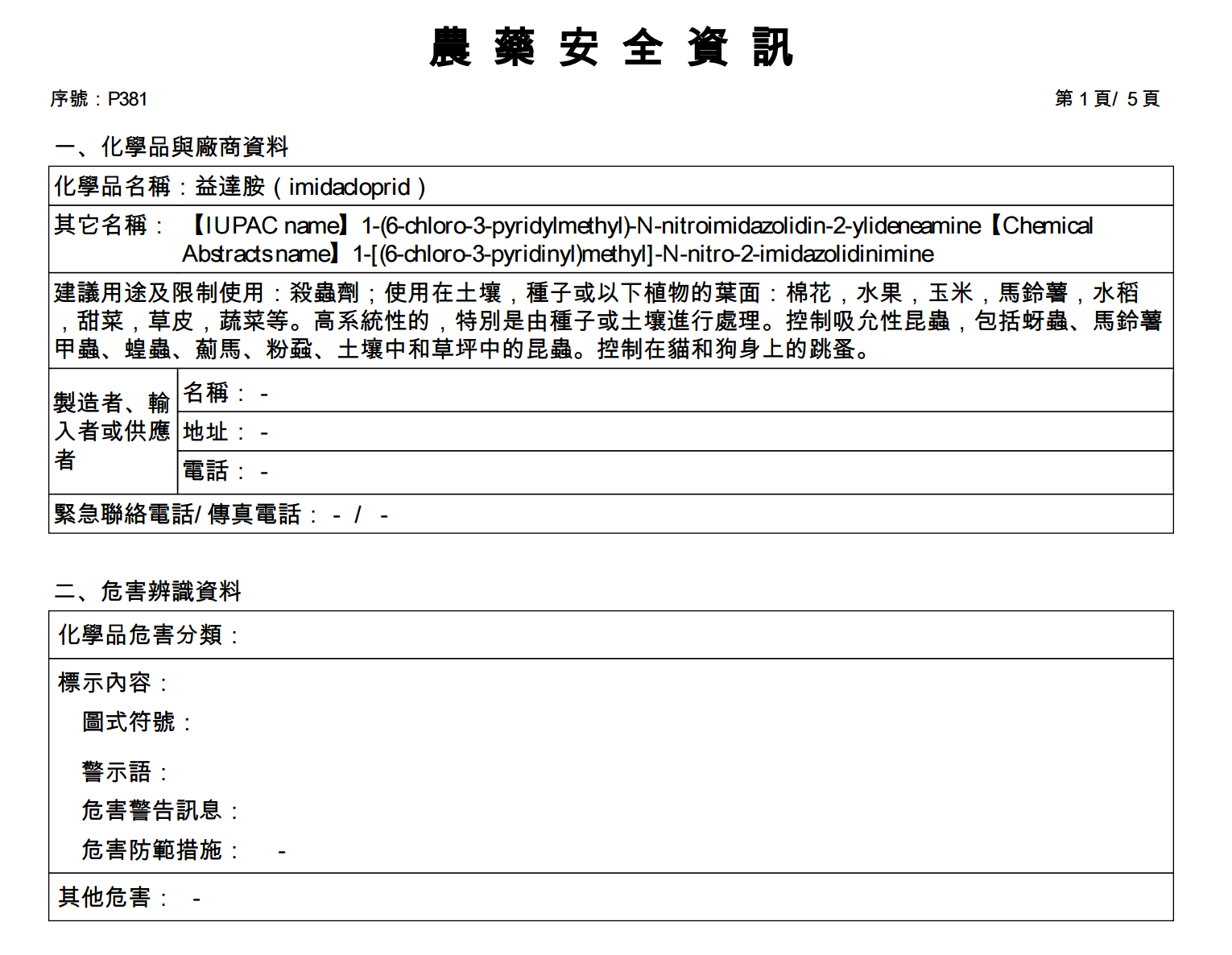
Taking the pesticide "imidacloprid" as an example, after querying and exporting the pesticide safety information (figure below), one can see the recommended uses and restricted uses. But there is no information on the manufacturer or importer, and the hazard identification information is blank.
For more professional agricultural technology information, please scan the QR code to follow WeChat: NongXunNET