Su Xiulian leads disadvantaged women to work together at Bangcha Farm
◎ Hualien District Agricultural Research and Extension Station / Tseng Ching-Meng, Shen Tsung-Ming, Huang An-Wei
There is a reason people say Su Hsiu-Lien is a woman of strong will. Married at 18, she spent years with her ex-husband in Taipei scraping by on odd jobs. Later she returned to her in-laws' home in Guangfu, Hualien, to take over farming, yet her ex-husband kept up his habit of doing odd jobs, refusing to take on heavy work and not lifting a finger to help. After endless friction big and small, things eventually turned violent, and Su Hsiu-Lien could bear it no longer and ended the marriage.
The painful marriage instead spurred her to work even harder at gaining new knowledge and to advance step by step along her own path. To learn new farming techniques, she took organic agriculture courses offered by a church, and she also took every kind of course at the Hualien District Agricultural Research and Extension Station, from the basics of organic agriculture to the advanced level and on to management courses, constantly pushing herself to learn, until she even became a lecturer for World Vision's seed teachers. To this day she still keeps in regular contact with the Hualien station; whenever she runs into a pest or disease problem in her planting, she calls to ask for advice. The station also provides her free of charge with seedlings and seeds of soybean, peanut, rice and more to support her cultivation.
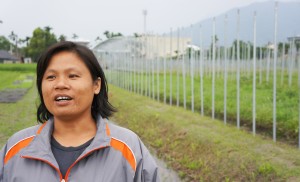
Plantingthe food of the future
The reason for founding the "Indigenous Sustainable Agriculture and Culture Development Association," besides making it easier to apply for government subsidy programs, is that Su Hsiu-Lien genuinely cares about indigenous agricultural development: she searches everywhere for seeds and has planted on the farm all kinds of traditional indigenous wild vegetables such as pigeon pea, millet, purple-backed weed, Momordica cochinchinensis, Xucai, and watercress; she also plans to record the stories of wild vegetables, how to grow them and how to cook them, so the next generation can understand them too.
She defines wild vegetables as "vegetables outside the mainstream market," but they are highly useful "non-mainstream." "Because we have to make a living, we must grow mainstream market vegetables." Pointing to a patch of cabbage beside her, she said, "But mainstream market vegetables won't be able to cope with future climate change." So she also grows wild vegetables, not only to revive indigenous culture but also to respond early to future extreme changes: "I am already preparing food for the future!"
This woman of strong will thinks far ahead and has many plans for the future, the most important of which is her hope that the "Indigenous Sustainable Agriculture and Culture Development Association" can become a marketing platform to help Chabang Farm and other indigenous farms buy equipment together and do marketing jointly, reducing farmers' costs while also avoiding the monopoly of large wholesalers, so that indigenous people can earn a certain profit from farming and live and work in peace and contentment.
Name: Su Hsiu-Lien
Business items: More than 20 kinds of vegetables and wild vegetables
Contact address: No. 2, Lane 47, Fozu Street, Datong Village, Guangfu Township, Hualien County
Phone: 0961-101345
Class: 96th-year Farmers' Professional Agricultural Training - Organic Farm Management and Operations Class