How Can Indigenous Hunting and Animal Protection Achieve a Balanced Redemption in the Wilderness
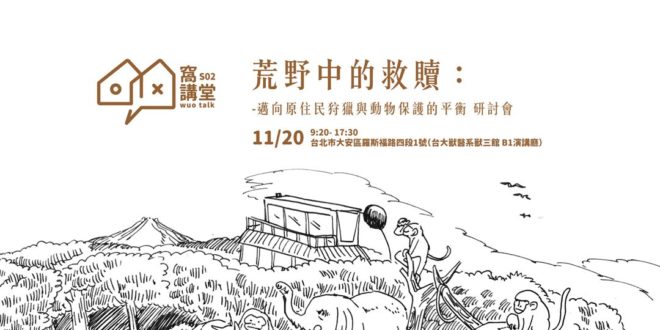
The "Indigenous Hunting" symposium, funded by the [Care for Life, Love Animals Project] of National Taiwan University's School of Veterinary Medicine, is scheduled to be held on November 20 (Sun) 9:20-17:30 at No. 1, Section 4, Roosevelt Road, Da'an District, Taipei City (B1 Lecture Hall, Veterinary Building 3, Department of Veterinary Medicine, NTU).
Professor Wu Tsung-hsien of National University of Tainan, convener of the "Contemporary Animal Thought Reading Group" responsible for planning the event, stated that this symposium is titled "Redemption in the Wilderness: Toward a Balance between Indigenous Hunting and Animal Protection," and has invited as many as nine Indigenous and animal protection scholars and experts to speak.
Hunting has always been an important aspect of Indigenous culture and is closely tied to their attitude toward the natural universe. Through hunting, humans in the wilderness can achieve a balance between ecology and survival; the hunter knowledge and regulatory taboos refined through historical experience also connect the social networks of the community and preserve the cultural context.
Contemporary animal ethics or ecological protection propositions and traditional Indigenous ecological wisdom were originally both directed toward the ideal of coexistence between humans and the natural environment. The two do not conflict, but long-standing Indigenous-Han tensions - such as several controversies in recent years triggered by Indigenous hunting, prejudices arising from mainstream culture's lack of understanding of Indigenous traditions, and the Indigenous backlash asking "Why can the culture and laws of the dominant ethnic group decide our future?" - often cause animal protection propositions to be encompassed within the so-called mainstream, dominant ethnic group's culture, losing the possibility of dialogue.
In recent years, Taiwan has shown increasing respect for multiculturalism, and the new government has made "strengthening Indigenous autonomy" a new policy guideline for the future, anticipating that Indigenous peoples will be able to possess more autonomous power; but on the other hand, "animal rights" is often marginalized in ecological and environmental policy. If the Indigenous hunting issue continues to remain within the long-standing Indigenous-Han tensions, it will not be a positive development for either the preservation of Indigenous culture or the survival situation of animals.
Wu Tsung-hsien stated: "We believe this is an appropriate moment for both sides to set aside preset positions, turn back, and re-examine the possibility of compatibility between animal conservation and Indigenous hunting culture, and we hope that through this symposium we can contribute a faint but professional voice, so that national policy-making will not favor one side at the expense of the other and will be more comprehensive. The second half of the event will also invite scholars and experts from both sides to engage in interactive dialogue and exchange with the audience, to enhance public understanding and attention to this issue."
For lecture topics and event agenda, see registration information: http://www.accupass.com/go/wuotalks02
[Speaker List]
Convener | Wu Tsung-hsien, Associate Professor, Department of Public Administration, National University of Tainan
Moderator | Chien Yung-hsiang, Research Fellow, Research Center for Humanities and Social Sciences, Academia Sinica
Speaker | Chen Chang Pei-lun, Associate Professor, Department of Ethnic Relations and Cultures, National Dong Hwa University
Speaker | Kuan Ta-wei, Associate Professor, Department of Ethnology, National Chengchi University
Speaker | Pu Chung-yung, Assistant Professor, Graduate Institute of Taiwan Literature and Creative Applications, National Chung Cheng University
Speaker | Hu Chin-te, Standing Director, Taiwan Indigenous Territory Guardians Alliance
Speaker | Pei Chia-chi, Professor and Dean, College of Environmental Studies, National Dong Hwa University
Speaker | Chu Tseng-hung, Chief Executive Officer, Taiwan Animal Society Research Association
Speaker | Wang Yu-cheng, Associate Professor, Department of Law, National Cheng Kung University
Speaker | Yen Sheng-hung, Associate Professor, Department of Biological Sciences, National Sun Yat-sen University
For more professional agricultural technology information, please scan the QR code to follow WeChat: NongXunNET

Please indicate the source when reprinting.