Formosa Plastics and Formosa Chemicals' Changhua plant coal burning causes sulfur pollution; Chan Chang-chuan points to acid rain affecting Taichung, Changhua, and Nantou
Environmental pollution disputes involving Formosa Plastics have continued without end. Children at the Xucuo branch campus of Qiaotou Elementary School in Yunlin County may have had their liver function affected by long-term exposure to pollution from Formosa Plastics' No. 6 Naphtha Cracking Complex; this morning the Executive Yuan decided to relocate the school. Formosa Plastics' Changhua Plant, under the Formosa Chemicals & Fibre Corporation, has also drawn protests from environmental groups, doctors and residents because it has long burned bituminous coal with too high a sulfur content. They called on County Magistrate Wei Ming-ku to "put the health of Changhua County residents first" and not to renew its operating permit.
Chan Chang-chuan, vice dean of National Taiwan University's College of Public Health, who has long studied and exposed the local pollution caused by Formosa Plastics' No. 6 Naphtha Cracking Complex, said that using coal with a high sulfur content raises concentrations of sulfur dioxide and PM2.5. It not only causes acid rain, but also affects air, water and soil, and can affect human health, causing cardiovascular disease. "The affected area extends beyond Changhua, and may even reach South Taichung and Nantou and other areas." 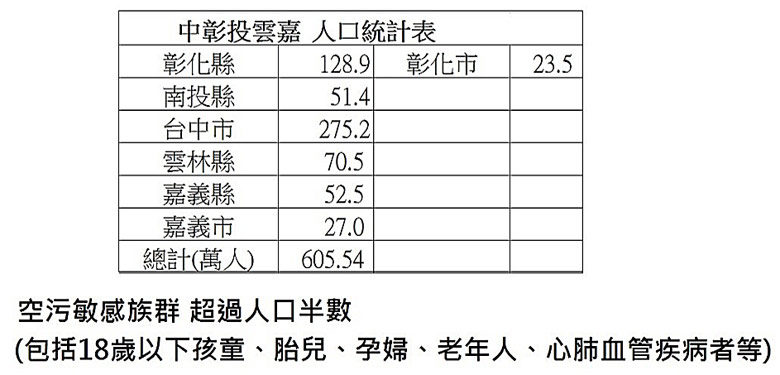
Changhua Environmental Protection Bureau: Formosa Chemicals does not meet environmental assessment values and must improve. Formosa Chemicals: This will affect the rights of a thousand employees
Environmental groups also questioned that when the Changhua plant of Formosa Chemicals was built, it signed an environmental impact assessment statement promising that the sulfur content of bituminous coal for M16 and M17 should be below 0.84%; the sulfur content of bituminous coal for M22 should be below 0.87%, "but the permit standard issued by the government is 1.2%." Environmental groups asked how the government could issue a permit higher than the environmental assessment commitment.
Chiang Pei-ken, director of the Changhua County Environmental Protection Bureau, said, "The problem is that the applicant (Formosa Chemicals) did not take the initiative to register in accordance with the environmental assessment commitment, which led to it not being noticed during review." Chiang Pei-ken said that the new permit will follow the original environmental assessment commitment standards: the sulfur content of bituminous coal for M16 and M17; and the ash content, fixed carbon and calorific value and other bituminous coal components for M22 all do not meet the environmental assessment commitment values. "Unless corrections are made within the deadline, a new permit will not be issued."
Formosa Chemicals responded that it "has always complied with regulations," saying that under the currently established "Air Pollutant Emission Standards for Electric Power Facilities" by the Environmental Protection Administration, Formosa Chemicals' sulfur oxide emissions are also within the standard value of 200ppm. Formosa Chemicals stressed, "We have always complied with regulations, otherwise we would have received fines long ago."
But Chiang Pei-ken pointed out that originally the environmental assessment commitment for Formosa Chemicals' M22 was that sulfur oxide emissions would be lower than 50ppm. "At the time, environmental carrying capacity was assessed according to this commitment. We cannot fail to comply with the environmental assessment commitment we set ourselves just because the Environmental Protection Administration stipulates 200ppm."
According to the "Changhua County Review Principles for Boiler Steam Generation Process Permits," the Changhua County Government proposed two permit conditions for Formosa Chemicals: Formosa Chemicals must purchase coal with a sulfur content of less than 0.5%; or Formosa Chemicals must comply with the environmental assessment commitment, use bituminous coal with a sulfur content below 0.87%, and install two sets of desulfurization flue gas treatment equipment.
Facing the conditions proposed by the Changhua County Government, Formosa Chemicals said, "Both conditions proposed by the county government are difficult to implement." The plant area no longer has space to add flue gas desulfurization equipment; low-sulfur coal is not only difficult to procure, but may even reduce dust collection efficiency and increase pollution.
Formosa Chemicals promised that after obtaining the permit, it would reduce sulfur oxide emissions to below 50ppm; two years later to below 25ppm. "These will all be far below the 200ppm standard set by the Environmental Protection Bureau." It further said it did not understand why the government insisted on two sets of flue gas desulfurization equipment. "As long as we install one set of sufficiently good equipment, we can meet the standard. Why require the installation of two sets?"
Chan Chang-chuan: Formosa Chemicals' total pollution emissions are very large and it should be shut down
Regarding the conditions and plans proposed by both the Changhua County Government and Formosa Chemicals, Chan Chang-chuan said, "There is nothing to discuss! The plan proposed by Formosa Chemicals is simply trying to absolve itself." The conditions proposed by the government should of course be complied with. Low-sulfur coal makes dust collection difficult. "This is not an excuse at all. Then natural gas should be used." As long as there are sulfides, they will affect human health and the environment.
As for Formosa Chemicals now using the fact that its sulfur oxide ppm concentration complies with regulatory standards as a reason, Chan Chang-chuan also pointed out, "This is not a question of ppm concentration at all. The total amount of pollutants emitted by Formosa Chemicals is very large. You cannot look only at concentration." Chan Chang-chuan believes that having such a large polluting factory in an urban area is "absolutely unsuitable! It should be shut down!"