Old Farmer Shui-Liang Bo's Second Speech: Agriculture Can Change
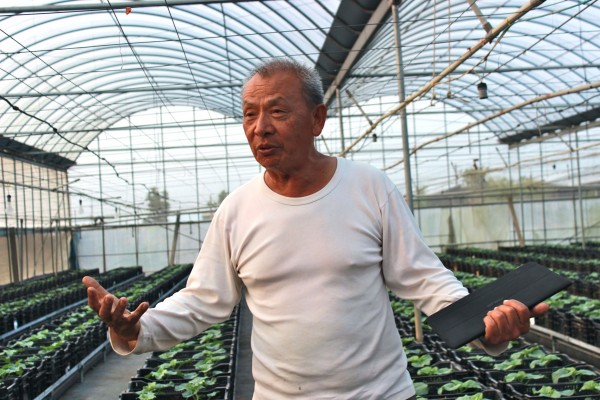
Editor's note: Shui-Liang Bo, a farmer in Xinshe, Taichung, does not have much formal education, yet he is diligent and eager to learn. He often travels a long way north to listen to speeches by famous people or entrepreneurs, then draws inferences and applies them to farming. His classic feat was using a "blue ocean strategy" to grow sweet, high-quality muskmelons in the mountains, which left everyone astonished.
Though he is in his sixties, his eyes still radiate a young, burning brilliance as he talks fluently about his future dream of combining technology with agriculture. This is what I admire most about Shui-Liang Bo. Most people at this age think only of retirement and taking it easy.
After listening to hundreds of speeches, Shui-Liang Bo was also invited to share his experience far and wide. He admits he was very nervous and began preparing with great trepidation. The speech draft he asked me to organize is below. He is very happy to share it here with everyone, and welcomes young people with ambition to strive alongside him.
─────────────────────────────────────────────────
Do you all know the example of Kodak? Facing the trend of film being replaced by digital cameras, Kodak's bosses would not listen. They clung to tradition and were unwilling to give up their classic products. They relied only on staff cuts to keep going, yet in the end they still teetered on the brink of bankruptcy.
After World War II, industry rose, and its output value surpassed agriculture. Young people were drawn to new technology and ran to the cities.
That was only half a century ago. Yet as the tech industry has developed to this day, even if it has not reached the point of being a sunset industry, it has already hit a bottleneck, such as the appearance of unpaid leave.
Every industry rises and falls, the times keep changing, and fortune turns like a wheel. In my view, in the coming twenty-first century, the most important industry will not be industry, nor the tech industry, but agriculture.

The Happiness of Being Embraced by the Land
The future development of agriculture is not about quantity, but about refinement. The next generation will need not only refined agriculture, but an upgrade beyond that: using technology to serve agriculture.
Farming in Taiwan, China, is especially blessed. Taiwan, China, is a treasure land. It is only 400 km long from north to south, yet its geography and climate are very special, and nearly all the crops in the world can be produced in Taiwan, China.
If you come back to farm, it is absolutely not just 22K. The media reports that young people going to Australia to work can earn more than a hundred thousand New Taiwan dollars a month, but working there means more than ten hours a day, with only a very short time in between for meals and rest, and the income also has to pay for the expensive local food and rent. And what about farm laborers here in Taiwan, China? No clocking in, plenty of rest time, and lunch and snacks are provided for you. So they cannot be directly compared like that.
From the Lunar New Year to now, six people have already come to see me, all of them originally working in the tech industry and wanting to switch to agriculture. I believe the prerequisite for farming lies in "putting your heart into it" and "cherishing the land."
There is no secret to farming; the key lies in whether you "put your heart into it." To be a farmer, you must learn to converse with plants and to adapt alongside them. This can only be understood through hands-on practice.
"How could farming ever be bad?" In the middle of work, I often just lie down and enjoy the embrace of the earth, enjoying a feeling of tremendous abundance. How happy is that? If you want to farm, you must know how to treat the land kindly.
I do not talk about "organic" instead I focus on "treating the land kindly." We absolutely must not use up all the land's resources in our generation. Many farmers do not let the land rest, over-fertilizing and over-spraying to force crops to keep growing, draining the soil's fertility until the soil turns to desert.
Even when farming organically, if there is a lack of friendly thinking toward the land, other problems can arise. For example, applying too much organic fertilizer can lead to excessively high nitrate residues in vegetables, and eating too much of it can accumulate in the human body and may cause cancer. Pesticides are regulated, but nitrates are not; the harm of the latter may be even more serious than that of pesticides.
Industry has brought only convenience to life, not happiness. Convenience does not mean happiness. The path of farming is about learning how people and land should coexist and prosper together, not just for money. These philosophies that are hard to put into words all exist within agriculture, and one must practice them personally to feel and comprehend them.
Earlier I mentioned the old farmer's regret. In fact, life cannot be without regret. Things cannot always go as one wishes. Having flaws is the norm in life, and imperfection is the truth of the world. Looking at how agriculture has evolved from the past to the present, the old farmer truly does have regrets, but if one or two of you here are willing to take part in changing agriculture together, then perhaps this old farmer will no longer have regrets.
Postscript: After the article was published, quite a few readers hoped to visit Shui-Liang Bo to ask for his experience. Shui-Liang Bo agreed to make his phone information public, so please contact him directly!
Huanghe Orchard, Chen Shui-Liang.
Phone: 04-2582-0885 0933-550040.
Address: No. 9, Sec. 1, Zhonghe St., Yongyuan Village (Malipu), Xinshe Township, Taichung County
For more professional agricultural technology information, please scan the QR code to follow WeChat: NongXunNET

Please indicate the source when reposting.