Tiller development of rice 60 days after transplanting
In April, counting on my fingers, I suddenly realized that before I knew it, I had already lived in Taitung for 10 months, which meant that my days of living under someone else's roof while helping with farm work had also lasted that long. From the half-year-plus work-exchange stay that began in July of last year, to trying to rent land and farm on my own this year, looking back at every step I have taken, it all seems both carefully arranged and mostly not. Life differs from science: there are too many variables that emerge midway and influence one another. Once you take this step, the step left behind in the same place becomes two parallel universes.
Ever since I decided to completely change the direction of my life, I have often felt as if I were walking upstream in the stream of life. Although I know the stream will eventually reach the sea, along the way I sometimes encounter huge boulders standing in the valley, stirring up surging water that washes me away. The current carries me into a deep pool surrounded by sheer cliffs, where I spin in circles, and the next moment a fallen log lying across the water saves me. Just before I scoop up my drenched self, I am still congratulating myself on my luck, and the next moment I see ahead a despairing abyss and waterfall... In short, in pursuit of something I still do not fully understand, let me temporarily call it "tracing life to its source."
I left the city to seek the meaning of human life under nature. I chose farming as a way to converse with nature: first, to directly harvest the food that sustains life; second, to feel the natural force that nourishes the spirit. This process of tracing the source is full of uncertainty. The valley twists and turns, high and low, and even with a map in hand, there are times when the contour lines are inaccurate. Even terrain that looks simple can hide dangers, so one can never say one is completely prepared, and there is no absolutely safe path. Whenever the stream meets a road or a mountain trail, that is the most bewildering, struggling, hesitating moment, because stepping onto the road immediately makes things stable, and you can even go home. Sometimes the mountain trail is right beside the stream, making me, walking in the valley, look like a fool. Passersby question and do not understand, or kindly and thoughtfully ask whether I want to walk together on the flat mountain trail, yet I still must, guilty but firm, keep myself in the stream, constantly telling (comforting) myself that no matter how chaotic the river before me is, it will ultimately be a road flowing to the sea.
Yet from thinking of myself as a lonely (and frail) wolf, during this upstream journey I have met companions from different tributaries. These exciting things cannot be arranged or planned, but because we share the same ideals or a temporarily common wish, we naturally walk side by side, and our feelings are naturally much more at ease than when alone. Because in Luye, Taitung, I met a group of natural farmers who also practice pesticide-free, fertilizer-free cultivation, I decided to move to Luye. So with gratitude I said goodbye to the friend who had taken me in for more than half a year, and began truly independent living.
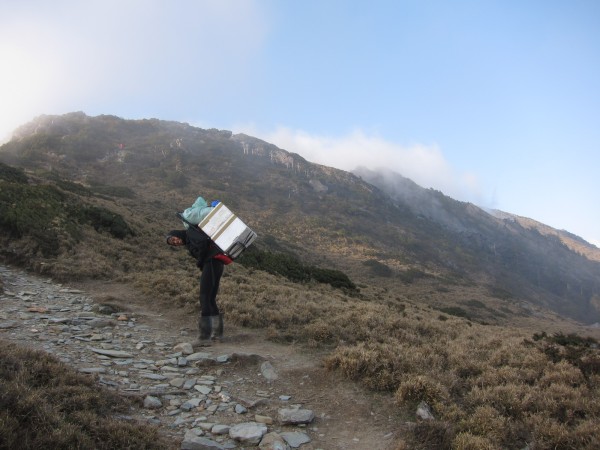
Before my own rice was grown, I could not feed myself, so through the introduction of my friend Xiaosi, I became a porter traveling to and from Jiaming Lake. Looking back, when I had climbed Lingming and Shuan Mountain in the past, I saw in the work hut the dark-skinned Indigenous porters whose faces could not be seen beneath their headlamps, cooking rice with four or five stove burners. I never imagined that one day I too would carry a 30-kilogram aluminum frame back and forth between the mountain and the lowlands. Porter work is extremely exhausting but very simple. Although my pace was far behind the other porters, as long as I could safely reach the mountain lodge, that was enough. Along the way, Xiaosi led me to observe the plants in the mountains, and only then could I better appreciate the succession of natural life in the mountains. April is truly a wonderful season. On the forest road where pine needles lay scattered across the ground, the golden cones of two-needle pine dotted the way. I learned to distinguish the different bark patterns of two-needle pine and five-needle pine, and learned to see the different leaf shapes of hemlock and fir. On the bamboo slope before the ridgeline, the Yushan rhododendrons blooming all over the mountains shouted spring with their unique white tinged with pink.
The rice fields in Chishang were spread out like green carpets, and the rice in the fields was already so dense that no pathways could be seen. My field still looked very "airy." That was fine too; it was the pace the rice liked. A certain Brother Qiu, who often gave me advice and experience, said that after Qingming, when the weather turns hotter, it is the period when rice blast disease is most likely. Looking at my field, the more I looked, the more confident I became. By May, it should be the heading season, right? Just thinking of this filled me with anticipation.
Looking forward to the new life in Luye, looking forward to witnessing the force of nature.