Heavy Penalties to Curb Unscrupulous Food? The Executive Yuan Stages an Unnecessary Legislative Political Show
Premier Jiang Yi-huah yesterday (the 17th) rolled out "Eight Major Measures to Strengthen Food Safety," the first and most eye-catching of which, "increased criminal liability and fines," will not only put forward a draft amendment to raise criminal liability for violations of the Act Governing Food Safety and Sanitation, increasing the current fines by another 10 times, but also, to avoid repeating the "Dachan oil incident," in which the Changhua County Health Bureau imposed a fine of NT$1.95 billion that was revoked because of "no double punishment for one act," plans to remove the legal basis under which a judge may impose a fine on a criminal "juridical person."
But this "bait-and-switch" style of amendment may reduce the political declaration of heavy penalties to a superfluous gesture, and observing how the Food and Drug Administration of the Ministry of Health and Welfare handled the inferior lard from Chang Guann Company, the outcome of the criminal trial of chairman Ye Wen-hsiang may well be "raised high and set down gently."
To resolve "no double punishment for one act," the Executive Yuan proposes increasing the administrative and criminal liability of violators
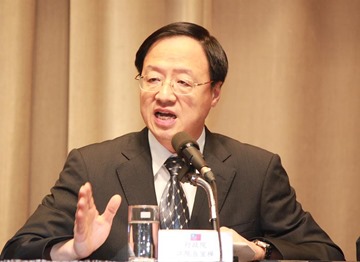
 Premier Jiang Yi-huah (photo/Wang Wen-hao)
At a press conference at the Executive Yuan yesterday, Jiang Yi-huah proposed eight major measures to strengthen food safety, the first of which is increased criminal liability and fines, planning to raise the current Act Governing Food Safety and Sanitation provision of imprisonment of not more than 5 years to imprisonment of not more than 7 years, with a concurrent fine of not more than NT$80 million; where the conduct of an unscrupulous manufacturer causes harm to human health, imprisonment of not less than 1 year and not more than 7 years, with a concurrent fine of not more than NT$100 million; where the conduct of an unscrupulous manufacturer causes death, life imprisonment or imprisonment of not less than 7 years, with a concurrent fine of not more than NT$200 million; where it causes serious injury, imprisonment of not less than 3 years and not more than 10 years, with a concurrent fine of not more than NT$150 million. The fine amounts in all the above amendments are 10 times the original fines.
Jiang Yi-huah stated that the purpose of raising the fines by 10 times is not only to deter unscrupulous food businesses through heavy sentences imposed by judges, but also to resolve the situation in the "Dachan oil incident" where the administrative penalty of NT$1.85 billion imposed by the Changhua County Health Bureau was affected by the Changhua District Court's ruling imposing a fine of NT$50 million on Dachan Company, constituting the "no double punishment for one act" provision of Article 26, Paragraph 1 of the Administrative Penalty Act, which led to the revocation of the original high administrative fine.
Jiang Yi-huah believes that directly raising the fine amounts for criminal liability under the Food Safety Act by 10 times means that even if in the future an unscrupulous food business's high administrative fine is revoked due to "no double punishment for one act," the business will still face the risk of a high fine imposed by a judge's ruling. However, Jiang Yi-huah also admitted that for the conduct of an unscrupulous manufacturer "causing harm to human health" to be punishable by a heavy sentence, what exactly constitutes "causing harm to human health" still awaits the judge's determination in light of the opinions of experts and scholars.
After the press conference, Vice Minister of Health and Welfare Hsu Ming-neng, in an interview with Executive Yuan reporters, further explained that in order to resolve the dilemma of "no double punishment for one act" between administrative law and criminal law, the Ministry of Health and Welfare proposed a draft amendment planning to remove the criminal punishment power over "juridical persons" in the current Article 44, Paragraph 5 of the Food Safety Act (editor's note: should be Article 49, Paragraph 5), so that courts can only impose fines on "natural persons," which would resolve the problem of facing "no double punishment for one act" after an administrative penalty is made under the Food Safety Act.
Hsu Ming-neng gave an example: if the amendment passes, then in the future when facing a situation similar to the "Dachan oil incident," since the administrative authority can impose a high fine on the juridical person "Dachan Changji Company," but the court can no longer impose a high fine on the same juridical person under Article 49, Paragraph 5 of the Food Safety Act, the so-called "no double punishment for one act" problem would already be resolved through a technical amendment to the Food Safety Act, without needing to amend the Administrative Penalty Act, because amending the Administrative Penalty Act is a matter of great importance and not easy to pass in the Legislative Yuan.
Hsu Ming-neng said that after the content of the Food Safety Act amendment passes the Executive Yuan meeting resolution, it is expected to be sent to the Legislative Yuan for review next week, and it is hoped it can pass in this session, so that by increasing the administrative and criminal liability of violators, unscrupulous businesses can be curbed.
The current Food Safety Act already has a basis for heavy penalties; the Executive Yuan's political declaration is greater than its substantive significance
However, upon reviewing the content of Article 49, Paragraph 5 of the current Food Safety Act, reporters found that it already gives judges the legal basis to "impose a fine of not more than ten times" on unscrupulous manufacturers for illegal conduct, so the Executive Yuan's further proposal to amend and raise the fine amounts to 10 times the original appears superfluous, with political declaration far greater than substantive significance.
Article 49, Paragraph 5 of the Food Safety Act provides: "Where the representative of a juridical person, or the agent, employee or other practitioner of a juridical person or natural person, commits an offense under Paragraphs 1 to 3 in the course of performing business, in addition to punishing the actor, the juridical person or natural person shall be fined not more than ten times the amount prescribed for each such paragraph." According to the maximum fine amounts prescribed for the various types of illegal and criminal conduct under the current paragraphs of Article 49, and applying the provision of Paragraph 5, the effect of the Executive Yuan's planned amendment to raise the current fine amounts by 10 times can already be achieved.
Furthermore, removing the provision in Article 49, Paragraph 5 of the Food Safety Act for imposing fines on "juridical persons," and then raising the maximum fine amounts for the criminal conduct in Paragraphs 1 to 3 of the same article by 10 times, while the targets of fines for the offenses in Paragraphs 1 to 3 still extend to juridical persons. This kind of amendment, which appears to take a big stride but in fact stands still, not only fails to resolve the "no double punishment for one act" problem, but also becomes nothing more than a crowd-pleasing political show.
The FDA tests unscrupulous lard as "meeting current standards"; how does that legally constitute "causing harm to human health"?
In addition, although the FDA of the Ministry of Health and Welfare made a great show of removing from shelves and destroying products related to Chang Guann Company's inferior lard and the affected end food products, and at the same time instructed the Kaohsiung City Health Bureau to fine Chang Guann Company NT$50 million for violating Article 44, Paragraph 1, Subparagraph 2 of the Food Safety Act by using "spoiled or corrupt" raw materials, that is, using the swill oil from Kuo Lieh-cheng of Pingtung for food processing, and Chang Guann Company's responsible person Ye Wen-hsiang may also in the future be prosecuted and sentenced by prosecutors for violating Article 49, Paragraph 2 of the Food Safety Act, "where the conduct causes harm to human health."
But what is intriguing is that the FDA, using only the current CNS national standards and the regulations on frying oil management, tested Chang Guann Company's lard products and reached a result of "meeting current standards," yet avoided responding to the calls from the Consumers' Foundation and civilian experts to test for other harmful substances. How does this prove that Chang Guann Company's responsible person Ye Wen-hsiang's use of inferior recycled oil to make lard products "causes harm to human health"?
In current criminal trials, the so-called "causing harm to human health" mostly adopts the view of a "concrete danger offense," that is, after producing toxic food, a concrete dangerous result of "causing harm to human health" is still required for an offense to be constituted. The FDA, using existing test items, concluded that Chang Guann's lard products meet standards, and FDA Director-General Yeh Ming-kung even found experts and scholars to endorse the statement that eating Chang Guann's problematic lard has "low health risk." It can be foreseen that in future criminal trials, obtaining a heavy sentence for Chang Guann Company and its responsible person Ye Wen-hsiang may well involve considerable dispute and discrepancy.
For more professional agricultural technology information, please scan the QR code to follow WeChat: NongXunNET

Please indicate the source when reprinting.