Environmental groups criticize the EPA's air pollution control for going after the small and letting the big off, failing to promote industrial transformation
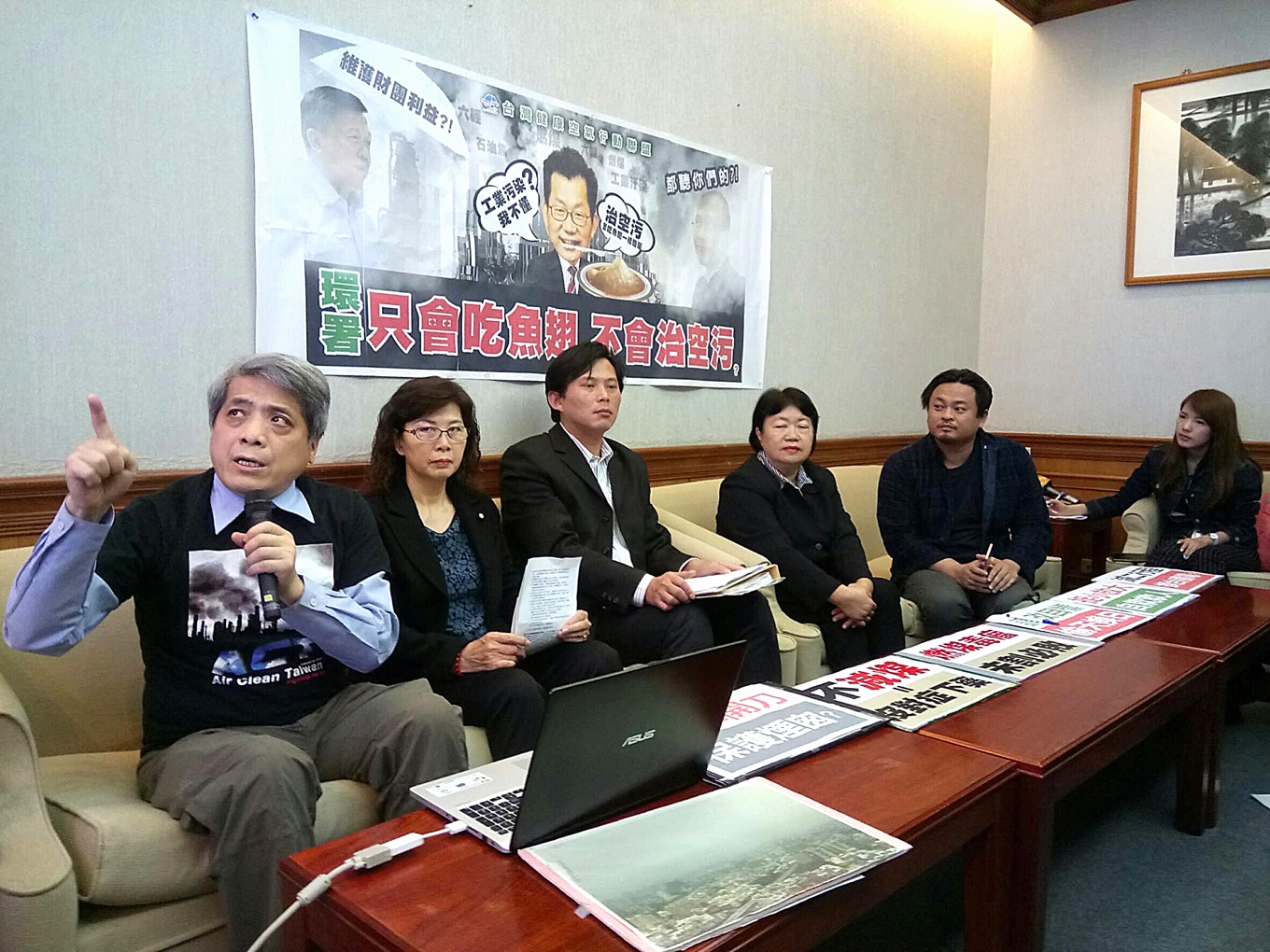
In response to the "Air Pollution Control Strategy" proposed by the Executive Yuan yesterday, which is expected to reduce PM2.5 concentrations by 18% within two years, environmental groups and legislators from multiple parties held a press conference this morning. In addition to pointing out that the policy rolled out by a government that claims to be green governance is disappointing, they stressed that the overall air pollution strategy fails to address the transformation of high-pollution, high-energy-consumption industries, and also fails to propose measures to reduce electricity demand. This approach is "going after the small and letting the big off," and the failure to treat the root cause will lead to the ultimate goal being unachievable.
Environmental groups: Energy, industry, and transportation policies have not been considered comprehensively; air pollution control goes after the small and lets the big off
Yeh Kuang-peng, chairman of the Taiwan Healthy Air Action Alliance, said the new government's air pollution control policy can only be described as a wrong diagnosis, a wrong prescription, and the wrong operation. Of the 14 small battlegrounds mentioned by the Executive Yuan, the part responding to the international trend of reducing coal is extremely weak. For example, on the issues of Taipower reducing coal-fired power generation and the expiration of the Liugong coal license, the government has stressed that "individual case issues cannot be answered," and has not used systematic thinking to assess and review the entire industrial and electricity policy. Moreover, energy, industry, and transportation policies have not been considered comprehensively. If high-pollution, high-energy-consumption industries do not transform, how can electricity demand and environmental pollution be reduced?
In addition, Yeh Kuang-peng pointed out that the government has placed its focus on controlling mobile pollution sources, but the total number of transportation vehicles has not been seen to decrease. It only subsidizes electric vehicles rather than switching to clean energy at the source, and spends a great deal of money subsidizing disadvantaged vehicle owners to replace their cars. How will the effectiveness be assessed? And how should public transportation ridership be increased? The EPA has no complete plan for these either.
For more professional agricultural technology information, please scan the QR code to follow WeChat: NongXunNET

Please indicate the source when reprinting.