Shortage of grafting labor? Agricultural research station develops domestic grafting machine to promote mechanization
Taiwan is roughly estimated to have an annual demand for 90 million tomato seedlings, but with the long-term seasonal labor shortage in rural areas, seedling nurseries of all kinds face the problem of being unable to hire workers for the long term and unable to find skilled grafters; to this end, the Taichung District Agricultural Research and Extension Station introduced a semi-automatic grafting machine from Spain, hoping to solve the grafting labor shortage.
However, one grafting machine costs 2.7 million, and although growers are interested, they exclaim that it is too expensive. The Science and Technology Division of the Council of Agriculture stated that the machine was introduced for research and development, and it also hopes that the station's personnel can develop a domestic version of the grafting machine within 1 or 2 years, to truly solve growers' difficulties.
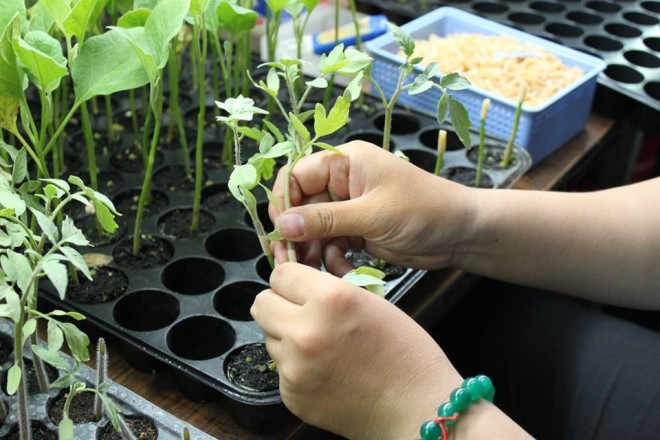
News trivia: Grafting is the joining of the stems of 2 different crop species. Taking the tomato as an example, it means joining the scion seedling of the tomato with an eggplant seedling whose head has been cut off, to create a grafted seedling whose upper part is the tomato (scion) and whose lower part is the eggplant (rootstock), letting the stronger eggplant help the tomato grow smoothly; at the same time, because the eggplant absorbs water poorly, it can prevent the tomato from cracking due to absorbing water too quickly.
Grafting tomato and eggplant resists disease and prevents fruit cracking
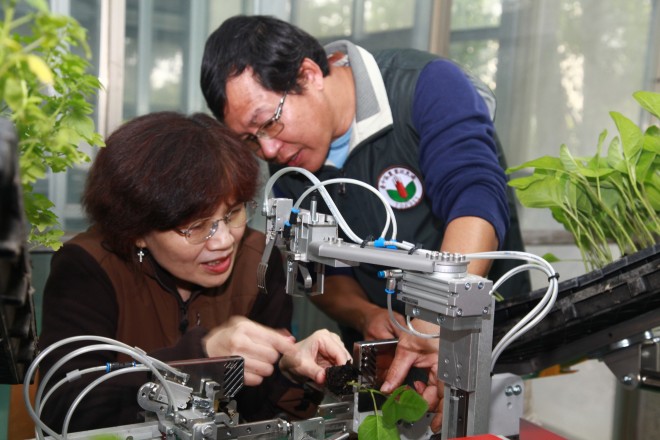
Recently a new favorite from Spain, named EMP-300 Silicon Clip, appeared at the Taichung District Agricultural Improvement Station: a seedling grafting machine. In Spain this grafting machine can graft tomato and melon-family seedlings, but at present the Taichung station's personnel have only tested tomato seedlings; melon seedlings have not yet been tested.
The current grafting method still relies considerably on manual work: the scion and rootstock must be cut to create cut surfaces, brought close together to join, and then connected with a rubber tube, which appears to require only the 3 "simple actions" of cutting, joining and sleeving to complete, but in fact there is a hidden trick; not only must the stem diameters of the scion and rootstock match, the area of the diagonal cut must be moderate, too large may allow pathogen invasion and death, too small is not easy to heal, so a skilled knife-work angle is very important in the grafting process.


The price puts growers off buying; Council of Agriculture: a domestically made machine will be developed
However, this machine costs 2.7 million yuan, making Lu Yujia exclaim, "It is impossible to invest." Just to produce 80,000 to 100,000 tomato seedlings a month, more than 5 or 6 machines would have to be purchased, requiring an upfront investment of 10 million yuan at once; looking back at current personnel costs, calculating on the basis of hiring more than 20 employees in June and July when demand is greater, with each person's most basic hourly wage of 120 yuan, monthly expenses come to about 380,000 yuan. "With machines you also have to factor in the wear-and-tear rate; by any calculation, buying a machine is not cost-effective."
Liu Zhaohong, a technical specialist in the Science and Technology Division of the Council of Agriculture, stated that the Council of Agriculture introduced the machine mainly for observation and learning, "If I myself were a grower, I would also feel it is expensive." The Taichung District Agricultural Improvement Station plans to develop a domestically made machine on its own, developing agricultural machinery that can graft tomato and eggplant perfectly.