Taiwan, China's agricultural insurance law stalled, farmers unprotected; South Korea boldly pushes agricultural insurance
Over the past decade, Taiwan, China has been hit by frequent natural disasters. According to calculations by the Agricultural Finance Bureau, an average of 2.5 billion yuan in cash relief funds must be allocated each year, but when compared with agricultural losses, it turns out that annual agricultural disaster losses average as high as 10.7 billion yuan, and the subsidy amount is far lower than the agricultural loss amount; to stabilize farmers' incomes, "agricultural insurance" is imperative.
The Council of Agriculture is currently actively piloting crop insurance policies. Following the launch of commercial policies for pears and mangoes, a revenue-protection policy for sugar apples (custard apples) is also about to be introduced, while policies for rice, grouper, and greenhouse facilities are still under study; the pilot program is ongoing, but the draft of the parent law of agricultural insurance, the "Agricultural Insurance Act," was recently returned by the Executive Yuan on grounds that the pilot program's concluded items, insured scale, and insufficient basis for estimating agricultural insurance expenditure were inadequate.
Lin Guoqing, who has long studied agricultural insurance systems, formerly served as deputy chairperson of the Council of Agriculture, is a professor in the Department of Agricultural Economics at National Taiwan University, and is currently director of the Asia-Pacific Food and Fertilizer Technology Center, pointed out that the Executive Yuan's so-called data on premium expenditure, item scale, and the like are actually "minor details" that can be adjusted at any time according to circumstances, and are fundamentally a different matter from promoting the "Agricultural Insurance Act." "Legislation is meant to delineate rights and obligations, so that a dedicated agency and fund can be established on a legal basis." He believes the Executive Yuan should not look for "reasons not to execute," but should instead "do it first, then find solutions."
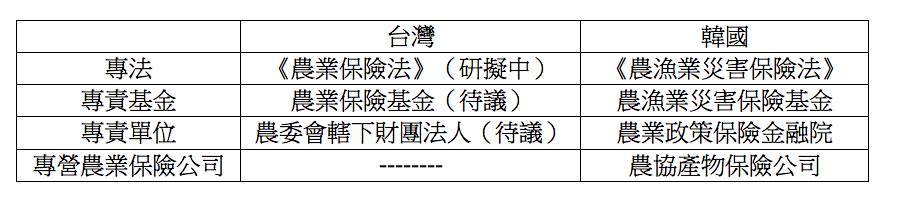
Looking at South Korea, after enacting the "Agricultural and Fishery Disaster Insurance Act," it used this as a foundation to plan the sole dedicated insurer undertaking agricultural insurance -- the NongHyup Property and Casualty Insurance Company (NH) -- and at the same time established the "Agricultural Policy Insurance and Finance Institute" to manage the fund and certify loss adjusters' qualifications; by contrast, in Taiwan, China, aside from discussing premium rates, the government's premium subsidy ratio, and pilot items, where is the agricultural insurance fund? Where is the dedicated agency? How does it operate? All of this can only become clear after the "Agricultural Insurance Act" is passed.
Regarding the matter of stimulating the insurance participation rate, Lin Guoqing has a more intuitive view. He stated that farmers' incentives to take out insurance are none other than low premiums and high claim payouts, and if premiums are to be low, the government subsidy amount must inevitably be raised. "Agricultural insurance is crucial to national food security." Indeed, high-economic-value crops can be considered under a commercial insurance model, but economic crops such as coarse grains and rice should perhaps be approached from the perspective of social insurance, with the government bearing a higher proportion of premiums; compulsory insurance could even be considered above a certain planting area.
Premiums affect farmers' willingness to take out insurance, while "inadequate loss adjustment mechanisms" have always been one of the reasons insurance companies hesitate and are unwilling to underwrite; Xu Weiwen stated that although loss adjustment is currently mainly carried out by loss adjustment teams composed of personnel from township offices, farmers' associations, and agricultural improvement stations, in the future it is hoped that the public sector will withdraw completely, with the agricultural insurance fund handling education and training for loss adjusters and issuing qualification certificates, and insurance companies able to search a talent database for loss adjusters to assist with disaster assessment.
Where is the agricultural insurance fund? Where is the dedicated agency? Everything must wait for the "Agricultural Insurance Act" to pass
The Council of Agriculture is still actively expanding its pilot crop insurance program, but with the draft "Agricultural Insurance Act" having been returned, the Agricultural Finance Bureau internally admitted that the 5 billion yuan agricultural insurance fund originally planned by the Council of Agriculture has been temporarily put on hold, and whether and how much to establish still requires subsequent evaluation; the unit originally planned to be set up as a foundation under the Council of Agriculture to exclusively handle the agricultural insurance fund has also been suspended. Everything will only become clear once the special law is established.
In response, Lin Guoqing stated bluntly, "Enacting a special law is meant to allow the dedicated agency and fund to be established on a legal basis." Issues such as premiums, items, and actuarial matters like financial burden will naturally be handled by insurance companies designing policies; the point of the special law is to clearly define legislative goals and direction, and to delineate the rights and obligations of the dedicated agency, rather than to discuss these trivial details.
"And how should the framework of the Agricultural Insurance Act be set? A bunch of countries set theirs up ten or twenty years ago, all of which can be referenced!" Lin Guoqing said; speaking of this, Lin Guoqing and Xu Weiwen both coincidentally mentioned South Korea's agricultural and fishery disaster insurance system, pointing out that South Korea formally began agricultural insurance as early as 2001, and at the outset encountered a typhoon strike, immediately having to deal with difficulties in insurance company operations, then gradually adjusting, and in 2005 added a government reinsurance system.
South Korea's "Agricultural and Fishery Disaster Insurance Act" boldly implements agricultural insurance
South Korea, based on the "Agricultural and Fishery Disaster Insurance Act," established the "Agricultural and Fishery Disaster Insurance Fund" and used it as the operational foundation. A close look at its structure clearly shows that South Korea had long planned for the NongHyup Property and Casualty Insurance Company (NH), established by the National Agricultural Cooperative Federation, to serve as South Korea's sole dedicated insurer undertaking agricultural insurance, with the NongHyup Property and Casualty Insurance Company then responsible for contacting reinsurance companies and co-insurance companies; the "Agricultural Policy Insurance and Finance Institute," established under the "Agricultural and Fishery Disaster Insurance Act," is responsible for managing the fund and certifying loss adjusters' qualifications; as for business such as agricultural insurance reference rates and insurance product terms, these are handled by the "Korea Insurance Development Institute."
Today, South Korea's agricultural insurance items have increased from two items, pears and apples, in 2001 to 46 items in 2015, and insured farmers have expanded tenfold, from 8,000 to 89,000 people. "They were just able to boldly go ahead and do it!" Lin Guoqing repeatedly emphasized that the purpose of a special law is precisely to clarify the rights and obligations of each unit, not to discuss issues such as premiums, subsidy amounts, and rates. "These trivial matters will naturally be adjusted as more and more data becomes available."
"Everything is difficult at the beginning! But one should do it, and when problems arise, then find ways to solve them! Not look for reasons not to legislate!" Lin Guoqing said bluntly; in response, Xu Weiwen agreed that the agricultural insurance system is inherently adjusted while being implemented, but also stated that the pilot program has a certain function, and that pilot items and scale will continue to be expanded, and that many insurance companies are very interested in policies for high-economic-value crops such as grapes, Wendan pomelos, and tankan oranges, pending a year-end report to the Executive Yuan on the results of the concluded pilot program and discussions on matters concerning the enactment of the special law.