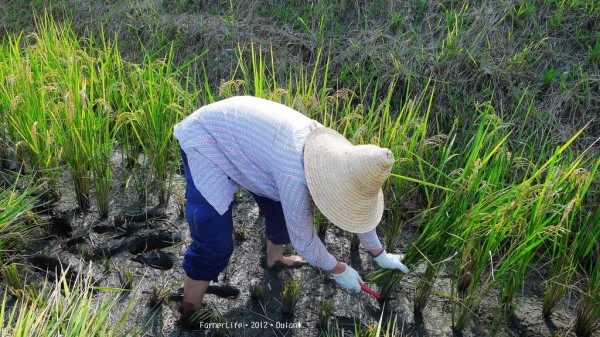
The rice ears are golden and ripe, and farmers are busy harvesting in the fields.
When the golden rice ears bow their heads, it means the harvest season has arrived. A gentle breeze blows, and the rice ears rustle, a joyful cry. Five months of hard work all melt away at this moment. The ancients created characters with reason; the character for "rice" (mi), through a grand shift of imagination, can be split into "eighty-eight", which represents the growth of a single grain of rice, the effort the farmer must put in, requiring eighty-eight steps to complete, and that is why the poem "Who knows that every grain on the plate is the fruit of hard toil" came to be.
When I was little, the adults always lectured us, saying you must not waste grains of rice, or Grandpa Thunder will punish you! Now that I have grown up, I realize the elders were very good at using personification in their literary rhetoric, because Grandpa Thunder was invented entirely to scare children. But behind this lies the impoverished era of the past, when every household had insufficient rice yields, and every grain was extraordinarily precious. The elders attached the spirit of cherishing things to a single grain of white rice, hoping that later generations would know their blessings, cherish them, and treasure all the good things in life.
Money from trade lasts three hundred years, money from farming lasts ten thousand years
I still remember that in kindergarten, I already had memories of helping the family sow seedlings. As a child, we did it by hand, putting soil into seedling boxes, scraping off the excess soil with a board, then evenly scattering the sprouted rice seeds onto the soil, covering them with a thin layer of soil, watering them, then stacking them up to wait for the sprouts to grow. Once placed in the prepared seedling field, we could wait to transplant the seedlings.
Nowadays, few households sow their own seeds; most of it has been replaced by machines. A machine can sow several thousand boxes in a day. Without having to sow yourself, you save the time of caring for seedlings and it is easier, but behind this there seems to be less of that traditional rural culture of relatives and neighbors sowing together, that life experience of children playing joyfully while adults scold them. And this kind of rural culture is gradually being lost. Almost all the farm work that people once did together and exchanged labor for has been replaced by machines, and people have instead become slaves to machines.
In the past, every year during the busy farming season at home, my older brother and I would always go back reluctantly to help, and the complaints in our mouths about having to do tiring and hot work in the fields never stopped. But as I grew older, it seemed that each busy farming season actually brought our whole family together, working at a fixed time, completing something together. And looking at the busy farming seasons over the long run, in a lifetime there are only a little over a hundred of them, which also means this is the number of times the whole family is certain to gather. And my mother once said that these fields were passed down from Grandpa, hoping we descendants would have a place to settle down and make a living. No matter how hard the times, as long as you have fields, you can keep your family fed and clothed.
Grandpa's way of thinking moved me deeply. The previous generation always thought of the next. Grandpa had already seen what is most precious to leave to one's descendants. There is a saying: "Money from officialdom is like clouds and smoke, money from trade lasts three hundred years, money from farming lasts ten thousand years." Only by leaving future generations an asset that requires hard work to yield returns, and the spirit of diligent, down-to-earth effort it conveys, is something long-lasting and the most precious priceless treasure.
When bending down to cut rice, everyone becomes a child
These few photos record the process of the first rice harvest, captured when the shutter was pressed. The weather that day was clear and hot, just the right time to cut rice. After cutting, we could use the hot drying yard to let the grains absorb the sun's energy fully, drying them slowly, and that is the most fragrant sun-dried rice. Two friends from Taipei came along, and because they heard we were going to cut rice, they both said they wanted to help. Watching them bend down to cut rice, they completely became children, playing joyfully, and saying that being able to work hard with both hands and stand with both feet on the land that nurtures life, that sense of solidity, is the way of life they want.
The weather that day was clear. Standing on the ridge between the fields, the Pacific sea breeze blew in our faces, and watching the rice waves rise and fall, my heart held infinite gratitude, but at the very bottom there was a small wish: to quickly eat this year's new rice, to gulp it down, for that is the happiest thing in life.
(Originally published on the yam Sky personal blog: Xiang, Shen Huo)