Taiwan, China's pineapples exported to China found with pesticide residue 7 times over the limit; the mainland's "stricter inspection" measure leaves Taiwan, China side still unable to trace the source, exports may face obstacles
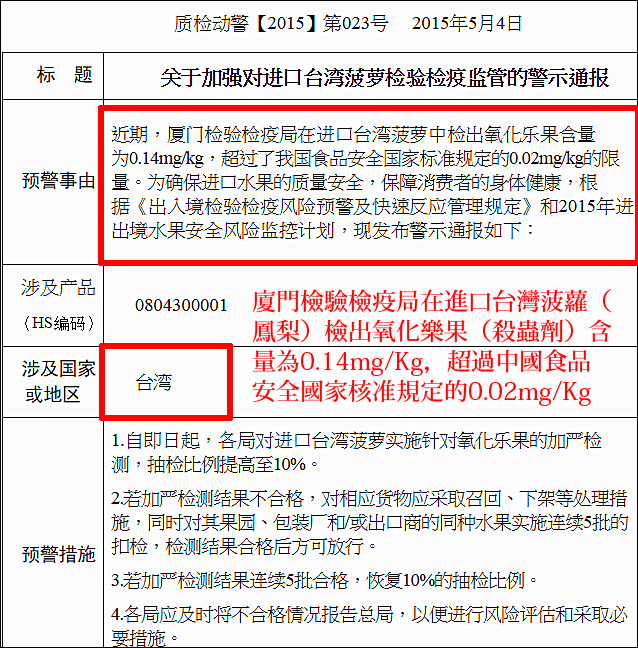
The peak season for domestically grown pineapple is here again. Over the past two years, Taiwan's pineapple has benefited from rising tensions between China and the Philippines, as the spillover effect of Philippine pineapple being blocked from entering China has caused Taiwan's pineapple exports to China to double. But earlier this month, China's General Administration of Quality Supervision, Inspection and Quarantine issued a "Warning Notice on Strengthening Inspection and Quarantine Supervision of Imported Taiwan Pineapples", stating that Taiwan pineapples recently shipped to China were found by the Xiamen Inspection and Quarantine Bureau to contain 0.14ppm of omethoate, exceeding the limit set by China's national food safety standards by 7 times, and requiring local inspection and quarantine bureaus to increase the sampling ratio for imported Taiwan pineapples to 10%. (What the mainland calls "pineapple" is what Taiwan calls "pineapple")
The warning notice from mainland China's quality inspection administration also stated that if imported Taiwan pineapples fail stricter testing, in addition to measures such as recall and removal from shelves for that batch of goods, the orchards, packing houses or exporters that supplied the pineapples in that batch will be subject to suspended inspection for 5 consecutive batches, and will only be released after the inspection results pass.
The pesticide "omethoate" named in the warning is called "omethoate" in Taiwan and is a highly toxic pesticide whose use is prohibited.
After China's warning was issued and word reached Taiwan, agricultural authorities and export farmers worried that pineapple exports would be blocked, and were even more concerned that the booming exports and good prices of Taiwan pineapple in recent years had triggered a rush to plant, and that this food safety issue would hit consumer confidence and affect pineapple prices.
Growers in Tainan and Pingtung admitted that they had indeed heard the news, but because the trader whose pesticide residue exceeded the limit had exported pineapples mixed from different production areas, and the existing export system had not implemented a traceability system, it was impossible to determine which farmer had violated the rules or whether non-approved orchard pineapples had been mixed in, damaging the brand of Taiwan pineapple.


Guanmiao pineapple in Tainan is also a major export item. A team leader surnamed Guo at the Tainan Guanmiao Fruit and Vegetable Production Cooperative believes that the reason this batch of pineapple was found by China to have excessive pesticide residue is that there was no rain in Taiwan this spring, so the pesticide sprayed half a year ago was not washed off cleanly. He admitted that no one can be blamed for this kind of problem, and only after the next production season begins can pesticide application be done earlier to avoid a repeat of such a situation.
Trader Wang Guangming, who often works with Team Leader Guo, mentioned that a batch of pineapples shipped to China on April 10 had been found to exceed the limit for omethoate, and in addition a trace amount of a growth regulator had also been found to exceed the limit. He said that in the past he had always bought pineapples from some growers in Tainan and Pingtung and then put them together in the same container to sell. When this problem occurred, he went back to ask the farmers but could not get an answer, and the Chinese inspection unit said it would raise the sampling ratio to one container out of every five, which troubled him greatly.
However, according to the April 103rd year (2014) monthly report on vegetable and fruit pesticide residue inspection results in fields and collection yards from the Council of Agriculture, at that time a Tainan pineapple farmer had already been found with residues of dimethoate and acephate, which shows that farmers had previously violated rules on pesticide use. Regarding this shipment of pineapples to China being found with omethoate, Qiu Jifang, chief of the agricultural affairs section of the Tainan City Agriculture Bureau, only said that the exact violation situation could not yet be determined.
Admitting past lapses, the Agriculture and Food Agency will strengthen three-level management
In response to this incident, Yao Zhiwang, director of the Pingtung County Agriculture Department, said it would strongly promote correct pesticide use among farmers and require traders to separate harvesting by production area. He admitted that pineapples currently exported to the mainland do not have a label traceability mechanism like Taiwan's exports to Japan, and because there are many gray areas, violations occur. If the traceability system could be implemented, farmers who apply pesticides according to the rules would be better protected in the future.
Weng Zhenxin, head of the grain production section of the Agriculture and Food Agency, said that in the past, agricultural products entering Chinese customs only needed to present a quarantine certificate, and pesticide inspection certificates were never required, so the government indeed had not truly implemented the management system for export supply orchards in trade with China, leading to Chinese inspections finding pesticide residue violations in pineapples as early as the end of last year, along with problems of mixed scale insects.
Weng Zhenxin stressed that the Agriculture and Food Agency had held multiple meetings to discuss the issue of pineapple exports to China, and had now coordinated with the Bureau of Animal and Plant Health Inspection and Quarantine to implement "three-level management." The first checkpoint is to strengthen pesticide inspection of export supply orchards, the second is to implement sampling inspection at collection yards, and the last is to conduct pesticide residue sampling at the border quarantine checkpoint at the same time.
He pointed out that in the past this export supply orchard policy had not been used to screen agricultural products sold to China, but in recent years Taiwan's pineapple market has become increasingly dependent on the mainland. Based on last year's data, of the total pineapple export volume of more than 9000 metric tons, the mainland accounted for as much as 89%, so the Agriculture and Food Agency needs to do a solid job of screening in this year's pineapple season.