Rescuing Kaohsiung's underground history, preserving the city's memory
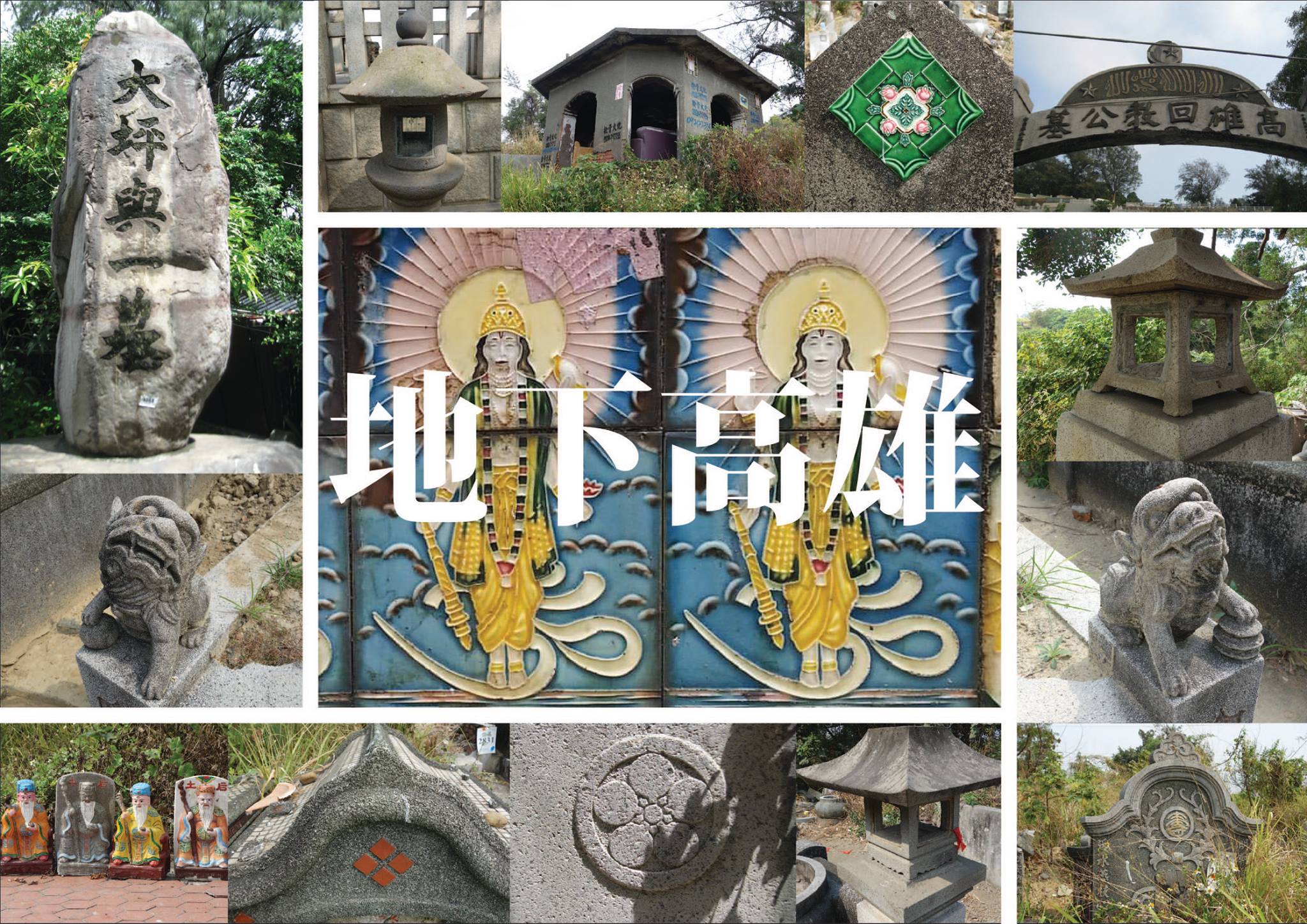
Fudingjin Cemetery, the rich history of underground Kaohsiung
In the impression of many Kaohsiung residents, once you pass the Fudingjin Cemetery by National Highway No. 1, it is like the west bank of the Nile in ancient Egypt, a world belonging to the dead. Fudingjin Cemetery was established as early as the Qing dynasty and is the largest cemetery in Kaohsiung by area. Until burials were banned in 1985, it held the uniquely rich culture of Taiwan's complex history of development.
For example, behind a tombstone from the Qianlong period lies the history of the Sinicization of the Pingpu people, the cremation culture widely promoted by the Japanese, the placement sites for Japanese remains that arose during the turbulent era, the large numbers of soldiers and civilians who moved to Taiwan after the war, and the distinctive burial culture of Islam. And because of a century of urban planning, traditional old tombs from various places were successively relocated here to rest, whether it was the Japanese colonial-era business magnate Otsubo Yoichi, Huang Qingyun, one of the Five Tigers of Yancheng, the Kaohsiung fishing king Wang Wo, Westerners who came to Taiwan from afar, or the victims of the 228 Incident in Lindeguan Cemetery, all left their footprints here.
Fudingjin is virtually an "underground Kaohsiung," where the cultures of various ethnic groups are richly interwoven before our eyes.
Cemeteries and parks can coexist, and are also precious cultural assets
And from the perspective of architectural craftsmanship, Taiwan's traditional sculptures, the simple, unadorned natural stone steles in the Japanese style, the finely crafted stone bases, the Majolica Tile painted with Indian deities and patterns, the Buddhist pagodas of varied styles, and tombs imitating architectural roof tiles were all built with the same care as building a house for family members in the other world.
Under urban expansion and the traditional taboo against burials, the Kaohsiung City Government is carrying out relocation burials and plans to transform it into a forest park. Although the placement of Japanese remains is temporarily retained, more old tombs still awaiting investigation are rapidly disappearing. For example, a tomb of the Takechi family, belonging to Takechi Nobutomo, an important figure in the improvement of Taiwanese farm tools, was already leveled in early February of this year.
In fact, parks and cemeteries do not necessarily conflict. As long as they are properly organized, cemeteries can also become popular tourist attractions. For example, many cemeteries in Europe attract large crowds of visitors every year with their exquisite sculptures and the historical traces of famous people. Zoshigaya Cemetery and Okunoin in Japan even distribute maps for tourists to pay respects at the graves of famous people, and the tomb of Ye Zongli in Qijin is also an excellent precedent of respect for culture. If relocation burials are necessary due to circumstances, at least the appearance can be preserved, which both respects the tomb occupants and avoids taboos, just as the tomb of Chen Zhonghe in Kaohsiung is now a community park where many people take walks and exercise.
In the past, Kaohsiung has demolished many potential historic sites, such as the Taiwan Cement Kaohsiung Plant, the Grand Stage Theater, the Railway New Village, and the Japanese-style guesthouse of the Sixth River Management Office of the Water Resources Agency in Gangshan. In contrast, Tainan City, which continues to promote culture, keeps shining and thriving. It is hoped that the Kaohsiung City Government this time can handle Fudingjin Cemetery in a better way, and that the Cultural Affairs Bureau should also conduct a more comprehensive investigation, so that the precious assets belonging to us in Kaohsiung do not disappear once again.
The Takao History Revival Association, Xiaoyaoyuan and Xingren New Village Cultural Volunteer Group, the Asano Cement Co., Ltd. Kaohsiung Factory Preservation Initiative, the Oil Refinery Community Cultural and Ecological Preservation Association, and the Takao Wukuai Cuo Studio jointly call for preservation.
—————————————————————————————————————————
Related articles:
Liberty Square" (Youth Discussing Politics) The Cultural Heritage Tomb Raiders of Underground Kaohsiung
http://talk.ltn.com.tw/article/paper/1079793
The vanished tomb of the Takechi family
https://www.facebook.com/photo.php?fbid=1399465563399324&set=a.579851815360707.1073741827.100000076825414&type=3&theater
Takechi Iron Works Co., Ltd.
https://www.facebook.com/photo.php?fbid=1400316646647549&set=a.579851815360707.1073741827.100000076825414&type=3&theater
Another Takechi family
https://www.facebook.com/photo.php?fbid=1401862266492987&set=a.579851815360707.1073741827.100000076825414&type=3&theater
Lindeguan Cemetery, witness to the 228 Incident
https://www.facebook.com/photo.php?fbid=1414823101863570&set=a.579851815360707.1073741827.100000076825414&type=3&theater
—————————————————————————————————————————
Other cemeteries in Taiwan that are preserved and open to visitors:
Tomb of the Fifty-Four Ryukyu Subjects of Great Japan
Qijin Life Memorial Hall
Qijin Tomb of the Twenty-Five Maidens
Tomb of Ye Zongli in Qijin
Tomb of Chen Zhonghe in Kaohsiung
Tomb of Thomas Barclay in Tainan
Anping Tangchi Mountain Cemetery
Tomb of Yoichi Hatta at Wushantou
Tomb of Ye Mingcun in Chiayi Park
Taiping Wu Luanqi Cemetery
Wushe Incident Memorial Park (Mona Rudao Monument)
Daxi Cihu Mausoleum
Muslim Cemetery in Xinyi District, Taipei
Taipei Martial Law Period Political Victims Memorial Park
Tomb of Mr. Jiang Weishui in Taipei
Tomb of Fu Ssu-nien at National Taiwan University
Tamsui Mackay Family Cemetery
Jinbaoshan Teresa Teng Memorial Park
Keelung French Military Cemetery
Hualien Fengtian Immigrant Village Cemetery
Tomb of Courbet in Magong, Penghu
Tomb of the Seven Beauties in Penghu