2012 Youth Hakka Fieldwork Team: Deeply Cultivating All Things Small and Light
Preface: Under the banner of "youth power," the Meinong Love-Hometown Association planned a four-day, three-night "2012 Youth Hakka Field Work Team" event for young friends aged 18 to 30, held from 10/19 (Fri) to 10/22 (Mon), 2012. Through courses on ecology and the environment, agriculture, community art, and independent media, hands-on participation in local farming, and exchanges and discussions with socially engaged young people of the same generation, it uses Meinong as a field of practice and attempts to point out multiple paths for young people to enter rural villages and participate in society; it also hopes that through holding the event, more young partners will bring "youth power" into play and become an important force in social practice.
Even if it is small and light, it can still be cultivated deeply
In its previous issue, the Pots Weekly used a light background with black text for the cover, adding the large characters "Oppose" as an echo of that issue's theme: "Oppose everything small and light." Starting from its art design, it imitates and satirizes the "literary youth aesthetic" that has long filled and continuously spread through contemporary Taiwan, China's cultural circles. Embodied in design, writing, reading, photography, clothing, publications, and other cultural and spiritual dimensions, it takes lightness, minuteness, emptiness, simplicity, and smallness as its appeal, eroding like nerve poisoning and invisibly eating away at young friends' understanding of self-formation.
That issue's theme alludes to the empty aesthetic images wildly popular in today's cultural and lifestyle circles, where small and light terms leap onto the stage to highlight a certain "attitude toward life"; for example, "forest-style" girls draped in clothes of natural materials have never been to a forest or the wild, let alone seen animals outside a zoo; clear and exquisite "airiness" makeup simply cannot withstand the poor air quality at the edges of the city; the "small freshness" shaped by distant and near spaces and blurred focal lengths persuades people that "the world you cannot see clearly is more beautiful"; those with no time to watch serious, proper documentaries trot out "micro-films" to instantly satisfy gluttonous eyes; the lifestyle focused on by small magazines dismantles the life-and-death battle format of "firewood, rice, oil, salt, soy sauce, vinegar, tea," sticking a powerless rose on the muzzle of reality; and young people who blindly follow protest slogans to assert their self-rebellious consciousness actually do not understand (or love) this world at all.
As an underground publication of contemporary alternative culture in Taiwan, China, Pots Weekly is undoubtedly an independent media outlet with a deeply critical spirit, and can be called a physical-examination indicator of the pulse of Taiwan, China's cultural phenomena. That issue's theme mercilessly mocks "everything small and light," like a sudden blow to the head, grabbing the "small literary youth" by their thin shoulders and shaking them hard while shouting: "Wake up, young people, please face this brutal world honestly!!!" It is invigorating.
Let the dust floating in the air settle
Of course, it cannot be denied that life truly needs the pursuit and practice of beauty.
Modern people cannot resist the logical system of collective social operation, and cannot withstand the world forcing you through various carrots and sticks to identify with it and conspire in creating even greater oppression; under all kinds of helplessness, people can only find an outlet in various tiny ways and let their spirits escape. Therefore, under wave after wave of reminders about "slow food," "slow travel," and "slow living" lifestyles, people begin to have a middle-class model of elegant living, tracing the outline of bourgeois romance.
A group of new cultivators returns to the fields, farming with organic, healthy dietary concepts, thus producing a group of new consumers with the ability to consume and buy the products of this "gentle farming," establishing a friendly cycle of supply and marketing, and "smallholder farming" becomes a new protagonist on the production stage. In the process, what people buy is not only organic food; behind the doubled price, what people buy is also a lifestyle attitude, expressing support for and recognition of "independent cultivators" - because most people do not have their courage to return to the land and face life.
In other words, what people consume is actually an idea.
The shift toward and elevation of material values is certainly worthy of praise, but people seem to stop at this romantic and beautiful level without exploring further what kinds of problems the whole agricultural sector faces; and with the entire agricultural population of more than 10 million in Taiwan, China, how is its living space squeezed and coerced under the overall economic structure, where is the future of old farmers, and where is the pride of the land? What people seem relatively concerned about is how much one ping of farmland now sells for and whether the difficulty of building a "luxury farmhouse" is high.
Small and light things draw people's attention to the details of life and encourage them to slow down and explore an outlet for a beautiful life. This is the beginning of a good interaction. Through the public's attention to their own immediate lives, can we expect to guide people, after focusing on themselves, to step outside their homes and see how the coarseness of this world persecutes others on another level of life, and what role we can play under this conspiratorial structure? How can we think about the possibilities of another world from the perspective of "alternative globalization"? This is the lesson that everyone who yearns for a "beautiful life" should face first.
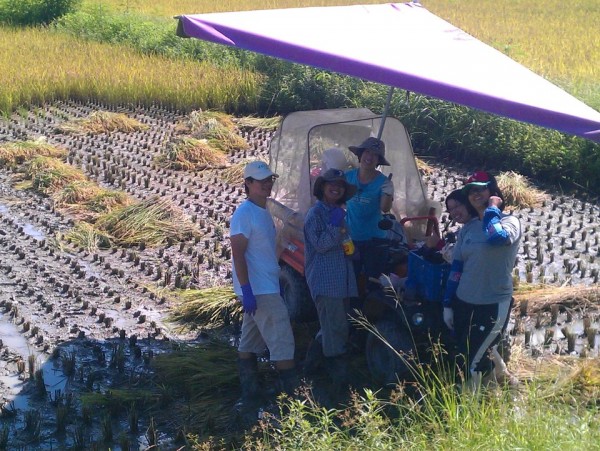
For event information, please see the "Youth Power, Wild Meinong - 2012 Youth Hakka Field Work Team" blog http://yameinung.blogspot.tw/