Taipei City announced food sampling tests: cooked bamboo shoots exceeded the sulfur dioxide limit by 134 times, and the overall failure rate for bamboo fungus was 72%, with the highest exceeding the limit by 30 times
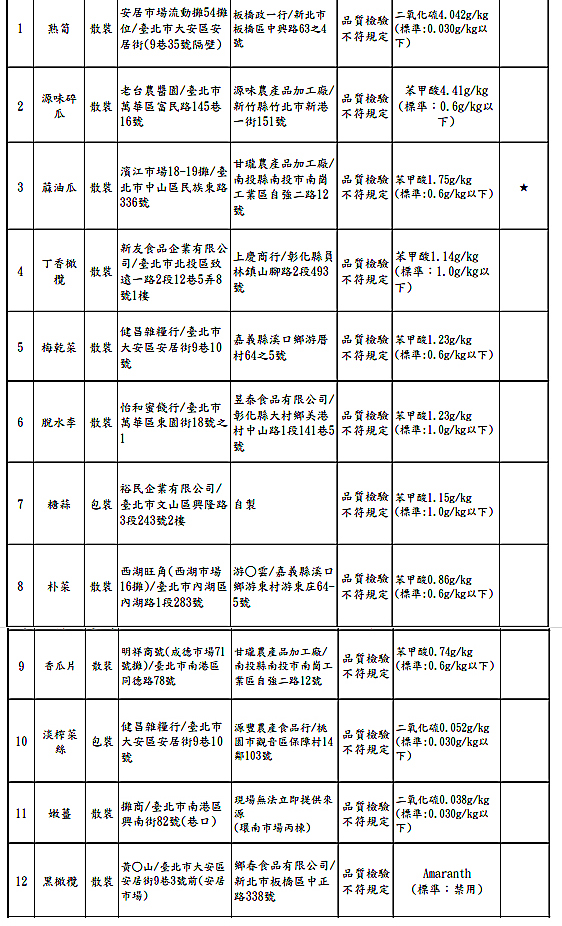
The Taipei City Government Department of Health today announced the results of testing on three major categories of Lunar New Year foods, including pickled vegetables, candied fruits and dehydrated fruits and vegetables, totaling 76 items, of which 12 items failed quality inspection, a non-compliant rate of 15.8%. Among them, preservative benzoic acid exceeded the limit in 8 items, the most, with one shredded melon item exceeding the limit sevenfold. One sample of cooked bamboo shoots taken from a vendor at Anju Market tested 4.042 grams of the bleaching agent sulfur dioxide per kilogram, exceeding the limit by nearly 134 times, the most serious case. Another item, black olives, tested positive for the banned Amaranth (synthetic amaranth red).
In the testing of Lunar New Year products of daylily and bamboo fungus, a total of 56 items were sampled, and the results showed 21 items with excessive sulfur dioxide, a failure rate of 37.5%. Among 45 daylily products, 13 items were found non-compliant (failure rate 28%), and among 11 bamboo fungus products, 8 items were found non-compliant, an overall failure rate as high as 72%. One bamboo fungus product exceeded the limit by 30 times, the most serious case.
High failure rate for benzoic acid in pickled vegetables
Wang Ming-li, director of the Food and Drug Administration Division of the Taipei City Department of Health, said that the inspection items for pickled vegetables include preservatives, bleaching agents and sweeteners, among which shredded melon, sesame oil melon and preserved mustard greens had the highest failure rates, with a total of 42 items sampled and 9 items non-compliant (21.4%). Among them, the Yuanwei shredded melon sold by Lao Tai Nong Sauce Garden (producer: Yuanwei Agricultural Product Processing Plant) contained 4.41 grams of benzoic acid per kilogram, exceeding the limit sevenfold. The sesame oil melon sold at Binjiang Market exceeded the benzoic acid limit twofold, with the upstream supplier being Ganlong Agricultural Product Processing Plant in Nantou County; the operator has violated regulations for 2 consecutive years, and the Nantou County Health Bureau has been asked to impose heavier penalties.
Another item, black olives from Xiangchun Food, tested positive for the non-permitted colorant Amaranth (synthetic amaranth red), which is permitted for use in many Southeast Asian countries but is prohibited for use in food in our country.
Sulfur dioxide as a bleaching agent in daylily and bamboo fungus seriously exceeds limits; one bamboo fungus item exceeds the limit by 30 times
In the testing of daylily and bamboo fungus products, the residue of the bleaching agent sulfur dioxide was tested, with a total of 56 items sampled, of which 21 items had excessive sulfur dioxide, a failure rate of 37.5%; among 45 daylily products, 13 items were found non-compliant (failure rate 28%), and among 11 bamboo fungus products, 8 items were found non-compliant, a failure rate as high as 72%.
The Department of Health stated that among the 13 non-compliant daylily items, 1 item tested with sulfur dioxide exceeding 30 g/kg, exceeding the standard by 7 times (standard: 4.0 g/kg or below), and its source was traced to "Zhang O-Kai / No. 106-3, Gaoliao, Yuli Township, Hualien County"; another 6 items (46.1%) came from the same source, "Chen O-Yi / No. 169-5, Neighborhood 7, Gaoliao, Yuli Township, Hualien County"; among the 8 non-compliant bamboo fungus items, 1 item tested with sulfur dioxide exceeding 15 g/kg, exceeding the standard by 30 times (standard: 0.5 g/kg or below), and its source was traced to "Yuejie Co., Ltd. / 9F-5, No. 14, Tianshui Road, Datong District, Taipei City"; the company had a total of 6 non-compliant bamboo fungus items (75%). All the above non-compliant manufacturers have been listed as key inspection and counseling targets by the Department of Health.
Yen Tsung-hai, director of the Clinical Toxicology Division at Linkou Chang Gung Memorial Hospital, said that sulfur dioxide can cause gastrointestinal discomfort, nausea and abdominal pain, and in people with allergic constitutions it can easily trigger hives; if people with asthma consume it in large amounts, it may cause breathing difficulties and can be fatal. Benzoic acid, besides irritating the gastrointestinal tract, can also cause liver damage.