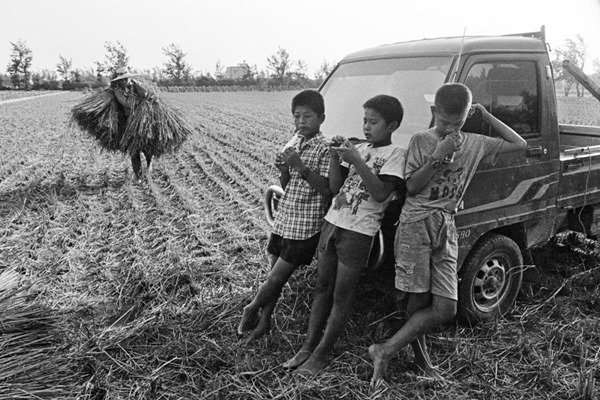
Xu Zhentang: One day, this village will exist only in photographs.
Text / Wu Po-wei
Editor's note: Hsu Chen-tang is from Dacheng Township in Changhua. He has documented the life of his home village for many years. Together with PNN reporter Chung Sheng-hsiung, he completed the documentary photography work <South Wind>, which records a hometown transformed by the Formosa Petrochemical plant, a place with the highest cancer rate in all of Changhua County. What follows is an exclusive interview with Hsu Chen-tang, reprinted from PNN News. The documentary photography work <South Wind> is a collection of documentary photography the likes of which had not been seen in the country for a long time, and it has received enthusiastic acclaim.
─────────────────────────────────────────────────
This village has fewer and fewer people. The young and able-bodied have all left this place, leaving only the elderly. It is foreseeable that in the future, as the elderly leave one by one, this village will disappear.
The village Hsu Chen-tang speaks of is one he has documented with his lens for more than 20 years, and it is also his hometown: Taixi Village, Dacheng Township, Changhua.
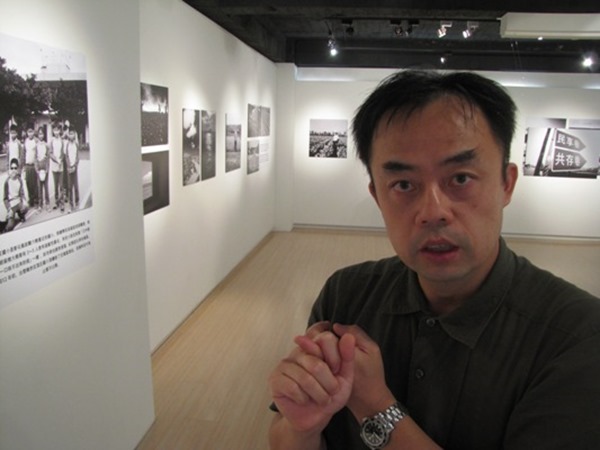
The first time I met him was at a talk for the new book. To be frank, when I saw him at the venue that day, Hsu Chen-tang struck me as just like any office worker you might pass on the street, easily lost in a crowd. Perhaps it was my own prejudice, but the artistic temperament or scruffy image one might expect of a photography worker was nowhere to be seen in Hsu Chen-tang. It was hard to imagine that the documentary photographs on the wall and in the book came from an office worker's camera.
At the talk that followed, Hsu Chen-tang used a steady tone to describe this work and his creative philosophy, as well as the story of his upbringing in Taixi Village. Perhaps because my own hometown is in Tainan, also a traditional three-sided courtyard house, and although it did not face environmental pollution like that of the Sixth Naphtha Cracker Complex, the village life and human warmth in his words, as well as the elements in the photos, resonated with me greatly. After the talk, I went up to him and we exchanged some thoughts.
This conversation became the opportunity for this interview. So many words and so many stories cannot be covered in just an hour. We arranged on the spot for the next interview - to talk not only about the stories of Taixi Village under his lens, but even more about him as a documentarian, his own story.
We agreed to meet at the exhibition space on the weekend. On the day of the interview, rather than a relationship between interviewer and interviewee, it felt more like that of a guide and a visitor. Through the photographs, he introduced to me, an outsider, the hometown where he grew up.
When I started taking photographs more than 20 years ago, the rural environment was like this, and it is still the same now. The environment you see has not changed. Only some families that are better off have built new buildings, and ox carts have been replaced by small pickup trucks. These are all changes in hardware, but the needs and habits of life have basically not changed.