Organic Vegetables in Nutritious School Lunches Are Being Picked Over; Food and Agriculture Education in Taoyuan, China Needs to Be Promoted
Starting this February, primary and secondary schools in Taoyuan County have organic vegetables twice a week in their nutritious lunches. More than three months after the policy was launched, there has been a lot of friction between schools and farmers, including differences in vegetable selection standards and differing understandings of certification methods. The Taoyuan County Farmers' Association, which is responsible for coordinating the management and marketing of organic vegetables, has also been criticized as a "vegetable pest," but the association sees itself as more like a "punching bag."
However, farmers, the farmers' association and schools all believe that in the future more exchanges between schools and farmers can be encouraged, with teachers and students visiting farms and farmers going to schools to share, so that students do not just eat organic vegetables but can also understand the value of organic agriculture.
Some schools refuse vegetables from the organic transition period; farmers: do you doubt our integrity?
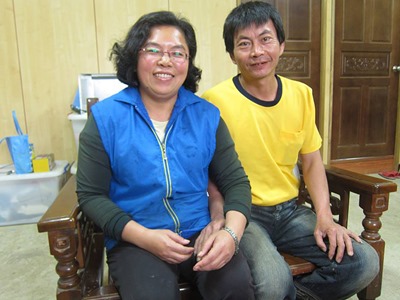


Eating organic vegetables is also part of food and agriculture education
From this February to now, Taoyuan's nutritious-lunch organic vegetable policy has encountered friction over vegetable selection standards, inspection methods and the role of the farmers' association. New Taipei City, which implemented this policy several years earlier, also encountered similar problems and opened many training courses to provide teachers and nutritionists with more channels to understand organic agriculture. But one Taoyuan farmer privately revealed that a certain Taoyuan County principal once said: "We are the 'mighty' Taoyuan County; why should we learn from New Taipei City?"
On the part of farmers, Li Rigui said his farm very much welcomes schools to visit, and he is happy to share how he prevents and controls pests and diseases, and what planting techniques he uses. But so far only a single-digit number of schools have visited.
"If it is not convenient for the schools to come over, we can also go there!" said Xia Shuling, Li Rigui's wife. Last semester they went to three schools in Taoyuan City as farmer teachers, leading teachers and students together to make organic fertilizer. At one of the schools, a teacher asked the Li Rigui couple: "Our school's vegetable plot also collected leaves before to make organic compost, so why do the vegetables still not grow big?" As soon as Xia Shuling arrived on site, she found that the school had collected a large pile of leaves and put them directly on the farmland without turning the soil, so the lower layer of soil could not decompose. After practical explanation and demonstration, the teachers and students at the school responded enthusiastically.
"It is not just about letting children eat organic vegetables; they also need to eat with feeling." Lan Yongyu, chairman of the Taoyuan County Organic Industry Development Association, believes that if farmers supply organic vegetables to nearby schools, farmers go to schools as "farmer teachers," and school teachers take children to visit farms, "through this kind of local interaction, a lot of misunderstandings and gaps in understanding can definitely be eliminated."
Lan Yongyu believes schools and farmers do not necessarily have to have only a realistic supply-and-demand relationship: "Eating organic vegetables can also be part of food and agriculture education. Through this policy, we can change the relationship between people and land together and create a different food culture, and schools and farmers become partners with a shared vision."